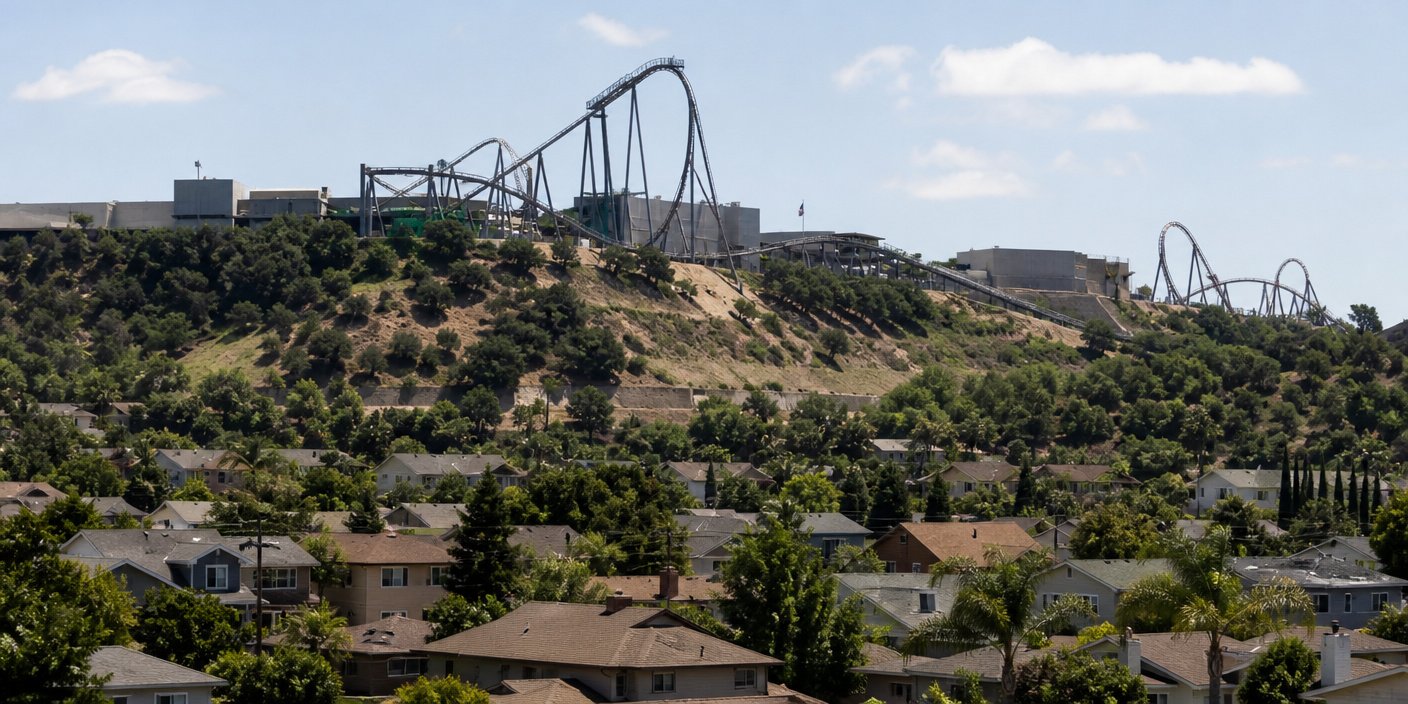
Universal Studios Hollywood has officially committed to installing advanced sound mitigation barriers to address mounting community concerns regarding noise pollution generated by its roller coasters. The decision comes after sustained pressure from local residents and targeted intervention from city council members who identified the park’s ‘disturbing’ noise levels as a significant quality-of-life issue for the surrounding neighborhoods of Toluca Lake and Studio City.
Key Highlights
- Mandated Mitigation: Universal Studios Hollywood has agreed to construct sound walls to dampen the noise produced by roller coaster operations.
- Council Involvement: Los Angeles City Council Member Nithya Raman (District 4) played a pivotal role in mediating between the theme park and the community.
- Noise Concerns: Local residents cited high-decibel screams and mechanical coaster noise as persistent disturbances, particularly during evening hours.
- Technological Solution: The planned barriers utilize specialized acoustic materials designed to absorb and deflect sound waves away from residential areas.
- Urban Balancing Act: This development highlights the ongoing struggle to balance major commercial entertainment operations with the residential tranquility of surrounding Los Angeles districts.
Balancing the Roar: Universal’s Acoustic Infrastructure Strategy
The tension between Universal Studios Hollywood—a pillar of the Los Angeles tourism economy—and its immediate neighbors has reached a turning point. As the theme park continues to expand its footprint with high-adrenaline attractions, including the upcoming ‘Fast & Furious: Hollywood Drift’ coaster, the sonic footprint has become a source of intense debate. The commitment to install physical sound barriers represents a necessary recalibration of the park’s operational protocols to coexist with the dense urban fabric of the San Fernando Valley.
The Anatomy of the Complaint
For residents living in the shadow of the hill upon which Universal Studios sits, the thrill of the theme park has increasingly become a source of irritation. The complaints are not merely about the generic ambient hum of a theme park; they are specific and visceral. Residents have reported that the ‘screams’ of coaster riders—amplified by the steep topography of the site and the echoing nature of the valley terrain—frequently penetrate residential windows, even at significant distances.
Beyond the human element of noise, the mechanical operation of roller coasters involves high-velocity track engagement, screeching brakes, and kinetic energy that generates low-frequency vibrations and high-decibel squeals. When these sounds are projected over the park’s perimeter, they create a ‘noise canyon’ effect. For the community, the issue is not just annoyance but a perceived decline in the right to quiet enjoyment of their homes, leading to formal grievances filed with local representatives.
Intervention and Governance
Council Member Nithya Raman, representing District 4, emerged as a critical conduit for these grievances. Recognizing the impact on her constituents, Raman’s office engaged in a series of negotiations with Universal’s management teams. This intervention moved the conversation from informal complaints to actionable, city-monitored requirements.
‘The goal has always been to ensure that the economic engine of our city does not come at the expense of our residents’ mental and physical well-being,’ a spokesperson for the council office noted during the announcement of the mitigation plans. This regulatory pressure forced the studio to evaluate its acoustic footprint not just from a business standpoint, but as a condition of its continued operation in a residential-adjacent zone.
The Engineering of Silence: Technical Mitigation
Universal Studios is currently consulting with acoustic engineers to design barriers that serve a dual purpose: effective sound attenuation and visual integration. The proposed solution is not merely a ‘wall,’ but a sophisticated acoustic abatement system.
These barriers utilize a combination of materials—often including specialized steel, concrete, and acoustic blankets—designed with specific surface textures to break up sound waves. By installing these panels along strategic points of the perimeter and near the most offending sections of the coaster tracks, the studio aims to redirect sound upward or absorb it entirely before it travels into the valley.
This engineering challenge is complex. The barriers must be high enough to break the direct line of sight between the coaster and the homes, but they must also adhere to local aesthetic zoning requirements. The use of ‘living walls’ (vegetation-covered acoustic panels) is reportedly being considered to ensure that the massive structures do not become eyesores for park guests or local commuters.
Broader Implications: The ‘Theme Park Paradox’
This situation serves as a bellwether for the future of urban theme parks. Across the globe, as cities expand, the separation between major commercial entertainment districts and residential zones is shrinking. The ‘Theme Park Paradox’—where a destination thrives on being central to a city, yet struggles to contain the noise that makes it a destination—is becoming an increasingly common urban planning headache.
If Universal Studios successfully mitigates this noise, it provides a blueprint for other operators facing similar scrutiny. Should the efforts fail to satisfy the residents, however, it may lead to stricter operational limitations, such as curtailed evening operating hours or restrictions on future ride development. The efficacy of these sound barriers will therefore be scrutinized not just by local homeowners, but by urban planners and theme park operators internationally, observing how to successfully layer heavy-duty entertainment infrastructure into a residential-adjacent footprint.
FAQ: People Also Ask
Q: Will the sound barriers completely eliminate the noise from Universal Studios?
A: While the barriers are engineered to significantly reduce decibel levels and mitigate the piercing nature of high-frequency sounds like screams and braking, complete elimination of all noise is physically impossible. The goal is to bring levels down to a standard that is compliant with local noise ordinances and non-intrusive for residential sleep patterns.
Q: Which roller coasters are the primary targets for these noise mitigation efforts?
A: The focus is primarily on the newer, high-speed attractions, including the upcoming ‘Fast & Furious: Hollywood Drift’ and other perimeter-facing rides that have been identified as the highest contributors to the noise complaints.
Q: When will the construction of these sound barriers be completed?
A: Universal Studios has begun the planning and approval phase with the city. While no exact completion date was finalized, the studio has indicated that the construction is a priority to address the concerns raised by the City Council.
Q: What happens if the barriers do not reduce the noise enough?
A: If initial mitigation efforts prove insufficient, local council members have indicated that further negotiations will be necessary. This could potentially include additional infrastructure, changes to operating hours, or further technical adjustments to the rides themselves.