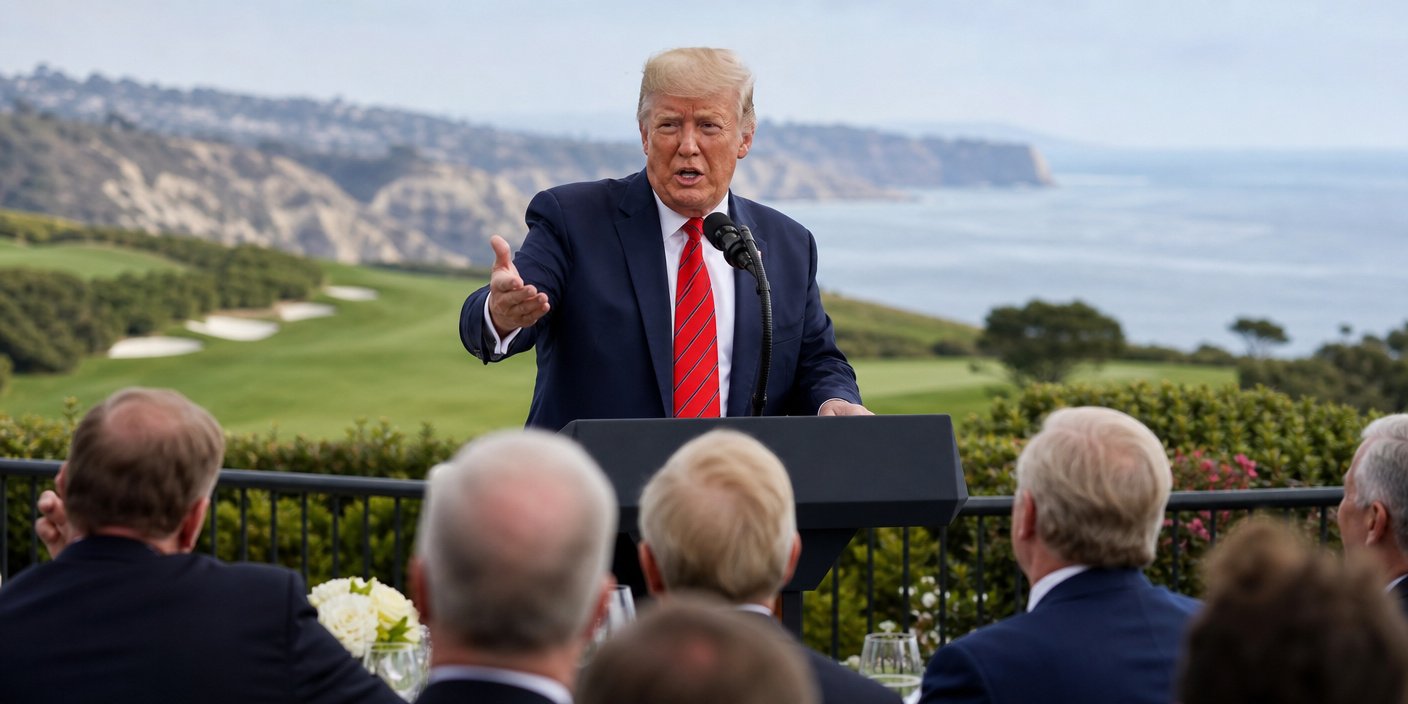
Former President Donald Trump has officially arrived in Los Angeles, signaling the commencement of a high-stakes two-day West Coast tour. This trip, anchored by an exclusive fundraising event at his Rancho Palos Verdes golf club, represents a strategic mobilization of resources and messaging as the GOP accelerates its economic policy advocacy ahead of the upcoming midterm elections. The visit highlights the enduring importance of high-net-worth donor networks within California, even as the state remains a political stronghold for the opposition.
Key Highlights
- RNC Fundraising Push: The tour is primarily dedicated to shoring up financial resources for the Republican National Committee (RNC), with a focus on high-dollar donor engagement at exclusive venues.
- Rancho Palos Verdes Centerpiece: The main event will take place at Trump’s own Rancho Palos Verdes golf club, serving as both a logistical hub and a symbolic backdrop for the former President’s address.
- Economic Policy Pivot: A core component of the visit involves intense advocacy regarding economic policy, with the campaign leveraging local venues to discuss inflation, tax reform, and national fiscal strategy.
- West Coast Strategic Significance: Despite California’s solidly Democratic electoral profile, the state continues to serve as a critical “ATM” for national campaigns, drawing top-tier political figures for rapid-fire fundraising cycles.
California Crossroads: Inside the GOP’s West Coast Fundraising Strategy
The arrival of Donald Trump in Southern California is not merely a geographic stopover; it is a calculated mobilization of capital and political narrative. While California rarely presents a competitive electoral map for a Republican presidential candidate in the general election, it remains an indispensable theater for fundraising. By touching down in Los Angeles, the Trump campaign is capitalizing on the high concentration of donor wealth residing in the coastal enclaves of Southern California.
The Mechanics of the Rancho Palos Verdes Event
The choice of the Rancho Palos Verdes golf club as the epicenter of this trip provides more than just a convenient venue. It serves as a “home-field” environment that allows for controlled messaging and high-security access. Fundraising events of this caliber are meticulously curated, designed to facilitate direct dialogue between the former President and major donors who are concerned with the trajectory of national fiscal policy. In these private settings, the discussion shifts from the populist rhetoric often seen at large-scale rallies to the granular details of regulatory policy, tax structure, and international trade—issues that form the backbone of the GOP’s current platform.
Analysts note that by holding the event at his own property, the campaign maximizes organizational efficiency while reinforcing the branding of the “Trump” entity. The logistical coordination required to move a former President into an urban center like Los Angeles is immense, and utilizing private, owned facilities streamlines security protocols and venue availability, ensuring the tour remains on a rigid, high-performance schedule.
Economic Messaging in an Inflationary Environment
Beyond the ledger sheets of the RNC, this tour is a vehicle for economic policy advocacy. The campaign is signaling a return to “kitchen table” economics, a strategy intended to contrast current administration policies with the economic environment of the previous four years. In Southern California, where the cost of living and energy prices are frequent points of public contention, the Trump team is betting that their message on tax cuts and deregulation will resonate not just with donors, but with the broader media narrative they are cultivating.
By framing the tour around economic stability and growth, the GOP is attempting to broaden the conversation beyond cultural wedge issues. This pivot is critical for midterm strategy, where suburban voters—a demographic that has been fluctuating in recent cycles—are often swayed primarily by fiscal outcomes. The Los Angeles stop allows the campaign to project an image of “business as usual” and stability, contrasting sharply with the chaotic headlines that often dominate the 24-hour news cycle.
The Blue State Fundraising Paradox
The paradox of Republican campaigning in California is well-documented but frequently misunderstood by the general public. While the state’s electoral votes are reliably out of reach, the state’s financial power is immense. Silicon Valley, Hollywood, and the luxury real estate sectors in places like Rancho Palos Verdes produce significant political contributions for candidates across the spectrum.
For the RNC, ignoring this resource pool would be a strategic error. This tour functions as a “resource extraction” mission, ensuring that the party’s war chest remains competitive against well-funded opposition. The visit also serves to energize the local “grassroots-plus” donor base—the small-to-mid-sized business owners who are heavily invested in the party’s platform and are often the most enthusiastic participants in intimate fundraising dinners.
Looking toward the future, this trip signals that the GOP is not willing to concede any part of the country when it comes to financial or media dominance. By planting a flag in Los Angeles, the campaign demonstrates a “total map” approach, proving that even in the heart of Democratic territory, the GOP can command attention, secure significant funds, and dictate the terms of the political conversation.
FAQ: People Also Ask
Q: Why does the former President choose to fundraise in a Democratic stronghold like California?
A: California represents one of the largest concentrations of wealth in the United States. Even when a state is not competitive on the electoral map, it is vital for “resource extraction”—gathering the campaign funds necessary to compete in battleground states across the nation.
Q: What is the primary focus of this specific West Coast tour?
A: The primary objectives are RNC fundraising and the advocacy of specific economic policies, including tax reform and regulatory shifts, intended to set the tone for the upcoming midterm election cycle.
Q: Why was the Rancho Palos Verdes golf club selected as the venue?
A: Utilizing private properties owned by the candidate allows for superior logistical control, enhanced security measures, and a more intimate environment suitable for high-dollar donor interactions, all while streamlining event management.
Q: How does this tour influence the broader midterm election strategy?
A: By raising significant capital and keeping the focus on the economy, the campaign aims to bolster the financial standing of the RNC and provide a clear, fiscal-focused narrative that can be broadcast nationally to sway moderate and suburban voters.