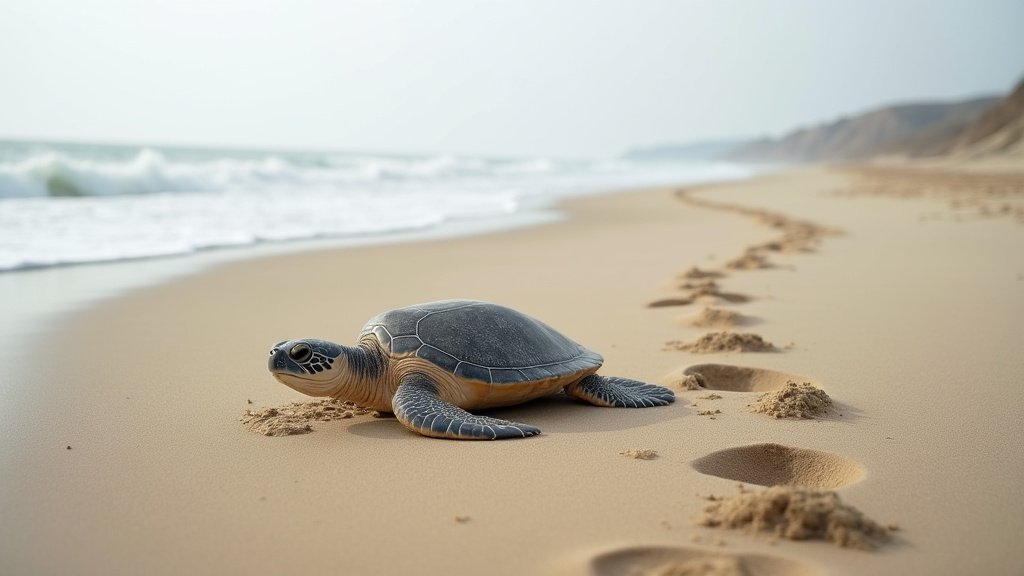
In an unprecedented biological event that has captured the attention of marine biologists, olive ridley sea turtles (Lepidochelys olivacea) have been observed attempting to nest on beaches along the Southern California coastline. Historically, these turtles are native to tropical and subtropical waters, primarily nesting in places like Mexico, Costa Rica, and India. The recent observation of this species near Seal Beach and Huntington Beach marks a significant deviation from established marine migration patterns, providing a stark indicator of the profound impact that ‘super’ El Niño events—and the accompanying surge in ocean temperatures—exert on marine ecosystems.
Key Highlights
- Historic First: This is the first recorded instance of olive ridley sea turtles attempting to nest on the U.S. West Coast, signaling a major shift in range due to environmental stressors.
- The El Niño Factor: Scientists attribute this migration to the ‘super’ El Niño-Southern Oscillation (ENSO), which has pushed warm equatorial water currents much further north than historical averages.
- Specific Locations: Verified sightings and nesting activity have been concentrated near the beaches of Seal Beach and Huntington Beach in Southern California.
- Ecological Implications: The shift highlights concerns about the ‘new normal’ for marine species as climate change continues to destabilize traditional habitats.
The Changing Tide: Assessing the California Nesting Event
The appearance of olive ridley sea turtles on the sandy shores of Southern California is not merely a biological curiosity; it is a profound signal of a rapidly changing ocean environment. For years, marine biologists have monitored the movement of tropical marine life as they track northward in response to rising sea surface temperatures. However, the confirmed nesting activity of Lepidochelys olivacea—a species known for its ‘arribada’ or synchronized mass nesting behavior—within the temperate waters of the U.S. West Coast represents a clear escalation of these trends.
Oceanographic Catalysts: The Role of ‘Super’ El Niño
At the core of this migration is the El Niño-Southern Oscillation (ENSO). During a ‘super’ El Niño event, the Pacific Ocean experiences a significant release of heat, causing the thermocline to deepen and warm surface waters to extend well beyond their typical tropical boundaries. This creates a thermal highway, allowing species that are physiologically adapted to warm water to travel thousands of miles away from their native breeding grounds.
For the olive ridley, which requires specific water temperatures for metabolic stability, the anomalously warm waters off the coast of California have essentially removed the thermal barrier that previously kept them in the tropics. As these turtles follow these warm currents, they become disoriented, finding themselves in a habitat that, while warm enough to survive in temporarily, is fundamentally unsuitable for long-term survival or reproductive success.
The Perils of Non-Native Nesting
The attempt to nest at Seal Beach and Huntington Beach presents immediate conservation challenges. While the water temperatures may have been temporarily inviting, the surrounding environment of Southern California is vastly different from the tropical beaches these turtles evolved to inhabit.
Firstly, these beaches are subject to heavy human traffic, pollution, and light pollution, which can disorient hatchlings and adults alike. Secondly, the sand temperature on California beaches often fails to reach the thermal requirements necessary for the successful incubation of Lepidochelys olivacea eggs. If the sand is too cool, the eggs may fail to develop, or, even if they do hatch, the sex ratio of the hatchlings—which is temperature-dependent—could be severely skewed, threatening the population’s viability.
A Window into a Warming Future
This event offers researchers a unique, albeit concerning, ‘laboratory’ to observe how climate change will redistribute marine biodiversity in the coming decades. If the frequency of ‘super’ El Niño events continues to rise, as many climate models predict, we may see a permanent northward shift in the ranges of various tropical marine species.
Conservationists and the National Oceanic and Atmospheric Administration (NOAA) are now tasked with the difficult challenge of monitoring these visitors without disrupting their natural behaviors. The focus has shifted toward creating protective protocols—such as cordoning off nesting sites and educating the public—to ensure that these turtles, caught in a changing climate, are given a fighting chance to return to their natural range.
The Long-Term Scientific Outlook
The scientific community is currently analyzing telemetry data from tagged individuals to understand whether these nesting attempts are one-off anomalies or the beginning of a sustained trend. The integration of satellite tracking and ocean temperature modeling is crucial. By mapping the exact isotherms—lines of constant temperature—that these turtles follow, researchers hope to predict where and when future nesting attempts might occur. This data is vital, as it allows for the proactive deployment of rescue teams and conservation resources.
While the sight of a sea turtle on a California beach may seem like a marvel, it serves as a sobering reminder of the volatility currently facing the global marine environment. The ecological ‘mismatch’—where species are forced to move faster than their biological instincts can adapt—is a hallmark of the Anthropocene, and the olive ridley’s journey serves as a living, breathing case study of this phenomenon.
FAQ: People Also Ask
Q: Are olive ridley sea turtles dangerous to humans?
A: No, olive ridley sea turtles are not dangerous to humans. They are generally docile marine animals. However, it is strictly prohibited by law to approach, touch, or harass sea turtles. If you spot one on the beach, keep a respectful distance and contact local wildlife authorities.
Q: Why did they choose Seal Beach and Huntington Beach?
A: Scientists believe these areas were simply where the warm currents pushed the turtles closest to the shore when they were ready to nest. The geography of the coastline may have also funneled them into these specific zones.
Q: What should I do if I see a sea turtle nesting in California?
A: If you encounter a nesting sea turtle, immediately maintain a distance of at least 50 feet. Keep lights off, as artificial light disorients them. Report the sighting immediately to the California Department of Fish and Wildlife or local marine stranding networks.
Q: Will these turtles survive in California waters long-term?
A: It is highly unlikely. California waters are generally too cold for the olive ridley species. As the El Niño event dissipates and ocean temperatures normalize, these turtles will likely face significant survival risks unless they migrate back to warmer southern latitudes.