The sudden silence of Oakland’s emergency dispatch center has sent shockwaves through the Bay Area, as local authorities scramble to identify the perpetrators behind a targeted infrastructure attack. Following the widespread failure of 911 emergency lines—a lifeline for the city’s residents—the Oakland Police Department has officially classified the incident as a criminal matter. This breach has exposed the fragile nature of urban communications, forcing a re-evaluation of how municipalities protect the critical systems that stand between public safety and chaos.
Key Highlights
- Criminal Investigation: The Oakland Police Department (OPD) is treating the incident as a deliberate act of sabotage following reports that physical lines were cut.
- Service Interruption: A major disruption occurred when AT&T fiber optic infrastructure was compromised, rendering the 911 system unreachable for a critical window.
- Infrastructure Vulnerability: The event highlights the risks associated with centralized communication networks that rely on vulnerable physical cables running through urban centers.
- Coordinated Response: City officials and AT&T technicians are working in tandem to repair the damage and implement backup protocols to prevent a recurrence of this blackout.
Anatomy of an Infrastructure Attack
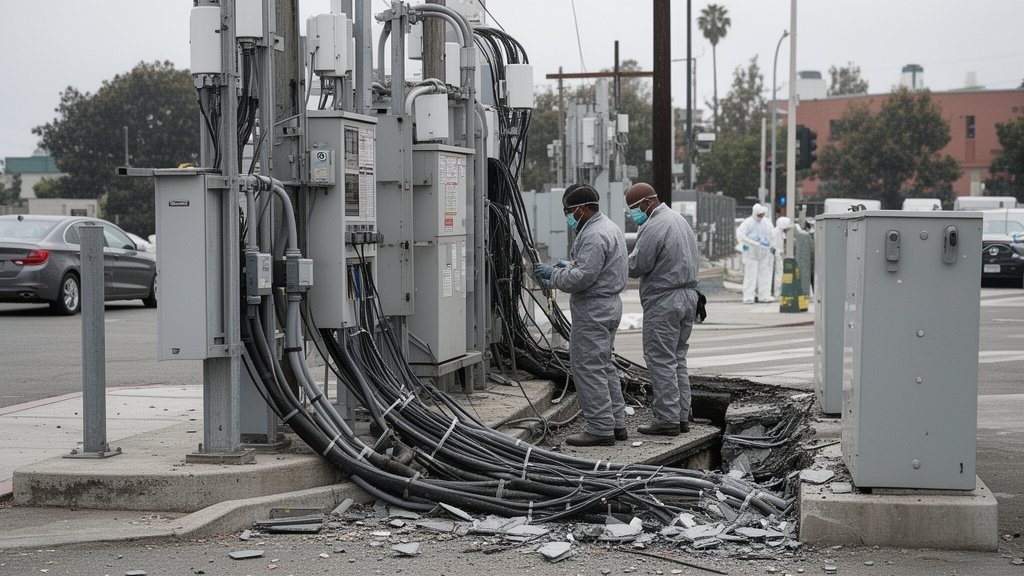
The crisis began when dispatchers across Oakland noted a sudden, total cessation of incoming calls. In the modern era, the 911 system is a sophisticated nexus of fiber optic data transmission. When the lines managed by AT&T were severed, the network essentially went dark. Unlike a simple server outage or software bug, this was a kinetic attack on physical infrastructure. Investigators from the Oakland Police Department, working in conjunction with state and federal entities, are currently analyzing forensic evidence gathered at the site of the damage. Preliminary reports indicate that the lines were cut in a location that suggests intentionality rather than an accidental excavation mishap. This distinction is critical; if the damage was deliberate, it elevates the incident from a maintenance issue to an act of domestic sabotage against public safety.
The Forensic Challenge
Investigating infrastructure sabotage presents unique challenges for law enforcement. Unlike traditional crime scenes, fiber optic lines are often buried in conduits or strung on poles across vast distances. Identifying the exact point of failure—and the individual or group responsible—requires a combination of geospatial mapping, surveillance footage from nearby businesses, and specialized forensic analysis of the physical damage to the cables. The OPD is currently leveraging every resource available, including reviewing security footage from the vicinity, to build a timeline of the disruption. The complexity lies in the fact that these networks are often located in public spaces that are difficult to surveil 24/7, creating a strategic challenge for the department as they attempt to catch the perpetrator in the act or through subsequent evidence trails.
Fragility of the Digital Lifeline
This incident underscores the terrifying vulnerability of our modern, hyper-connected society. While Oakland has made strides in integrating smart city technology, the foundation of these systems often relies on legacy infrastructure that has not been sufficiently hardened against physical threats. Fiber optic cables, while incredibly efficient at transmitting data, are physically fragile. A single well-placed cut can disable emergency services for an entire municipality. The reliance on a single provider for such critical infrastructure is a point of contention that will likely dominate city council meetings for months to come. Experts argue that redundancy is not just a technological luxury but a necessity for urban survival. Without secondary, diverse communication pathways, a single point of failure can lead to catastrophic delays in response times for police, fire, and medical emergencies.
Public Safety Consequences
During the hours the lines were down, the human cost was palpable. Residents attempting to report emergencies were met with silence or busy signals, a scenario that fundamentally undermines the social contract between the city and its citizens. Emergency response times—a metric tracked with extreme precision by municipal authorities—suffered significantly as dispatchers were forced to switch to backup radio protocols or alternative communication channels. This period of uncertainty created a vacuum of information, leading to widespread anxiety across affected neighborhoods. The Oakland Police Department had to quickly pivot to disseminating information through social media and traditional news outlets to inform the public of alternative emergency contact methods. This reactive approach, while necessary, highlights the need for a more robust, automated failover system that can trigger instantaneously when a primary line is breached.
Moving Toward Systemic Resilience
The path forward for Oakland involves a multi-faceted approach to security and resilience. First, city leaders are calling for an immediate audit of critical utility infrastructure. This involves working with providers like AT&T to assess whether current physical protections—such as hardened conduits, alarmed cabinets, and enhanced surveillance—are sufficient to deter sabotage. Secondly, there is a push to accelerate the deployment of decentralized emergency communication networks. By utilizing mesh networks or satellite-based backup systems, the city could ensure that even if traditional fiber lines are compromised, the ability to receive and dispatch emergency services remains intact. This incident serves as a wake-up call, not just for Oakland, but for urban centers nationwide, regarding the necessity of treating communication infrastructure with the same level of security and protection as military or governmental installations.
FAQ: People Also Ask
Q: Was the Oakland 911 outage caused by a cyberattack?
A: Current evidence suggests the outage was caused by physical damage to AT&T fiber optic lines. While the distinction between a cyber-attack and physical sabotage is technical, the Oakland Police Department is treating this as a criminal investigation into the physical destruction of property.
Q: What should I do if 911 fails in the future?
A: In the event of a system-wide 911 failure, local authorities usually advise citizens to use alternative communication channels, such as contacting local police station desk lines, using the “Text-to-911” service if available and functioning, or going directly to the nearest fire station or police precinct.
Q: How does the city plan to prevent future line severing?
A: The city is coordinating with telecom providers to enhance physical security measures around critical nodes. Discussions are also underway regarding the implementation of redundant, diverse fiber pathways so that a single cut does not result in a total system failure.