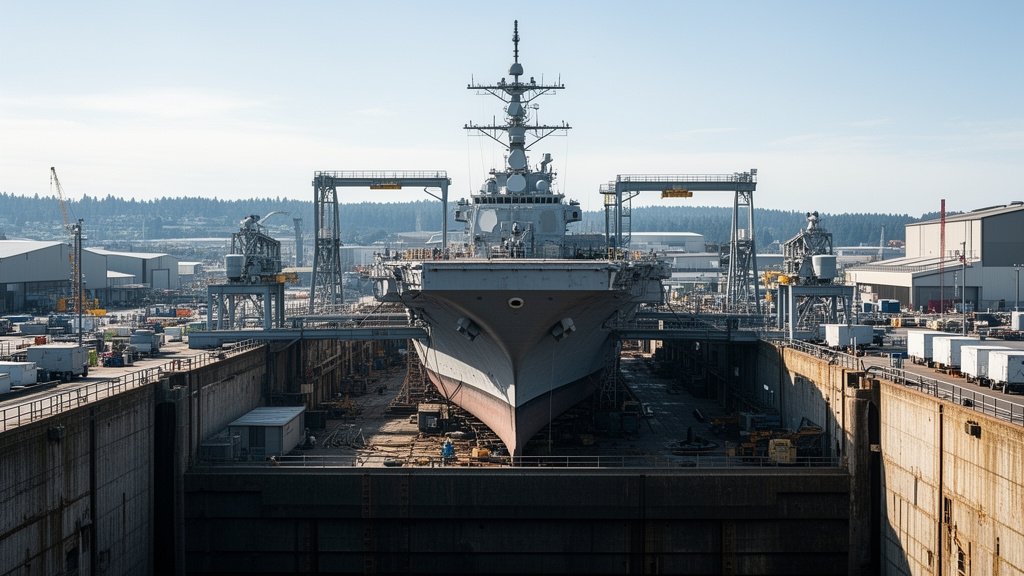
The U.S. Navy has formally launched a massive solicitation process to secure construction contracts valued at up to $30 billion, aiming to modernize critical shipyard infrastructure essential for maintaining American maritime superiority. This initiative, part of the broader Shipyard Infrastructure Optimization Program (SIOP), marks a generational investment in four vital public shipyards, with a particular emphasis on increasing capacity and readiness at the Puget Sound Naval Shipyard and Intermediate Maintenance Facility in Washington State. As the Navy grapples with an aging infrastructure that has struggled to keep pace with the maintenance requirements of modern warships, this solicitation represents a pivot toward long-term fleet availability and operational resilience.
Key Highlights
- $30 Billion Investment: The Navy is soliciting high-value contracts to overhaul aging facilities, ensuring the fleet remains combat-ready.
- Strategic Scope: The SIOP program targets four public shipyards: Puget Sound (WA), Pearl Harbor (HI), Portsmouth (ME), and Norfolk (VA).
- Modernization Priority: Primary objectives include dry dock upgrades, utility grid stabilization, and digital infrastructure integration to support Ford-class aircraft carriers and Virginia-class submarines.
- Fleet Readiness: The project is designed to eliminate maintenance backlogs and reduce the time ships spend out of service, a critical factor for Pacific and Atlantic deterrence.
The Strategic Imperative of SIOP
The Shipyard Infrastructure Optimization Program (SIOP) is the Navy’s 20-year, multibillion-dollar effort to reconfigure and modernize its four public shipyards. The decision to solicit $30 billion in contracts at this juncture is not merely a repair effort; it is a fundamental shift in how the Navy approaches ship maintenance. For decades, the nation’s public shipyards—some of which have roots dating back to the 19th century—have operated on infrastructure designed for vessels that are significantly smaller and less complex than today’s nuclear-powered platforms.
Overcoming the ‘Four Yards’ Bottleneck
The central challenge lies in the physical capacity of the four existing dry docks. Many of these docks were built before the advent of supercarriers and the sophisticated sensor suites found on Virginia-class attack submarines. When these vessels require maintenance, the limited number of capable dry docks often forces a bottleneck, resulting in ‘idle time’ for the fleet. By upgrading the physical footprint at Puget Sound and its sister yards, the Navy intends to synchronize shipyard capability with ship deployment schedules. This is a critical requirement for maintaining a high-tempo presence in contested waters, particularly the Indo-Pacific region.
Technical and Digital Modernization
The solicitation goes beyond mere concrete and steel. A significant portion of the $30 billion allocation is designated for utility grid upgrades and digital modernization. Modernizing a shipyard involves integrating industrial control systems, improving power reliability, and upgrading the logistical flow of materials and personnel. The Navy requires contractors capable of managing complex, integrated construction projects that can proceed while active maintenance work on submarines and aircraft carriers continues nearby. This creates a challenging ‘construct-while-operating’ environment that demands high-level project management and industrial expertise.
Future-Proofing the Fleet
The economic and strategic implications of this solicitation are vast. Beyond the immediate construction work, this project serves as a cornerstone for the U.S. industrial base. The infusion of $30 billion acts as a stimulus for regional economies, particularly in the Pacific Northwest, where Puget Sound Naval Shipyard serves as a major employer and technological hub. Furthermore, the program is expected to stabilize the industrial supply chain, providing a long-term roadmap for contractors who specialize in heavy maritime infrastructure.
Looking toward the future, the Navy faces a growing competitive environment. The ability to return vessels to the fleet faster is a key metric in the U.S. Department of Defense’s strategy to maintain a qualitative advantage over peer adversaries. By addressing the infrastructure gap today, the Navy is effectively purchasing future operational capacity—ensuring that when a carrier or submarine needs service, it is not left waiting for a dry dock that lacks the modern power or space to accommodate it.
FAQ: People Also Ask
Q: What exactly is the Shipyard Infrastructure Optimization Program (SIOP)?
A: SIOP is the Navy’s comprehensive, 20-year plan to modernize its four public shipyards (Puget Sound, Pearl Harbor, Portsmouth, and Norfolk) to support the fleet of the future, including Ford-class carriers and Virginia-class submarines.
Q: Why is Puget Sound Naval Shipyard being prioritized?
A: As the primary maintenance hub for the Pacific Fleet, Puget Sound is critical for the maintenance of nuclear-powered submarines and aircraft carriers. Its modernization is vital for ensuring the U.S. Navy maintains a consistent, ready presence in the Pacific.
Q: How does this $30 billion figure compare to past maintenance budgets?
A: This solicitation represents a significant, centralized push to fix systemic infrastructure issues rather than relying on piecemeal repairs. It is one of the largest sustained infrastructure investments in the Navy’s recent history, specifically tailored for long-term fleet readiness.
Q: What is the primary goal of these facility upgrades?
A: The goal is to reduce ship maintenance delays, increase dry dock capacity, and create a digital and physical environment capable of supporting the next generation of maritime technology.