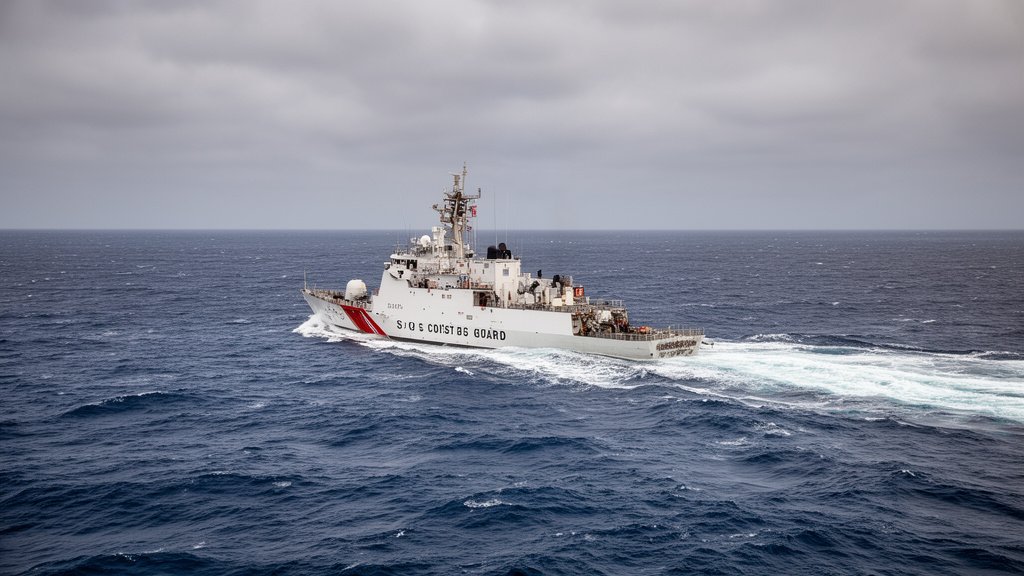
The U.S. Coast Guard, in collaboration with Mexican naval assets, has officially suspended the search for 11 individuals missing approximately 140 miles west of Ensenada, Mexico. This decision, announced following a grueling 89-hour coordinated search operation, marks the conclusion of an active rescue phase initiated after distress signals were received on Friday. While 16 survivors were successfully located and pulled from the water, the unforgiving conditions and the time elapsed since the initial distress call led authorities to determine that the probability of survival had diminished below the threshold for active search and rescue (SAR) operations.
Key Highlights
- The Scale of Operations: A coordinated multi-agency effort involving U.S. Coast Guard and Mexican naval assets spanned 89 hours of continuous search operations.
- Outcome of Rescue: 16 individuals were rescued on Friday; however, 11 remain missing after the search effort concluded.
- Geographic Challenge: The incident occurred 140 miles west of Ensenada, placing the search zone in a remote and complex section of the Pacific Ocean.
- Standard Procedure: The suspension follows the established U.S. Coast Guard SAR decision matrix, which evaluates environmental conditions, water temperature, and survivability timelines.
The Anatomy of a High-Stakes Maritime Search
The suspension of a search and rescue operation is one of the most difficult and calculated decisions a command center can make. When the U.S. Coast Guard and its international partners, such as the Mexican Navy (SEMAR), initiate a search, they operate under a rigid scientific framework designed to maximize the probability of detection while balancing the safety of the rescue crews themselves. The incident 140 miles west of Ensenada presented a unique set of challenges that exemplify the volatility of open-ocean rescue missions.
The Search and Rescue (SAR) Decision Matrix
Search operations are not abandoned lightly. Coast Guard command centers utilize a sophisticated ‘Search and Rescue Optimal Planning System’ (SAROPS). This system integrates environmental data—such as ocean currents, wind speed, water temperature, and drift patterns—to generate probability maps for missing targets. In this case, the 89-hour operation represents a significant duration, pushing the boundaries of what is considered a ‘survivable’ window in open-ocean conditions.
Factors such as hypothermia risk, dehydration, and the lack of specialized maritime survival equipment for the missing individuals are mathematically factored into the decision to suspend. By the time the operation was called off, the Coast Guard command determined that further active searching would yield a negligible probability of finding the missing persons alive, necessitating the shift from an active rescue mission to a closure phase. This process is mandated by policy to prevent the unnecessary expenditure of limited SAR resources and to mitigate the risks posed to rescue personnel operating in harsh, unpredictable environments.
The Maritime Realities West of Ensenada
Geographically, the waters 140 miles off the coast of Ensenada are notoriously difficult. This region is influenced by the California Current, which brings cold, nutrient-rich water southward along the coast. While this makes for a rich marine ecosystem, it also creates dangerous conditions for small, unseaworthy vessels—often referred to as ‘pangas’ in the context of maritime smuggling or unauthorized migration. These vessels lack the structural integrity, navigation equipment, and life-saving apparatus required for the open Pacific. The distance of 140 miles from the coast indicates that these individuals were far beyond the safety of the continental shelf, where swells can become massive and irregular, often swamping smaller craft with little warning.
International Cooperation and Asset Deployment
One of the critical components of this operation was the seamless integration between U.S. Coast Guard assets and Mexican naval units. Maritime borders, while political, are fluid in the eyes of search and rescue operations. Under international maritime law and specific agreements between the U.S. and Mexico, SAR coordination is prioritized above all else. During this 89-hour window, patrol cutters, aircraft, and rapid-response boats worked in a synchronized grid pattern. The logistics involved in refueling and re-tasking these assets in such a remote location are immense, requiring constant communication and shared intelligence to avoid overlapping search areas or missing gaps in the coverage zone. The fact that 16 survivors were rescued is a testament to the effectiveness of this joint-force deployment, even as the outcome for the remaining 11 was tragic.
The Aftermath and Humanitarian Implications
While the search is suspended, the investigation into the origins of this distress call often continues. Incidents of this nature frequently highlight the broader humanitarian crisis involving maritime migration routes. The use of overloaded, under-equipped vessels to traverse deep-ocean routes creates a systemic vulnerability that puts lives at extreme risk. For the Coast Guard, the conclusion of the search initiates an administrative and after-action review, documenting the effectiveness of the response and identifying potential gaps in future regional maritime safety protocols. For the families of the missing, this marks the agonizing transition from a period of hope to a period of mourning and uncertainty, as the focus shifts from active rescue to potential recovery efforts, which are rarely successful once significant time has passed.
FAQ: People Also Ask
1. Why does the Coast Guard stop searching after a certain amount of time?
The Coast Guard utilizes a survival model based on the ‘survivability window,’ which considers water temperature, the condition of the individuals, and the equipment they are using. Once the time elapsed exceeds the statistical probability of survival for those conditions, the mission is suspended to reallocate resources to active emergencies.
2. What happens to the survivors who were rescued?
Survivors are generally transferred to the custody of relevant authorities for medical assessment and intake processing, depending on the circumstances of the vessel’s origin and the legal status of the passengers.
3. Will the Coast Guard restart the search if new information comes to light?
Yes. While the active search is suspended, the case remains open. If credible new information or sighting reports emerge that suggest a high probability of locating survivors, the Coast Guard command center has the discretion to re-evaluate and potentially resume search activities.
4. What is the difference between suspending a search and ending it?
A ‘suspension’ means the active, multi-asset search has concluded because the mathematical probability of finding survivors is exhausted. It is rarely called ‘ending’ or ‘closing’ the case, as the investigation into the incident, the vessel, and any potential criminal elements (such as smuggling) typically continues.