The Trump Administration has formally launched the ‘America First Seafood Strategy,’ a comprehensive, coordinated federal framework aimed at revitalizing the United States’ maritime industry. By targeting structural inefficiencies, complex regulatory roadblocks, and outdated infrastructure, the initiative seeks to transition the American seafood sector from a net importer to a global competitive powerhouse. The strategy places a premium on boosting domestic harvests, expanding sustainable aquaculture, and fortifying the logistical pipelines that move product from coastal docks to American dinner tables, marking a pivot toward aggressive economic nationalism in the maritime sector.
Key Highlights
• Infrastructure Modernization: A focus on upgrading port facilities and cold-chain logistics to reduce bottlenecks that currently hinder domestic fishermen and processors.
• Regulatory Streamlining: A directive to simplify permitting processes under the National Environmental Policy Act (NEPA) and other federal mandates to accelerate aquaculture development and fishing access.
• Supply Chain Security: A strategic effort to reduce reliance on foreign seafood imports, prioritizing domestic production to ensure food security for American consumers.
• West Coast Economic Stimulus: Targeted support for Pacific Northwest and California coastal communities, addressing the specific operational costs faced by fleets in these regions.
Revitalizing America’s Blue Economy: The Path Forward
The American seafood industry has long operated under the shadow of complex bureaucracy and aging infrastructure, often struggling to compete with heavily subsidized international rivals. The ‘America First Seafood Strategy’ represents a paradigm shift, recognizing the maritime sector not merely as a subset of environmental policy, but as a critical pillar of national economic security. By centralizing federal coordination, the Administration aims to unlock the vast potential of the U.S. Exclusive Economic Zone (EEZ), the largest in the world.
Infrastructure Modernization: Breaking Bottlenecks
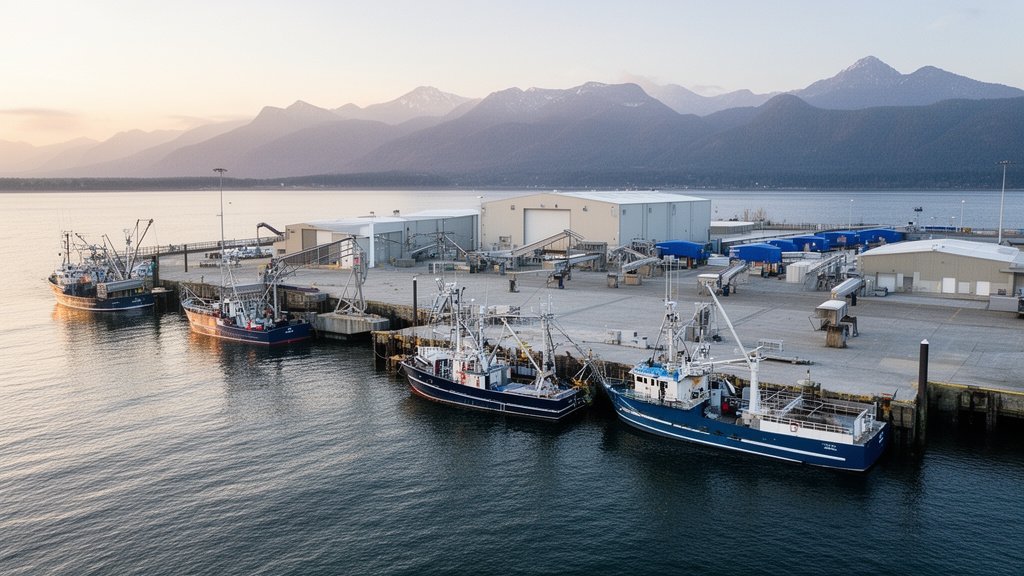
At the heart of the initiative is a commitment to physical infrastructure. Many coastal communities have relied on port facilities that have seen little investment in decades. The strategy identifies port congestion, inadequate cold-storage facilities, and outdated processing technology as primary obstacles to growth. By leveraging public-private partnerships, the administration intends to facilitate funding for regional hubs. These upgrades are not just about cement and steel; they are about technological integration. Automated inventory management, improved energy efficiency in processing plants, and modernized docks will allow domestic harvesters to process catches faster, reducing spoilage and maintaining higher quality standards that fetch premium prices in global markets. This modernization is expected to particularly benefit West Coast operations, where high labor costs must be offset by extreme operational efficiency.
Cutting Regulatory Red Tape for Domestic Harvesters
For years, domestic aquaculture and commercial fishing operations have cited the ‘regulatory maze’ as a primary deterrent to investment. The new strategy focuses on simplifying the permitting landscape. By streamlining the interaction between federal agencies—specifically the National Oceanic and Atmospheric Administration (NOAA), the U.S. Food and Drug Administration (FDA), and the Environmental Protection Agency—the strategy aims to create a ‘one-stop-shop’ for regulatory compliance. This is critical for the burgeoning aquaculture sector. Current permitting for offshore fish farming is fragmented, often requiring approvals from multiple agencies with overlapping jurisdictions. The administration’s move to consolidate these oversight mechanisms is intended to provide the legal certainty that private investors need to commit capital to long-term aquaculture projects. By reducing the time and cost associated with regulatory navigation, the strategy seeks to lower the barrier to entry for small-to-medium-sized enterprises, effectively democratizing access to the maritime economy.
Enhancing Global Competitiveness and Trade
The ‘America First’ approach extends to the global marketplace. The strategy emphasizes leveling the playing field against foreign competitors who often operate under lower environmental and labor standards. By bolstering domestic production volumes, the U.S. aims to reduce its substantial trade deficit in seafood products. This involves aggressive trade diplomacy to open new markets for U.S. exports while simultaneously implementing stronger monitoring and enforcement of existing seafood import regulations. The goal is to ensure that products entering the U.S. market are subjected to the same rigorous sustainability and health standards that domestic producers must meet, effectively neutralizing the price advantage held by foreign operations that ignore these benchmarks.
The Economic Ripple Effect on West Coast Communities
One of the most significant secondary angles of this strategy is its hyper-local impact on West Coast fishing communities. In states like Washington, Oregon, and California, fishing is more than an industry; it is the cultural and economic backbone. However, these communities face unique challenges: strict environmental regulations, rising energy costs, and climate-driven migration of fish stocks. The strategy provides a necessary counter-balance, proposing dedicated grants for vessel retrofitting and gear modernization. By providing the tools for these communities to pivot to different species or adopt more fuel-efficient fishing techniques, the administration hopes to insulate these towns from the volatility of global seafood pricing. The long-term economic prediction is a revitalization of ‘working waterfronts,’ where the economic output of fishing supports vibrant, year-round economies rather than seasonal, subsistence-based livelihoods.
Ensuring Long-Term Food Security
Food security has re-emerged as a primary concern for the U.S. government, shifting the perspective on seafood. The ‘America First Seafood Strategy’ frames domestic fishing as a strategic national asset. The current reliance on imports leaves the U.S. food supply chain vulnerable to geopolitical shocks, pandemics, and global supply chain disruptions. By increasing the domestic yield, the strategy aims to create a buffer. A resilient national seafood supply ensures that protein sources remain stable and affordable for the American public, regardless of external crises. This angle moves the conversation away from simple economic gains and into the realm of national safety and resilience, making it a priority across the political spectrum.
Future-Proofing Through Sustainable Aquaculture
The future of the strategy lies in the balanced expansion of sustainable aquaculture. While traditional wild-capture fishing remains vital, the administration recognizes that global demand for seafood is outpacing the ocean’s natural replacement rates. The strategy invests in the development of sustainable, closed-loop aquaculture systems that can operate with minimal impact on local ecosystems. By integrating advanced technology—such as AI-driven feeding systems and real-time water quality monitoring—the U.S. aims to lead the world in high-tech, low-impact fish production. This not only secures food supplies but also positions the U.S. as an exporter of intellectual property and technological solutions, further strengthening the domestic economic impact.
FAQ: People Also Ask
How does this strategy affect small-scale fishing businesses?
The strategy emphasizes leveling the playing field. By reducing regulatory costs and providing access to infrastructure grants, it aims to help smaller operators compete against industrial-scale international conglomerates, reducing the administrative burden that often falls hardest on family-owned fleets.
Does this strategy conflict with existing environmental protections?
The administration maintains that this strategy balances economic growth with sustainability. It aims to modernize permitting processes for efficiency—not to abandon environmental standards—ensuring that economic expansion does not come at the cost of marine health.
What are the primary ‘bottlenecks’ mentioned in the strategy?
The primary bottlenecks include port congestion, lack of modern cold-storage logistics, fragmented permitting processes across multiple federal agencies, and an aging fleet that lacks the fuel-efficiency and processing technologies required to compete globally.