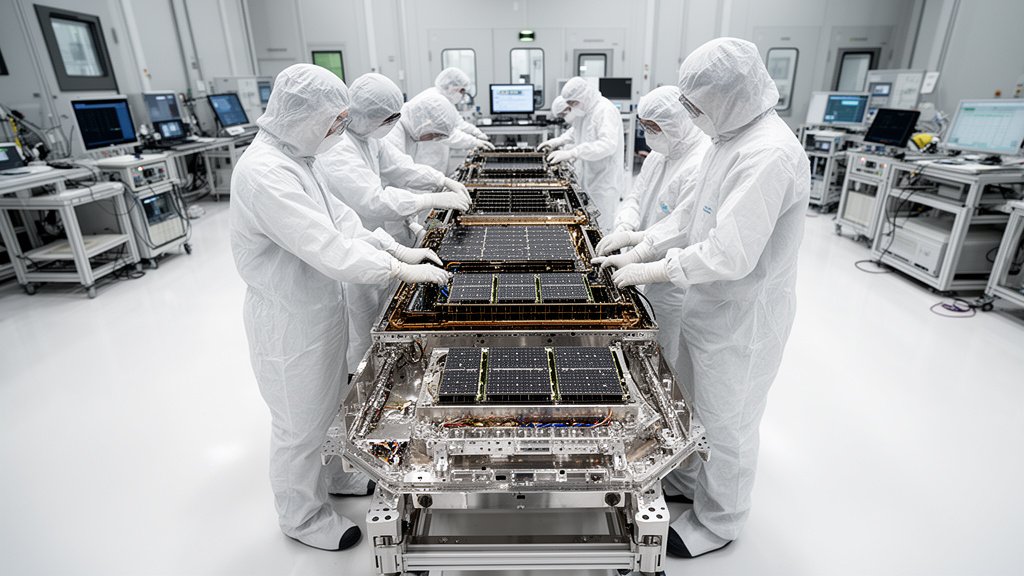
The landscape of space infrastructure is undergoing a seismic shift as Sophia Space and SLI have officially formalized a $300 million framework agreement. This strategic partnership is set to develop and deploy a constellation of 10 satellites specifically designed for orbital edge computing. By positioning processing power directly in low-Earth orbit, the venture aims to revolutionize how data is managed, processed, and transmitted, moving away from traditional, latency-heavy reliance on ground-based cloud infrastructure.
Key Highlights
- Financial Commitment: A $300 million framework agreement establishes the capital structure for the 10-satellite constellation deployment.
- Technological Shift: The project focuses on “Orbital Edge” computing, enabling real-time data processing in space rather than relying on ground-based processing.
- Regional Impact: The initiative reinforces Southern California’s position as a premier global hub for aerospace and “hard tech” development.
- Scalability: The framework allows for modular growth, targeting the burgeoning demand for high-speed, secure, and resilient orbital data services.
The Architecture of the Orbital Edge
The fundamental premise behind the Sophia Space and SLI collaboration is the maturation of orbital edge computing. In a conventional satellite network, satellites act primarily as data pipes: they collect raw data and beam it down to terrestrial ground stations, where it is processed by cloud servers. This process creates significant latency and bandwidth constraints, particularly when handling massive datasets in real-time environments such as maritime logistics, defense operations, and disaster response.
By integrating advanced processing hardware directly into the satellite bus, the Sophia Space-SLI constellation aims to perform analytics, filtering, and data compression at the source. This is the definition of “Edge” in this context—moving the compute as close to the data generation point as possible. The $300 million investment is not merely for hardware manufacturing; it encompasses the development of the sophisticated software stack required to manage distributed compute nodes in a vacuum. This dual-focus approach—hardware and software integration—is what distinguishes this constellation from legacy communication satellites.
Scaling the Infrastructure
Achieving a 10-satellite footprint is a critical phase for the alliance. While small in comparison to massive constellations like Starlink, the specific focus here is on quality of compute per unit rather than pure coverage volume. Each satellite will serve as a high-performance node. The financial framework allows for the procurement of components, launch services, and rigorous testing cycles, ensuring that each unit is hardened against the harsh environment of space while maintaining the computational stability required for complex AI-driven workloads.
Strengthening the Southern California Aerospace Ecosystem
The aerospace industry in Southern California has seen a resurgence characterized by “hard tech” integration. The partnership between Sophia Space and SLI is a bellwether for this trend. Historically, the region relied on massive defense contracts; today, it is driven by a hybrid model of commercial agility and government-supported innovation.
This $300 million infusion serves as a catalyst for the local supply chain. The project necessitates specialized talent in fields ranging from satellite propulsion and power systems to machine learning and cybersecurity. As the project scales, it is expected to generate significant job growth, particularly in the design and integration sectors, further solidifying the region’s dominance in the global space economy. The decision to anchor the project in the SoCal corridor highlights the availability of specialized manufacturing facilities and elite talent pools that are uniquely positioned to execute such high-stakes engineering projects.
The Competitive Landscape
While major players are flooding LEO (Low Earth Orbit) with connectivity satellites, the Sophia-SLI focus on edge-processing adds a layer of competitive differentiation. By offering real-time data analysis to government and enterprise clients, the venture is carving out a niche that bypasses the limitations of traditional “bent-pipe” satellite communications. This competitive strategy is vital for securing long-term government contracts and private sector partnerships, where data sovereignty and processing speed are increasingly critical metrics.
Addressing Data Latency and Security
A primary goal of this constellation is the mitigation of data latency. In the current geopolitical and commercial climate, the speed at which intelligence can be converted into actionable data is paramount. Traditional data transmission paths involve multiple hops and heavy processing loads on the ground. By offloading these tasks to the satellites themselves, the Sophia-SLI constellation can provide critical intelligence to users on the ground in seconds rather than minutes.
Furthermore, processing data in orbit enhances security. By reducing the reliance on vulnerable ground transmission links—which are susceptible to jamming, interception, and localized outages—the system offers a more robust and resilient information architecture. This level of autonomy is highly attractive for institutional clients who require secure communications that function independently of localized terrestrial failures.
FAQ: People Also Ask
What is ‘Orbital Edge’ computing?
Orbital edge computing involves embedding high-performance processors directly onto satellites. This allows the satellite to process, analyze, and filter data in space, rather than transmitting raw data to a ground station for processing. It drastically reduces latency and bandwidth usage.
Why is the Southern California aerospace sector significant here?
Southern California has a dense concentration of aerospace manufacturing, engineering talent, and test facilities. The region’s ability to integrate complex hardware and software makes it the ideal location for developing next-generation technologies like the Sophia Space-SLI constellation.
What is the timeline for the 10-satellite deployment?
While exact launch dates are contingent on launch provider schedules and integration testing, the $300 million framework is structured to support a phased deployment, likely occurring over the next 24 to 36 months to ensure system stability and iterative software improvements.
How does this deal affect the market?
This deal signals a shift in investment toward “hard tech” and space infrastructure. It demonstrates that the market is moving beyond basic satellite connectivity and toward complex, value-added services provided directly from space.