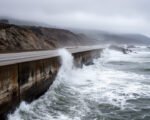
The California coastline, a 840-mile ecological and economic powerhouse, faces a critical regulatory crossroads. The National Oceanic and Atmospheric Administration (NOAA) has initiated a periodic program review of the California Coastal Management Program, sparking intense concern among environmental organizations including the Surfrider Foundation. Activists argue that this federal scrutiny could be weaponized to weaken the state’s “federal consistency” authority—the legal mechanism that allows California to block federal actions, such as offshore oil and gas leasing, that conflict with the state’s rigorous conservation standards.
Key Highlights
- NOAA Oversight: The Office for Coastal Management (OCM) is conducting a routine but highly consequential review of California’s coastal program.
- The ‘Consistency’ Threat: Advocates fear the review could erode the California Coastal Commission’s (CCC) power to enforce federal consistency, a tool established under the Coastal Zone Management Act (CZMA).
- Offshore Drilling Fears: Stakeholders warn that weakening state oversight could pave the way for a resurgence of federal offshore oil and gas operations.
- Legal Precedent: The outcome of this review could set a national precedent for how federal agencies interact with state coastal protection entities.
The Battle Over Federal Consistency and Local Control
At the heart of this challenge lies the Coastal Zone Management Act (CZMA) of 1972. This federal statute was designed to encourage states to manage their own coastal zones by offering federal funding in exchange for the development of programs that balance conservation with development. Crucially, Section 307 of the CZMA grants states the power of “federal consistency.” This means that any federal activity—whether it’s the military expanding a base, the Coast Guard building a facility, or the Department of the Interior auctioning offshore drilling rights—must be consistent with the state’s federally approved coastal program.
For decades, the California Coastal Commission (CCC) has utilized this power as a formidable shield. If the federal government attempts to lease waters for oil extraction, the CCC can review the proposal. If the state determines the project is inconsistent with California’s coastal protection policies, the state can effectively block the project. It is this specific gatekeeping power that environmentalists fear is under the microscope. If NOAA’s review process concludes that California’s regulations are “too restrictive” or inconsistent with federal energy policies, the resulting pressure could force the state to dilute its standards.
The Historical Context: Decades of Defense
To understand the gravity of the current challenge, one must look at the historical evolution of the California Coastal Commission. The agency was born out of a 1972 ballot initiative, Proposition 20, which was passed by voters specifically to protect the coastline from unchecked overdevelopment and industrial exploitation. This was later codified in the California Coastal Act of 1976.
Historically, the relationship between federal agencies and the CCC has been fraught with tension. During the Reagan administration, the federal government attempted to expand offshore drilling aggressively, leading to a series of legal battles that reached the Supreme Court. The federal consistency clause has been the primary legal weapon utilized by the state to protect the Pacific coastline from the environmental risks of spills and industrial noise associated with offshore drilling. Any effort to diminish this power is viewed by environmental historians as a direct attack on the 50-year legacy of Californian environmentalism.
Economic Impact: The Trillion-Dollar Coastline
Beyond the ecological arguments, the stakes for the state’s economy are immense. The California coast supports a massive blue economy, including commercial and recreational fishing, tourism, and coastal real estate. These industries rely on a pristine coastline and clean waters.
Research suggests that offshore drilling poses a non-negligible risk to these industries. A significant oil spill would have catastrophic impacts on the tourism sector, which contributes billions of dollars annually to the state’s GDP. The Surfrider Foundation and other industry advocates emphasize that the coastal economy is built on a model of sustainable use. If federal reviewers prioritize energy independence metrics over localized economic health, they risk destabilizing the primary engines of the California coastal economy. The economic argument against weakening coastal protections is bolstered by the potential liability costs of environmental remediation in the event of industrial failure.
Future Predictions: The Precedent Effect
Looking ahead, the outcome of the NOAA review carries national implications. If the federal government successfully pressures California to narrow the scope of its coastal protections, it creates a template that could be applied to other coastal states like Oregon, Washington, or Florida.
Environmental law experts suggest that this could trigger a wave of litigation. If the federal government attempts to override state decisions based on the findings of this program review, the California Attorney General’s office would likely challenge the move in federal court. This would set the stage for a landmark interpretation of the CZMA—one that will either cement state autonomy in coastal management or shift the balance of power decisively toward federal agencies. Advocates are preparing for a long legal and administrative slog, signaling that they will not accept any reduction in the state’s ability to veto federal projects that threaten the integrity of the Pacific Ocean.
FAQ: People Also Ask
1. What specifically is the NOAA Office for Coastal Management (OCM) reviewing?
NOAA is performing a periodic evaluation of the California Coastal Management Program as required by the Coastal Zone Management Act. They are reviewing whether California is adhering to the terms of its federally approved program and effectively implementing it.
2. Can the federal government actually strip California of its coastal protection powers?
Not easily, but they can apply significant administrative and legal pressure. Through the program review, the federal government can threaten to withhold funding or, more critically, issue findings that claim the state is overstepping its authority. This can be used to influence policy changes or create legal leverage in court.
3. Why is the Surfrider Foundation so concerned about this specific review?
Surfrider and other activists believe that this review is being influenced by political interests seeking to expand offshore drilling. They fear that federal officials may attempt to reinterpret the CZMA’s “federal consistency” rules to limit California’s ability to block projects related to oil, gas, or other federal infrastructure developments.