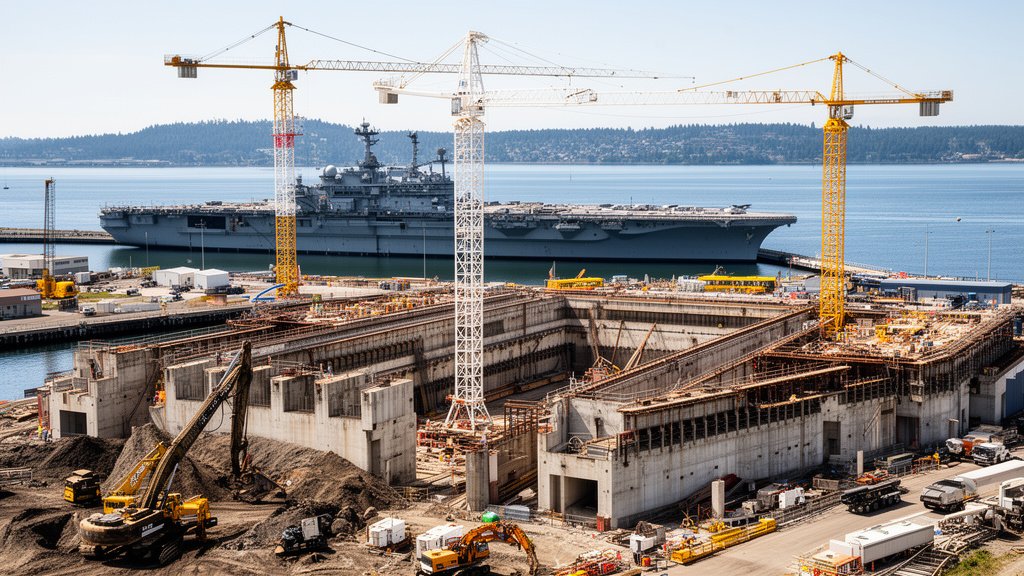
The U.S. Navy has officially moved forward with the modernization of the Puget Sound Naval Shipyard and Intermediate Maintenance Facility (PSNS & IMF) in Bremerton, Washington, marking a pivotal shift in the service’s Pacific maintenance strategy. This project centers on the construction of a new multi-mission dry dock, a critical upgrade designed to address the growing capacity gap for servicing the Navy’s massive, next-generation Gerald R. Ford-class aircraft carriers and aging Nimitz-class vessels.
Key Highlights
- Strategic Infrastructure Optimization: The initiative is part of the broader Shipyard Infrastructure Optimization Program (SIOP), a 20-year, multi-billion-dollar effort to modernize the Navy’s four public shipyards.
- Addressing The Capacity Crunch: Currently, the Navy faces a severe lack of West Coast facilities capable of dry-docking and performing full-scale maintenance on its largest warships, leading to scheduling inefficiencies.
Ford-Class Integration: The new dry dock is specifically engineered to handle the increased weight, footprint, and technical requirements of the Ford-class carriers, which are set to replace the aging Nimitz*-class fleet.
- Operational Readiness: By establishing a high-capacity facility on the West Coast, the Navy aims to reduce the time ships spend in transit to East Coast facilities or foreign ports, thereby increasing the number of carrier strike groups available for rapid deployment in the Indo-Pacific.
Securing the Pacific: The Critical Need for Modernized Maintenance
The U.S. Navy’s decision to break ground on a new multi-mission dry dock at Puget Sound is not merely a construction project; it is a vital component of national security. As the Department of Defense increasingly pivots its focus toward the Indo-Pacific, the ability to maintain and repair the fleet locally has become a bottleneck that threatens operational tempo. For years, the Navy has struggled with a maintenance backlog, where carriers were forced to wait for dry dock availability or undergo repairs at facilities ill-equipped to handle modern requirements.
The Shipyard Infrastructure Optimization Program (SIOP)
The Shipyard Infrastructure Optimization Program (SIOP) represents the most significant investment in the U.S. Navy’s public shipyards since the Second World War. The infrastructure at Puget Sound, while historic and capable, was largely designed for the vessels of the 20th century. Today’s Ford-class carriers feature advanced electrical systems, electromagnetic aircraft launch systems (EMALS), and a hull design that requires specific docking criteria to ensure structural integrity during maintenance. The new dry dock is the centerpiece of the PSNS & IMF optimization plan, designed to provide the necessary depth, width, and crane capacity to accommodate these ships safely.
Overcoming the Maintenance Bottleneck
One of the most persistent issues in naval readiness is the ‘dry dock availability’ cycle. When a carrier needs significant repairs or refueling, it must be removed from the water. If a carrier is homeported on the West Coast—as many are, to facilitate presence in the Pacific—but the only available dry dock is in Norfolk, Virginia, the ship must make a long, costly, and time-consuming journey through the Panama Canal or around South America. This transit time effectively removes the asset from the theater of operations for weeks or months. By constructing this facility in Bremerton, the Navy drastically reduces this logistical friction, allowing commanders to return ships to the fleet faster.
Technological Leap: The Engineering Challenge
Designing a dry dock for a 100,000-ton aircraft carrier is an engineering feat of immense proportions. The dock must not only support the immense weight of the hull but must also provide seismic reinforcement, given the location in the Pacific Northwest. Furthermore, the dock is being built with future-proofing in mind, ensuring that the facility can accommodate evolving maritime technologies, including potential future autonomous vessels and advanced nuclear propulsion systems. This facility is being designed to operate for the next century, incorporating digital twins for maintenance scheduling and automated sensor arrays to monitor structural health in real-time.
Economic and Regional Impact
Beyond the naval strategic benefits, the project represents a massive economic stimulus for the Pacific Northwest. The construction phase involves thousands of skilled trade jobs, ranging from civil engineering and steel fabrication to specialized electrical and nuclear maintenance training. The long-term presence of a high-capacity dry dock ensures the continued viability of PSNS & IMF as a major employer and the cornerstone of the regional maritime industrial base. This ensures that the Navy maintains a stable pipeline of highly trained personnel who are essential for the maintenance of the fleet.
Geopolitical Implications and Future Deterrence
The construction of this dock is a signal to allies and adversaries alike. The ability to project power requires the ability to sustain that power. A carrier strike group is only as good as its maintenance schedule. By hardening its maintenance infrastructure, the U.S. Navy is demonstrating a commitment to a long-term presence in the Indo-Pacific. Critics of the project point to the massive costs and potential environmental impacts of such large-scale construction on the Puget Sound, yet the consensus among defense analysts remains that the cost of inaction—reduced naval availability and delayed ship maintenance—far outweighs the capital investment of the construction.
FAQ: People Also Ask
Q: Why is the new dry dock necessary now?
A: The Navy is retiring Nimitz-class carriers and replacing them with Ford-class vessels. These new ships are larger, heavier, and feature different hull profiles that existing legacy dry docks cannot support, necessitating a complete infrastructure rebuild.
Q: What is the ‘Shipyard Infrastructure Optimization Program’ (SIOP)?
A: SIOP is the Navy’s holistic plan to modernize its four public shipyards (Puget Sound, Norfolk, Portsmouth, and Pearl Harbor) over a 20-year period to address outdated infrastructure and support the next generation of warships.
Q: How does this impact the Navy’s readiness?
A: By reducing the need for carriers to travel from the West Coast to the East Coast for maintenance, the Navy will save thousands of man-hours and significantly increase the ‘on-station’ time available for the Pacific Fleet, improving deterrence capabilities.
Q: What are the main engineering challenges?
A: The project requires massive excavation, seismic-resistant concrete work, and the integration of highly complex pumping and power systems to manage the dry docking process of a nuclear-powered vessel in a highly regulated, environmentally sensitive area.