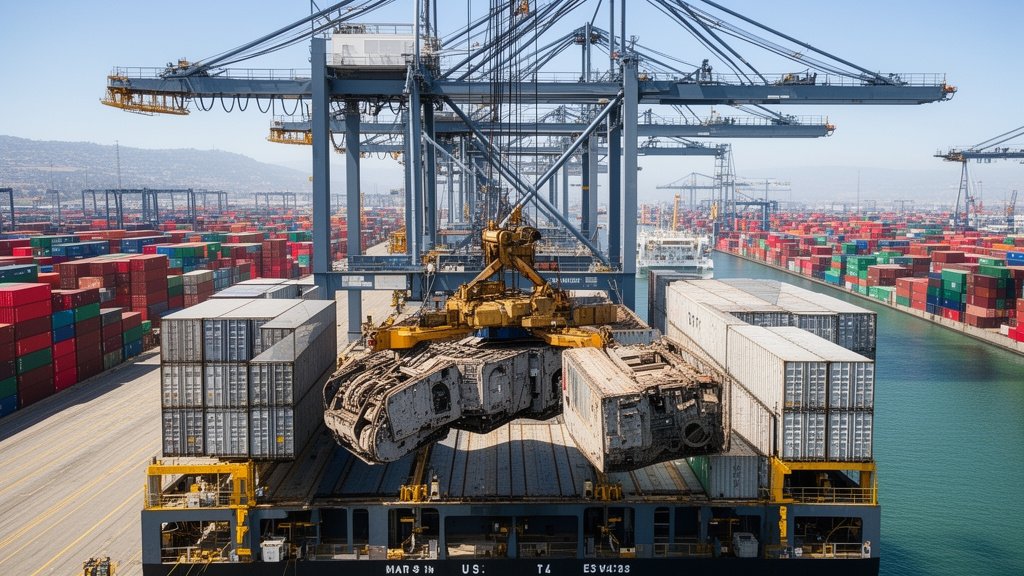
Maersk’s latest market update for September 2026 paints a vivid picture of a logistics landscape under historic pressure. The report highlights strong, sustained demand for shipping into the U.S. West Coast, fueled by a dual-engine surge: a robust retail peak season and an unprecedented, specialized demand for AI data center and power generation equipment. While port capacity remains tight, the operational reliability for major logistics cooperations like Gemini remains high, indicating a strained but functioning regional supply chain that is successfully adapting to a new, high-tech reality.
The Infrastructure Shift: AI and the New Cargo
The defining characteristic of the third quarter of 2026 is the rapid influx of capital equipment related to artificial intelligence. Unlike traditional retail goods, which typically follow predictable seasonal cycles, AI infrastructure components—ranging from massive modular cooling units to specialized power transformers and server arrays—demand specific handling and expedited transit. These are not just consumer commodities; they are the backbone of the next generation of industrial expansion. Maersk’s logistics data indicates that these shipments are being prioritized with a sense of urgency that has traditionally been reserved for high-value pharmaceuticals or perishable food items.
This shift is fundamentally altering the throughput requirements for West Coast ports. These facilities were designed to handle high volumes of containerized consumer electronics, apparel, and furniture. Adapting to handle “heavy-lift” industrial machinery required for massive data center builds has pushed the existing infrastructure to its operational limits. The challenge is not just volume, but the specific technical requirements for offloading, drayage, and inland transport of equipment that often exceeds standard container specifications. The market is witnessing a friction point where traditional supply chain capabilities are being force-matched to a high-velocity technological rollout.
The Gemini Advantage in Congested Waters
Amidst this operational intensity, the Gemini Cooperation—the strategic collaboration between Maersk and Hapag-Lloyd—has become a critical stabilizing force. The September 2026 data confirms that despite the congestion plaguing the Pacific gateways, Gemini’s schedule reliability remains significantly higher than industry averages. This reliability has provided a vital buffer for shippers who are managing the precarious balance between stock-outs and excess inventory.
The Gemini network’s ability to maintain these high standards of reliability is largely attributed to its optimized port-call structure and its integration of advanced predictive analytics. By streamlining port-to-port transit times and reducing dwell times at heavily trafficked hubs like the Port of Los Angeles and the Port of Long Beach, the cooperation has managed to prevent the systemic “logjam” scenarios that crippled the supply chain in previous years. For businesses that are heavily reliant on the steady arrival of both retail goods for the holidays and mission-critical AI hardware, this consistency has become the most valuable currency in global trade.
Navigating the Retail Peak Season
While the AI infrastructure demand is the modern anomaly, the traditional retail peak season continues to exert significant pressure on the North American logistics network. September marks the crucial window where retailers consolidate their inventory strategies for the fourth quarter. The confluence of this peak season with the specialized equipment demand has resulted in a “double peak” scenario. The data suggests that warehouse capacity in the Inland Empire and other major distribution hubs is at near-maximum utilization.
Maersk’s analysis suggests that shippers who had previously relied on just-in-time inventory models have largely transitioned to a “just-in-case” strategy. This shift in inventory philosophy, while adding to the current strain on storage capacity, has arguably prevented a broader supply chain breakdown. By prioritizing early inventory positioning, retailers have effectively smoothed out the anticipated bottleneck, though the cost of capital and storage remains a significant factor in the bottom-line profitability for major importers.
Future Outlook: Building Resilience
Looking toward the remainder of 2026 and into 2027, the primary takeaway from the Maersk update is that the current strain on the West Coast supply chain is not merely a temporary disruption; it is the new baseline. The demand for industrial capacity to support the AI revolution is projected to remain elevated for the foreseeable future. Consequently, the reliance on high-reliability partnerships, such as those provided by the Gemini Cooperation, will likely intensify.
The industry must now reconcile the need for high-volume retail throughput with the need for high-precision industrial logistics. This is driving a wave of investment in port automation, specialized intermodal transport, and integrated digital logistics platforms. The “strained but functioning” status reported for September 2026 is, in effect, a success story of industrial adaptation. It demonstrates that the logistics network, while pushed to its limits, possesses the resilience to pivot alongside the rapid evolution of the global economy.
FAQ: People Also Ask
Q: What is causing the ‘double peak’ in West Coast shipping volumes?
A: The double peak is caused by the convergence of the traditional holiday retail season, where consumer goods are imported in high volumes, and the simultaneous, massive surge in demand for AI data center hardware and power generation equipment.
Q: How does the Gemini Cooperation help with current port congestion?
A: The Gemini Cooperation (Maersk and Hapag-Lloyd) maintains high schedule reliability through optimized port-call structures and advanced predictive analytics, allowing them to bypass or manage around the worst bottlenecks that affect less-coordinated fleets.
Q: Is the supply chain broken?
A: No. While Maersk describes the supply chain as “strained,” it remains functional. The industry has shifted toward “just-in-case” inventory strategies to manage the high volume, ensuring that goods and equipment continue to flow despite limited port capacity.
Q: How is AI equipment different from normal shipping cargo?
A: AI equipment often involves “heavy-lift” machinery, such as specialized cooling units and power transformers, which require different handling, loading, and inland transport logistics compared to standard containerized consumer goods.