The Lucas Incident, a rapidly expanding wildfire burning near Bachelor Valley in Lake County, California, has reached 4,008 acres with 15% containment. A Red Flag Warning remains in effect across the region as dangerous weather conditions continue to challenge fire suppression efforts, threatening local infrastructure and forcing evacuations in high-risk zones.
Key Highlights
- Rapid Expansion: The Lucas Incident has officially scorched 4,008 acres of brush and timberland.
- Containment Challenge: Crews have reached 15% containment, but rugged terrain and shifting winds are complicating line construction.
- Critical Weather: A National Weather Service (NWS) Red Flag Warning persists, citing low relative humidity and gusty winds that increase the potential for rapid fire growth.
- Resource Allocation: Local and state agencies have mobilized heavy equipment and aerial support, though air operations face visibility constraints due to smoke density.
The Lucas Incident: A Critical Response Analysis
The Lucas Incident represents a significant test for emergency services in Northern California, occurring during a period of heightened meteorological volatility. As the fire consumes 4,008 acres, the primary objective for the Lake County Sheriff’s Office and CAL FIRE remains the protection of life and the establishment of defensible space around threatened communities near Bachelor Valley. The combination of parched fuel beds—a legacy of prolonged dry spells—and the current Red Flag Warning has turned a manageable blaze into a high-priority emergency scenario.
Meteorological Factors Driving Growth
The persistence of the Red Flag Warning is the central complicating factor for incident commanders. Red Flag Warnings are issued by the National Weather Service (NWS) when weather events may result in extreme fire behavior. In the case of the Lucas Incident, the intersection of single-digit humidity levels and persistent wind gusts prevents the “overnight recovery” of fuel moisture. Normally, fires in this region slow down during cooler, more humid nocturnal hours. However, the current atmospheric profile is effectively keeping the fuels dry 24 hours a day. This lack of recovery window makes the current 15% containment figure a fragile statistic that requires constant monitoring.
The Fight on the Ground
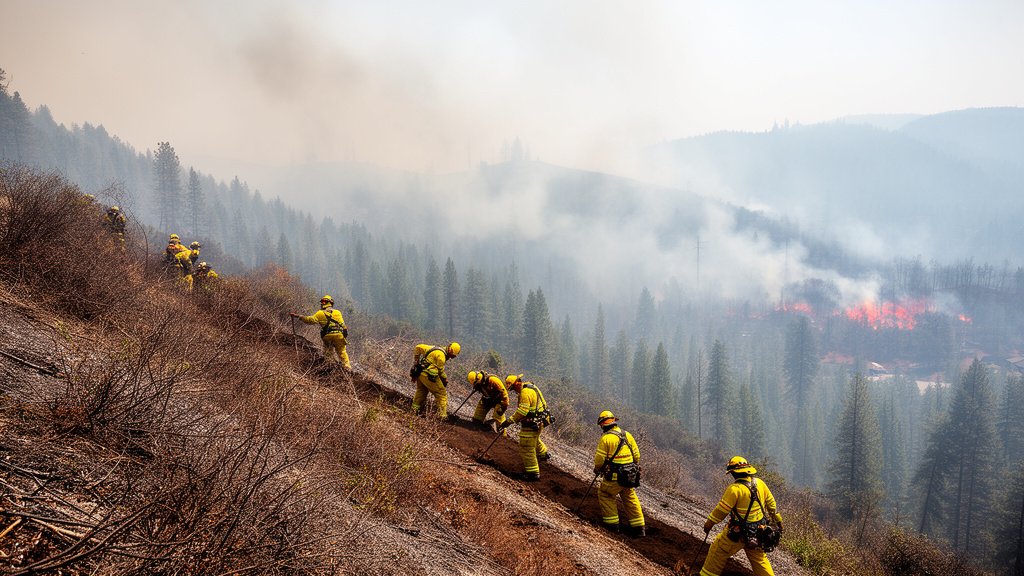
Tactical operations are being dictated by the challenging geography of the Bachelor Valley region. Much of the fire’s perimeter exists in steep, inaccessible terrain where traditional engine access is limited. Instead, incident commanders are relying on a ‘hand-crew-heavy’ approach, utilizing specialized hotshot crews to manually construct fire lines and clear vegetation. This labor-intensive strategy is inherently slower than heavy machinery, explaining the current 15% containment rate. Aerial support, including air tankers and helicopters, has been deployed to drop fire retardant on the flanks of the fire, but high-altitude turbulence caused by heat plumes often limits the window of opportunity for these assets.
Historical Context and Regional Vulnerability
Lake County has historically been one of California’s most fire-prone regions, defined by its complex topography and wildland-urban interface (WUI). The Lucas Incident is not an isolated event but rather part of a broader, systemic challenge facing the county. Long-term drought conditions have left local vegetation, particularly manzanita and chamise, highly susceptible to ignition. Furthermore, the region’s history of massive wildfires has created a legacy of dead timber, which serves as a potent fuel source. As the climate shifts, incidents like this demonstrate that the traditional wildfire season is expanding, forcing local authorities to re-evaluate their preparedness models.
Secondary Angles: Examining the Broader Impact
1. Public Health and Air Quality: The smoke plume from the 4,008-acre blaze has significantly degraded air quality in Lake County. Local health departments have issued warnings for vulnerable populations, including the elderly and those with respiratory issues, to remain indoors and utilize HEPA filtration systems to mitigate the impact of particulate matter (PM2.5).
2. Economic Strain on Agriculture: The Lucas Incident directly impacts the local agricultural sector, particularly viticulture. Even fires that do not reach vineyards directly can cause ‘smoke taint’ on unharvested grapes, potentially leading to substantial financial losses for local growers. The disruption of access roads also complicates supply chains for smaller, family-owned farms in the Bachelor Valley.
3. Insurance Market Volatility: The recurrence of major incidents in this specific area of California exacerbates the growing crisis in the property insurance market. As insurers pull back from high-risk zones, property values and homeowners’ ability to secure coverage are being severely tested. The Lucas Incident will likely serve as another data point for insurance actuaries evaluating the insurability of properties within this zip code.
FAQ: People Also Ask
1. What does a Red Flag Warning mean for the Lucas Incident?
A Red Flag Warning indicates that critical fire weather conditions are occurring or imminent. It means that any new or existing fires have a high potential for rapid growth and extreme behavior due to strong winds, low humidity, and high temperatures. For the Lucas Incident, this complicates the ability of firefighters to hold their current lines.
2. Is the 15% containment a good sign?
Containment refers to the percentage of the fire perimeter that is fully surrounded by a control line. While 15% is a start, it is relatively low. It indicates that the fire is still active and potentially growing in the remaining 85% of its perimeter. It is a baseline figure that firefighters hope to increase as conditions allow.
3. Are there mandatory evacuations due to the Lucas Incident?
The situation is fluid. Residents near Bachelor Valley should monitor official Lake County Sheriff’s Office alerts and emergency portals. Evacuation orders are determined by proximity to the active fire front and the predicted rate of spread based on current wind patterns. Always follow local guidance rather than rumors.
4. How is the Lucas Incident being fought?
Fire suppression is a multi-pronged effort involving ground crews, bulldozers to create fire breaks, and aerial firefighting aircraft dropping retardant. Due to the rugged terrain in Lake County, ground crews are currently the primary force, with air assets providing support where safety and weather conditions allow.