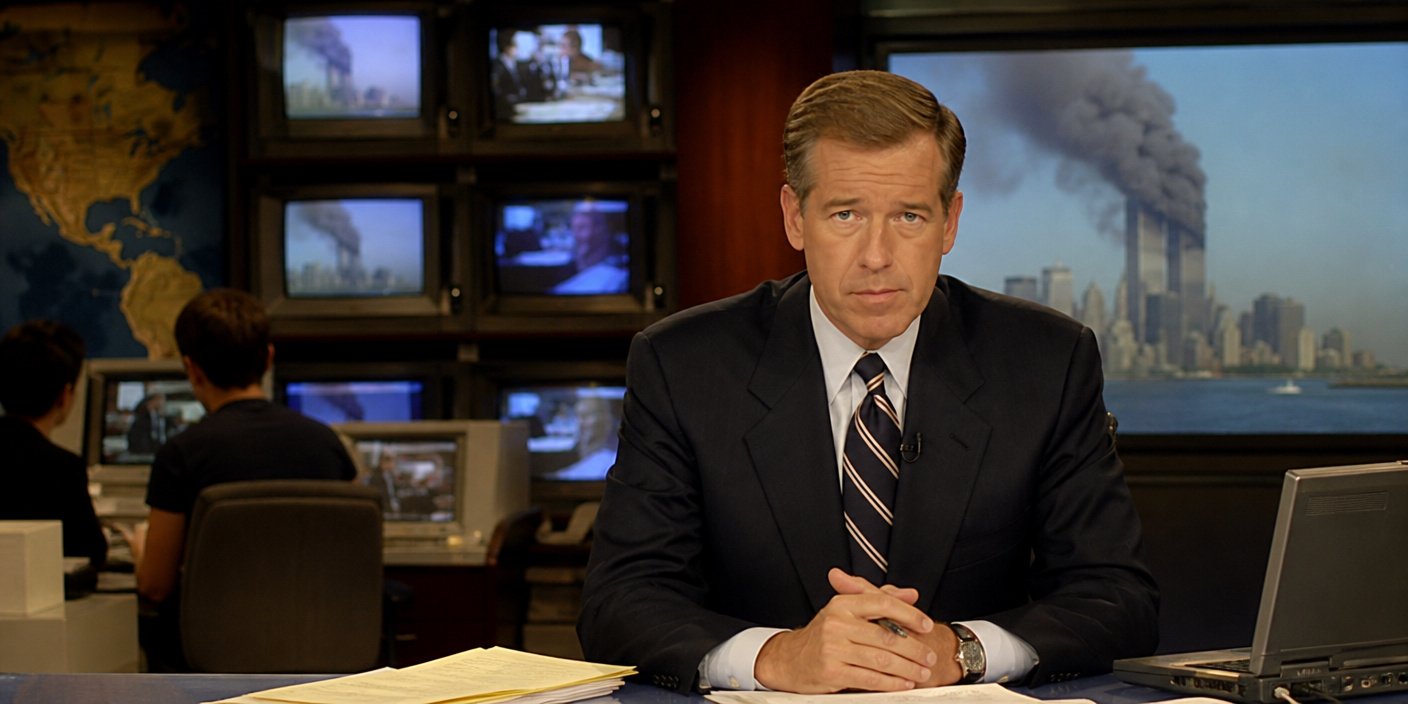
At 5:46 a.m. PT on September 11, 2001, the West Coast was waking up to a standard Tuesday morning. By 6:00 a.m., the rhythm of local television in Los Angeles—usually dominated by traffic reports, weather, and soft news—was shattered. For L.A. news anchors, the unfolding tragedy in New York and Washington D.C. created an impossible paradox: the requirement to remain a stoic, informative beacon for a terrified audience while personally reeling from the realization that the world had irreversibly changed. As the 25th anniversary of the attacks brings these memories into sharper focus, we examine the monumental challenge of balancing journalistic duty with human shock during one of history’s most volatile mornings.
Key Highlights
- The Time Zone Gap: L.A. anchors were uniquely positioned, as the attacks began at 5:46 a.m. PT, meaning many were already live in the studio, having to switch from routine local broadcasts to a national, world-altering crisis in seconds.
- The Information Vacuum: Unlike today’s social media-driven news cycle, 2001 relied on limited satellite feeds and landline phone verification, requiring anchors to act as the primary filter for misinformation.
- The Anchor’s Stoicism: Broadcasters faced the psychological struggle of maintaining a calm, authoritative “anchor voice” while their own families and colleagues were potentially in harm’s way.
- Legacy of the Coverage: The day fundamentally shifted the ethos of local news, moving stations toward more “hard news” and rapid-response breaking coverage that remains the industry standard today.
The Morning the West Coast Stood Still: Reporting from the Edge of History
The “California Buffer” has long been a term used in newsrooms to describe the three-hour time difference that usually allows West Coast broadcasters to curate and verify East Coast stories before airtime. On September 11, that buffer vanished. As the American Airlines Flight 11 hit the North Tower, Los Angeles stations like KTLA (Channel 5) and KCAL 9 were in the middle of their morning blocks. For veteran anchors, the morning became a blur of frantic producer notes, flickering satellite feeds, and the growing, sinking realization that this was not a localized accident.
Navigating the Void of Information
In 2001, the digital landscape was primitive. There was no Twitter, no real-time viral video, and no instant verification from social media. Anchors were flying blind, forced to rely on incoming wire reports from the Associated Press and raw footage from New York affiliates. The primary challenge was verifying the impossible. Was it one plane? Was it a terrorist attack? Was there more?
For the anchors sitting at the desk, the pressure was exacerbated by the lack of context. They had to speak to an audience that was turning to them for answers, yet they had to be careful not to amplify rumors. This required a level of professional discipline that effectively functioned as a dam against mass panic in the Los Angeles area. Every word spoken on air had to be measured, accurate, and calm, even as the newsroom floor behind them devolved into controlled chaos.
The Anchor’s Dilemma: Composure vs. Crisis
Perhaps the most difficult element for L.A. news teams was the internal tension between their identities as parents/partners and as journalists. Many anchors had family members traveling, working, or living in the affected cities. The duty to report—the “professional mask”—had to be donned instantly. This “anchor voice” is a learned trait, a form of controlled psychological distancing.
Archives of the day show the evolution of the news delivery: early segments were hesitant and inquisitive, but as the scale of the destruction became clear—particularly after the Pentagon was struck and the South Tower collapsed—the tone shifted to a solemn, grave delivery. These anchors were the first point of contact for millions of Angelenos. They were the ones who had to confirm the FAA ground stop, the closure of airports like LAX, and the looming security threats that kept the city on edge for weeks. The psychological toll of “vicarious trauma”—witnessing horror from a distance while having to remain the voice of reason—remained an under-discussed aspect of the job for years after.
The Shift in Local News Ethos
Before 9/11, local news in Los Angeles was a blend of community-focused segments and regional politics. Post-9/11, the mandate changed. The “hard news” capability of every station was tested and expanded. This event catalyzed a shift toward continuous, rolling news coverage. The infrastructure created to handle the deluge of information on that Tuesday eventually evolved into the 24/7 breaking news models we see today. The reliance on satellite truck coordination and the rapid-fire verification processes that define modern L.A. newsrooms were born in the crucible of that morning.
Secondary Angles: A Historical Assessment
1. Technological Resilience: The event highlighted the fragility of the broadcast infrastructure of 2001. With phone lines jammed, newsrooms had to establish “hotline” emergency channels to communicate with D.C. and New York, a stark contrast to modern IP-based communication.
2. The 9/11 Commission Impact: The coverage provided by local stations became part of the historical record, often cited by the 9/11 Commission in tracking the timeline of the day. The raw, unedited tapes from stations like KTLA are now considered essential primary source material.
3. Psychological Impact on Talent: Research into “vicarious trauma” in media indicates that journalists who reported during the 9/11 attacks faced higher rates of burnout in the following 24 months, leading to a significant evolution in how newsrooms manage mental health and crisis support for their on-air talent.
FAQ: People Also Ask
Q: How did the three-hour time difference affect L.A. news coverage?
A: It meant that while New York was deep into the chaos by 9:00 a.m. ET, L.A. stations were effectively forced to skip their usual morning local content entirely to catch up to the national feed, resulting in a “total pivot” rather than a gradual transition to national news.
Q: Which L.A. stations were most prominent during the coverage?
A: Stations like KTLA (Channel 5), KCAL 9, and KNBC were instrumental. Legendary broadcasters, including the late Hal Fishman at KTLA, were widely cited for their ability to maintain composure while delivering complex, shifting information to the public.
Q: How did newsrooms verify information without the internet?
A: Newsrooms relied on landlines, dedicated news wires (Associated Press and Reuters), and “pool feeds” from major networks. Verification was often based on the credibility of the source (e.g., official statements from the FAA or law enforcement) rather than the rapid, unverified speed of social media.
Q: Did the events of 9/11 change how news anchors dress or speak?
A: In the immediate aftermath, “anchor attire” became more formal and muted across all stations. The tone of delivery became significantly more sober, dropping the upbeat, conversational “happy talk” that had been prevalent in local news during the 1990s.