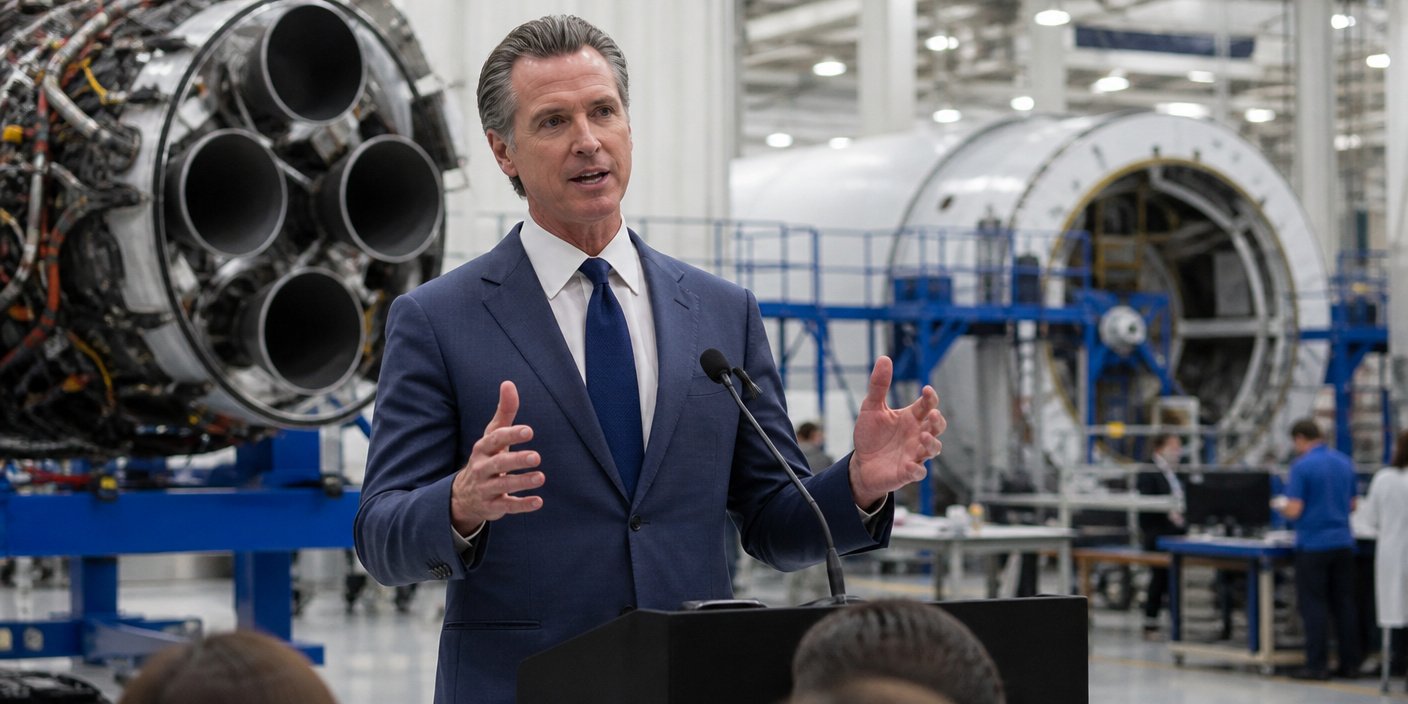
Governor Gavin Newsom recently visited Long Beach—a coastal city now famously dubbed “Space Beach”—to announce a strategic $19 million investment package aimed at fortifying California’s infrastructure and expanding its workforce development pipelines. This move underscores the state’s absolute commitment to maintaining its position as the premier global hub for aerospace, satellite technology, and advanced defense manufacturing, building on California’s existing status as the nation’s leader in NASA funding and venture capital investment for the space sector.
Key Highlights
- Strategic Investment: A $19 million state funding allocation focused specifically on enhancing aerospace infrastructure and bolstering technical workforce development in the Long Beach area.
- Market Dominance: California continues to outpace all other states, holding the #1 ranking for both NASA funding and private space sector venture capital.
- ‘Space Beach’ Ecosystem: The Long Beach region has emerged as a central hub for commercial space flight and orbital launch manufacturing, creating a unique cluster of innovation.
- Economic Vision: The initiative is designed to bridge the gap between high-level engineering research and practical, on-the-ground manufacturing to ensure the state remains competitive against emerging space hubs in states like Texas and Florida.
The New Frontier: Why Long Beach is Leading the Space Race
For decades, the aerospace industry was defined by sprawling, secretive government facilities tucked away in the Mojave Desert or Southern California’s inland valleys. However, the last decade has seen a drastic shift toward urbanized, accessible, and commercialized space technology. Long Beach, with its historic port infrastructure and proximity to major technical universities, has organically transformed into a specialized cluster now colloquially known as “Space Beach.” This rebranding is more than just a marketing tactic; it represents a fundamental change in how the state views its economic future.
The $19 Million Investment Breakdown
The $19 million package announced by Governor Newsom is not a “one-size-fits-all” grant. Instead, it is highly targeted toward specific bottlenecks in the current supply chain. A significant portion of the funding is earmarked for local workforce training initiatives. Aerospace engineering, while lucrative, requires specialized skills—precision welding, composite manufacturing, and software-defined satellite systems—that traditional trade schools and universities often struggle to scale rapidly enough to meet industry demand. By partnering with local community colleges and technical training programs in the Long Beach area, this initiative intends to create a “pipeline to launch,” where students move directly from classroom to the factory floor of companies like Relativity Space, Rocket Lab, and others currently operating within the city’s boundaries.
Furthermore, the funding addresses the physical infrastructure needs of these companies. In an era where orbital launch cadence is increasing, the ability to rapidly iterate, test, and manufacture hardware is a competitive advantage. The state’s funding will support the renovation of existing industrial facilities to meet modern “clean room” standards, ensuring that Long Beach remains as hospitable to high-tech manufacturing as it is to the heavy shipping and logistics operations that have defined the city for a century.
California vs. The Competition
It is impossible to discuss this development without addressing the fierce competition for aerospace dominance. In recent years, companies have aggressively relocated manufacturing operations to states offering lower operational costs or, in some cases, less stringent regulatory hurdles. However, California’s ace in the hole has always been its intellectual capital. The state’s universities, such as Caltech, UCLA, and USC, provide an endless supply of PhDs and engineers who are critical to the research-heavy aspects of aerospace.
By securing the #1 ranking in both NASA funding and private space venture capital, California has proven that despite the high cost of living, the value proposition of being in the state—proximity to talent, capital, and a mature supply chain—is unparalleled. The $19 million investment acts as a “lubricant” for this engine, ensuring that while other states might offer cheaper land, California offers the most sophisticated ecosystem for success. The Newsom administration is banking on the fact that for the world’s most cutting-edge space companies, “cheaper” is rarely better than “closest to the best talent.”
The Future of Defense Tech Integration
The overlap between commercial space flight and national defense is widening. Technologies developed for satellite constellations or long-range launch vehicles have dual-use applications that are highly sought after by the Department of Defense. This $19 million investment is inherently linked to national security. By strengthening the commercial base in Long Beach, the state is effectively insulating the national aerospace sector from the risks of relying on fragmented, distant, or less-developed infrastructure.
Looking forward, the success of this “Space Beach” strategy will likely serve as a blueprint for other California hubs. If the state can successfully integrate this new funding into a self-sustaining cycle of innovation and manufacturing, it will not only secure its economic future for the next 20 years but also solidify the United States’ technological advantage in an increasingly contested space domain. The shift is clear: the future of aerospace isn’t just about launching rockets; it is about building the infrastructure that makes those launches routine, reliable, and entirely Californian.
FAQ: People Also Ask
1. Why is Long Beach called ‘Space Beach’?
The term originated because a high concentration of commercial space companies, including Relativity Space and Rocket Lab, established their headquarters and manufacturing facilities in Long Beach due to its unique combination of available industrial space, port access, and proximity to engineering talent. The community and local government have embraced the moniker as a branding identity for the city’s tech-forward economic future.
2. How does this funding impact local employment?
The $19 million investment focuses on workforce development programs. This includes funding for vocational training, apprenticeships, and partnerships between local educational institutions and aerospace firms to prepare workers for high-demand roles like aerospace manufacturing technicians, composite specialists, and software integration experts.
3. Is this investment meant to compete with other states?
Yes, inherently. While the funding supports the growth of local businesses, it is designed to ensure California remains more attractive than states like Texas or Florida for aerospace startups. By lowering the barriers to infrastructure expansion and training, the state aims to mitigate the cost-of-doing-business challenges that have previously encouraged some aerospace firms to relocate.
4. Does this involve military or just commercial space?
It involves both. The aerospace industry is increasingly “dual-use,” meaning technologies developed for commercial satellites or launch vehicles are often relevant to defense and intelligence applications. By strengthening the overall aerospace industrial base, the state is supporting both the commercial launch market and the national defense industrial base.