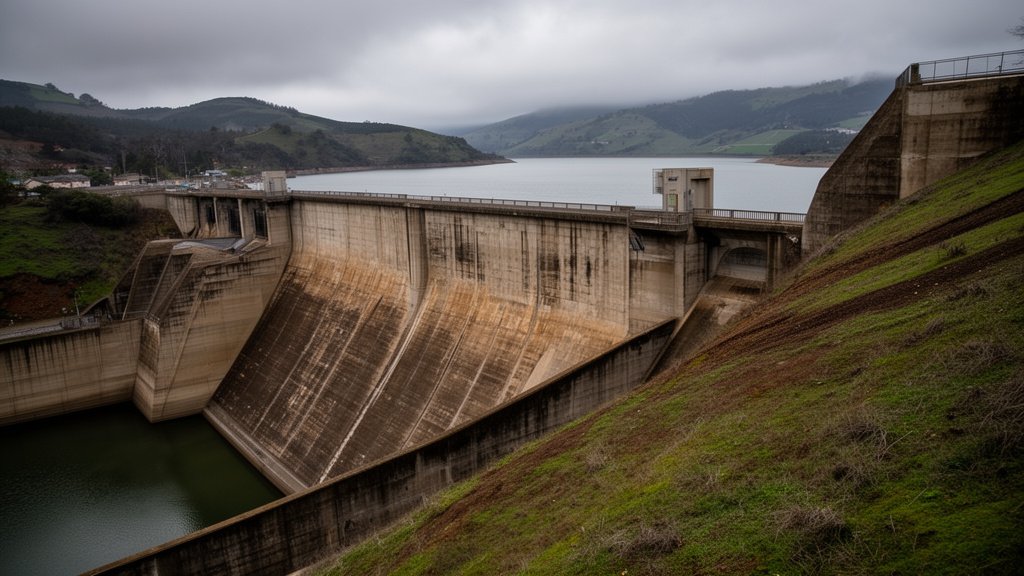
A damning state audit released Monday has sounded an urgent alarm regarding the structural integrity of California’s water infrastructure. The report identifies 57 dams across the state as being in “poor” or “unsatisfactory” condition, a grim statistic that takes on added volatility as meteorologists warn of a projected severe El Niño winter. These findings suggest that a significant portion of California’s aging hydraulic infrastructure—built largely in the mid-20th century—is ill-equipped to handle the intense, rapid-fire precipitation events that define modern climate cycles, placing over 1.5 million residents in potential zones of catastrophic risk.
Key Highlights
- Critical Audit Findings: A state audit reveals 57 dams currently classified as in “poor” or “unsatisfactory” condition, indicating severe structural deficiencies.
- Human Impact: Experts estimate that these high-hazard structures put 1.5 million residents at direct risk of flooding should failures occur.
- El Niño Escalation: The proximity of a severe El Niño winter threatens to strain spillways and embankments that are already failing to meet modern safety standards.
- Economic Consequences: Beyond the threat to life, a systemic failure would result in massive, multi-billion-dollar economic losses, affecting agriculture, power generation, and property.
Structural Instability: Facing the Impending Deluge
The revelation that 57 dams are in a compromised state is not merely an administrative oversight; it is an active public safety hazard. As the California Department of Water Resources (DWR) and the Division of Safety of Dams (DSOD) grapple with this reality, the discourse has shifted from maintenance logs to survival calculations. The fundamental problem lies in the classification systems: “unsatisfactory” does not simply mean a rusty gate or minor seepage. In the context of dam safety, it typically denotes a critical deficiency in the spillway, a loss of freeboard (the distance between the water level and the top of the dam), or active structural degradation that could lead to an uncontrolled release of water during peak storm events.
The Climate Collision: Aging Concrete Meets Extreme Weather
For decades, California’s water infrastructure was managed under a paradigm of predictability—snowpack melted slowly, and rainfall was distributed across a standard wet season. Today, that stability has vanished. The impending El Niño winter is expected to bring heavy, concentrated atmospheric rivers—a phenomenon that test engineers refer to as “inflow design flood” exceedance. When a dam is rated as having a compromised spillway, it means it cannot effectively route a “design flood” without the risk of overtopping or scouring. If the spillway fails, the dam fails, and if the dam fails, the catastrophe is immediate and downstream.
The Ghost of Oroville: A Precedent for Disaster
To understand the gravity of this audit, one must look back at the 2017 Oroville Dam crisis. In that instance, the primary and emergency spillways fractured under the pressure of excessive rainfall, leading to the emergency evacuation of 188,000 people. While the Oroville incident was the most high-profile warning, the new audit suggests that the danger is not isolated to single, famous structures. Instead, the risk is distributed across 57 separate locations, many of which lack the massive budgets or public scrutiny that were afforded to Oroville during its reconstruction. The danger is that these 57 sites are essentially ticking clocks in a weather system that no longer plays by historical rules.
The 1.5 Million Residents at Risk
Perhaps the most sobering statistic in the report is the exposure of 1.5 million residents. This figure accounts for those living in the potential inundation zones downstream of these “high-hazard” dams. The danger here is twofold: direct flooding and the failure of critical infrastructure systems (like power and transport) that occur in the immediate wake of a dam breach. In many of these regions, evacuation routes are limited, and emergency response times could be significantly hindered by the very storm events that trigger the failure. The economic damage of such a failure is difficult to quantify but would certainly reach into the billions. Beyond the initial disaster, the potential loss of agricultural water rights, the destruction of prime real estate, and the long-term impact on local insurance markets would ripple through the state economy for years.
Addressing the Infrastructure Deficit
Why have these repairs not occurred? The obstacles are complex. They involve a tangle of municipal vs. state funding, environmental impact reports, and the sheer technical difficulty of working on legacy structures. Many of these dams are “orphan” structures or owned by small districts with limited tax bases, making it nearly impossible to fund the retrofitting required by modern DSOD standards. The state is currently facing a policy dilemma: does it prioritize immediate, expensive retrofits for the most dangerous dams, or does it shift toward managed decline and potential decommissioning for those that are too far gone to save?
Policy Recommendations and Future Resilience
Moving forward, the audit suggests a pivot toward aggressive, proactive maintenance. The state is being urged to implement a “triage” system, focusing funding on the dams with the highest “consequence of failure” potential. This means prioritizing dams located above population centers. Furthermore, there is an urgent call for better real-time monitoring. Many of these older dams lack the telemetry systems (real-time sensors for seepage, pressure, and movement) that modern engineers consider standard. Integrating IoT-based monitoring into these aging structures could provide the early warning time needed to evacuate vulnerable populations before an incident becomes a tragedy.
FAQ: People Also Ask
Q: What does it mean for a dam to be in “unsatisfactory” condition?
A: In technical terms, an “unsatisfactory” rating from the Division of Safety of Dams means that the structure has documented safety deficiencies that could lead to failure during a significant flood or seismic event. It usually implies that the dam cannot safely pass or store the maximum expected water volume required by safety standards.
Q: Are these dams in danger of failing right now?
A: The report classifies them as high-hazard, meaning a failure would result in loss of life and significant property damage. They are not necessarily failing today, but they lack the necessary “factor of safety” to withstand the severe weather events projected for the upcoming El Niño season.
Q: What should residents living below these dams do?
A: Residents are advised to consult their local county emergency management office to view inundation maps. Knowing your evacuation zone and having a pre-planned emergency kit is vital, particularly in high-risk areas during the winter storm season.
Q: Is there funding available to fix these issues?
A: While state and federal infrastructure bills have allocated funding for water projects, the scale of repairs required for 57 dams often exceeds available budgets. The issue remains a significant legislative hurdle in the current state session.