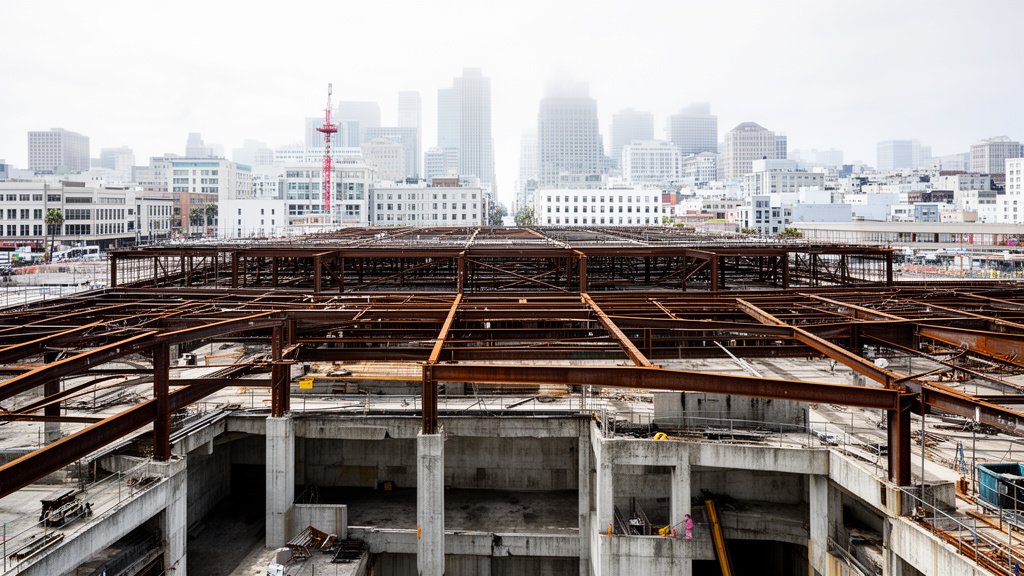
The stalled, multi-billion-dollar hole in the ground at the corner of First and Mission streets—a glaring symbol of San Francisco’s pandemic-era stagnation—has officially been resurrected. The San Francisco Recovery Fund has unveiled comprehensive plans for “Fifty at First,” a soaring 915-foot tower designed to replace the long-abandoned Oceanwide Center. This ambitious project aims to reclaim the South of Market (SoMa) skyline, breathing new life into a project site that has remained dormant since 2020. As the city works to define its post-pandemic identity, the announcement of Fifty at First serves as a concrete indicator of renewed institutional confidence in the downtown commercial and residential market.
Key Highlights
- Project Replacement: Fifty at First officially succeeds the failed Oceanwide Center, utilizing the prime SoMa real estate at First and Mission.
- Vertical Ambition: The structure is planned to reach a height of 915 feet, cementing its place as a major feature in the San Francisco skyline.
- Total Capacity: The development will yield approximately 1.5 million square feet of mixed-use space.
- Timeline: Construction is slated for a completion date of 2031, signaling a long-term commitment to the city’s urban renewal.
Resurrecting the First and Mission District
For nearly four years, the site at First and Mission was the most recognizable ghost of San Francisco’s real estate crisis. When Oceanwide Holdings, a Beijing-based developer, halted construction in 2020 due to mounting financial pressures and the global pandemic, the site became a cavernous, steel-ribbed reminder of the city’s economic stalling. The arrival of the San Francisco Recovery Fund marks a pivot from abandonment to activation. By repurposing the site, the new development team is not merely cleaning up a construction hazard but actively attempting to reset the narrative of the city’s financial district.
Architectural and Urban Impact
At 915 feet, Fifty at First will be one of the tallest structures in the city, positioning it within the upper echelon of San Francisco’s vertical density. This height serves as a strategic marker of urban optimism. The project intends to offer 1.5 million square feet of space, designed to cater to modern demands for flexible, high-efficiency, and tech-forward environments. Architects and city planners are closely watching the project, as it represents a shift toward “future-proofing” urban infrastructure. Rather than relying on the traditional office layouts of the early 2010s, Fifty at First is rumored to incorporate mixed-use fluidity—integrating residential, commercial, and communal spaces to ensure the building remains active even if traditional office occupancy rates fluctuate.
The Economic Calculus of 2031
Setting a completion date of 2031 is a calculated move that accounts for the lengthy regulatory, financial, and construction cycles involved in high-rise development. The current economic environment in San Francisco is characterized by high vacancy rates, yet the San Francisco Recovery Fund is betting on a significant long-term rebound. This timeline suggests an expectation that by the turn of the decade, the demand for premium, amenity-rich urban space will have stabilized and grown. The project is effectively a long-term hedge against current market volatility, positioning the property to capture the anticipated surge in economic activity as the city’s downtown evolves into a more balanced live-work hub.
Challenges of the Re-Start
While the announcement brings relief to local officials, transforming a stalled site into a completed tower is notoriously difficult. The “sunk cost” of the previous structure means the developers must integrate existing foundations or undertake complex remediation to ensure safety and structural integrity. Engineering firms involved in the project face the challenge of updating a foundation built for a different architectural vision, requiring precise coordination to blend the old with the new. This logistical hurdle will be the first major test for the development team in the coming quarters.
FAQ: People Also Ask
Q: What happened to the original Oceanwide Center plans?
A: The Oceanwide Center was abandoned by its original developer, Oceanwide Holdings, in 2020 due to severe financial difficulties and the impact of the pandemic. The site remained idle until the San Francisco Recovery Fund intervened to propose Fifty at First.
Q: Is Fifty at First primarily for office space?
A: While specific breakdowns are still being finalized, the 1.5 million square feet is projected to be mixed-use, likely incorporating a blend of residential units, office space, and retail to adapt to modern market needs.
Q: Why does the project take until 2031 to complete?
A: Developing a 915-foot tower is a massive engineering undertaking. The timeline accounts for complex site remediation of the existing dormant foundation, permitting, supply chain logistics, and the phased approach required for a structure of this scale in an urban core.