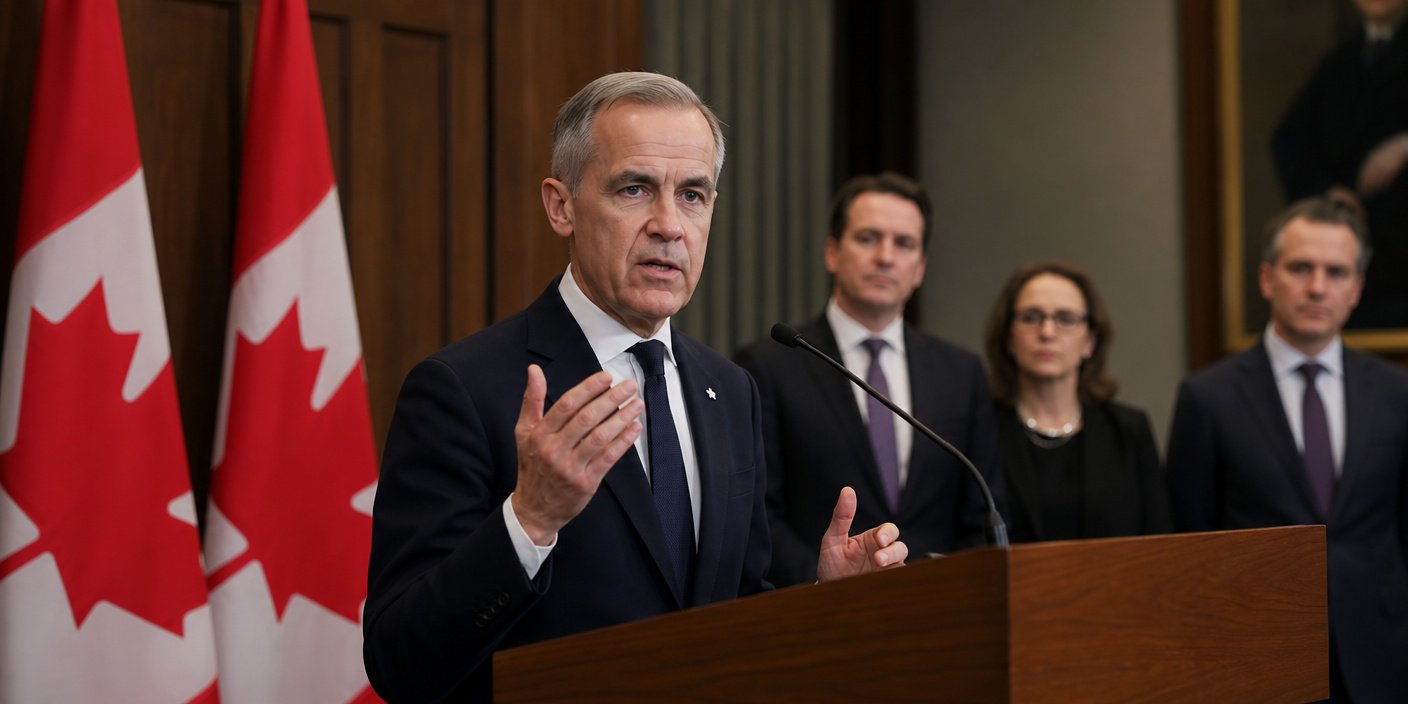
Prime Minister Mark Carney has formally suspended all ongoing trade negotiations with the United States, citing the “unjustified” imposition of new American import levies on Canadian goods. In a decisive press conference held earlier today, the Prime Minister announced that Ottawa would waste no time in implementing a comprehensive, dollar-for-dollar retaliatory tariff regime. This move, which breaks weeks of quiet diplomatic efforts, signals a fundamental shift in Canada’s approach to the current administration’s trade policy, moving from collaborative bargaining to a stance of assertive economic defense.
Key Highlights
- Negotiations Suspended: PM Mark Carney has officially halted all trade talks with the U.S. delegation following an impasse over new tariff implementation.
- Dollar-for-Dollar Retaliation: Canada has authorized a mirror-image tariff policy, ensuring that the financial impact of the American levies is directly returned upon U.S. exports.
- Direct Justification: The government identifies the new U.S. import levies as “unjustified” and in direct violation of the spirit of existing trilateral trade frameworks.
- Strategic Shift: This move marks a pivot toward economic protectionism, aimed at insulating Canadian industries from abrupt policy volatility.
The Breakdown of Diplomacy and the Path to Retaliation
The collapse of trade negotiations represents a watershed moment in the relationship between Ottawa and Washington. After weeks of back-channel discussions, the Prime Minister’s office confirmed that the deadlock was primarily caused by the U.S. refusal to offer concessions on a suite of newly introduced import levies. According to sources within Global Affairs Canada (GAC), the Canadian side presented a framework for de-escalation, which was rejected by the Office of the United States Trade Representative (USTR).
Prime Minister Carney, utilizing his background in central banking and economic policy, framed the decision as a necessary measure to protect the integrity of the Canadian market. “We cannot, and will not, allow our domestic industries to bear the burden of arbitrary fiscal policy decisions made beyond our borders,” Carney stated. The strategy of dollar-for-dollar retaliation is widely viewed as a “tit-for-tat” deterrent, designed not necessarily to ignite a prolonged trade war, but to force the U.S. back to the negotiating table under a more balanced set of conditions. By matching the financial weight of the American tariffs, Canada is signaling that the cost of protectionism for the U.S. will be equal to the pain inflicted upon Canada.
Impact on the Automotive and Manufacturing Sectors
The immediate concern among economists is the ripple effect on the deeply integrated North American automotive supply chain. With vehicle components frequently crossing the border multiple times before final assembly, the imposition of tariffs creates a logistical and financial nightmare for manufacturers. Analysts from the Bank of Canada have expressed concerns that this disruption could lead to inflationary pressure on consumer goods. If the dispute persists, industry leaders anticipate a shift in supply chain mapping, as corporations may begin to hedge against long-term instability by moving production centers or diversifying raw material sources, potentially away from the North American corridor entirely.
The Economic Arithmetic of the Response
Central to the government’s plan is the precise calibration of the retaliatory measures. By targeting imports that are strategically significant to the U.S. economy but for which Canada has alternative domestic or international suppliers, Ottawa is attempting to minimize the blowback on Canadian consumers while maximizing political pressure on U.S. policymakers. This calculation relies on the assumption that specific American sectors—particularly those in agriculture and industrial manufacturing—will lobby the U.S. administration for a de-escalation once the costs of Canadian retaliation hit their bottom lines.
Historical Context: A Departure from Tradition
While Canada has utilized retaliatory trade measures in the past, the intensity and speed of this specific response differ from historical norms. Typically, Canadian trade strategy favors slow-burning legal challenges through established dispute-resolution mechanisms. By choosing to bypass these lengthier processes in favor of immediate, unilateral retaliatory tariffs, the Carney administration is breaking with decades of diplomatic caution. This strategy carries high risks, including the potential for a full-scale trade war, but proponents argue that it is the only effective way to deal with a U.S. administration that prioritizes unilateral action over established international norms.
Future Predictions and Strategic Autonomy
Looking ahead, the long-term ramifications of this suspension are significant. If this breakdown in negotiations becomes the new status quo, Canada will likely be forced to accelerate its “diversification strategy,” seeking to strengthen trade ties with the European Union, the Indo-Pacific region, and Latin America. While the immediate focus is on the current tariff dispute, the subtext of the Prime Minister’s announcement is clear: Canada is seeking greater economic autonomy and a reduced reliance on the U.S. as its primary trade partner. Whether this proves to be a temporary tactical standoff or a permanent divergence remains to be seen.
FAQ: People Also Ask
Q: Why did Prime Minister Carney decide to suspend the trade talks?
A: The suspension occurred because the U.S. administration refused to remove newly announced import levies, which Canada views as both unjustified and economically damaging. The Prime Minister determined that further negotiations without a change in the U.S. position were ineffective.
Q: What does “dollar-for-dollar” retaliation mean?
A: It means that for every dollar of tax revenue or economic value lost due to the new U.S. tariffs, Canada will impose an equivalent value of tariffs on American goods entering Canada. The goal is to ensure the economic “pain” is equal for both sides.
Q: How will this affect Canadian consumers in the short term?
A: There is potential for price increases on specific imported goods. The government is attempting to mitigate this by targeting retaliatory measures carefully, but economists warn that in a globally integrated supply chain, some costs may inevitably be passed down to the retail level.
Q: Is there any hope for a resumption of talks?
A: While the talks are currently suspended, diplomacy is rarely “over” permanently. The Canadian government has left the door open for future discussions, provided that the U.S. demonstrates a willingness to revisit the tariff issue.