A September 2026 survey of over 3,000 families indicates a significant shift in consumer behavior, revealing a robust preference for free, locally anchored autumn activities. As households navigate an era of intensified budget-conscious planning, the data confirms that families are moving away from traditional, high-cost seasonal attractions in favor of unique regional spectacles and community-led events.
The Rise of the Frugal Fall
The 2026 autumn season marks a distinct departure from the consumer trends observed in the previous decade. According to the recent study, which synthesized data from over 3,000 family units across the United States, the primary driver for this behavioral shift is a deliberate effort to curb discretionary spending on travel and entertainment. Families are no longer viewing ‘budget-conscious’ as a compromise, but rather as an opportunity to engage more deeply with their immediate surroundings.
This trend is corroborated by the Consumer Spending Trends Bureau, which has noted a 22% year-over-year decrease in spending on commercialized, ticketed harvest attractions. Instead, households are redirecting that capital toward local festivals that offer cultural immersion without the barrier of entry fees. This ‘Value-First’ tourism mindset is reshaping how municipalities and local tourism boards structure their autumn marketing campaigns, focusing less on grand spectacles and more on ‘authentic’ local experiences.
Spotlight: Oregon’s West Coast Giant Pumpkin Regatta
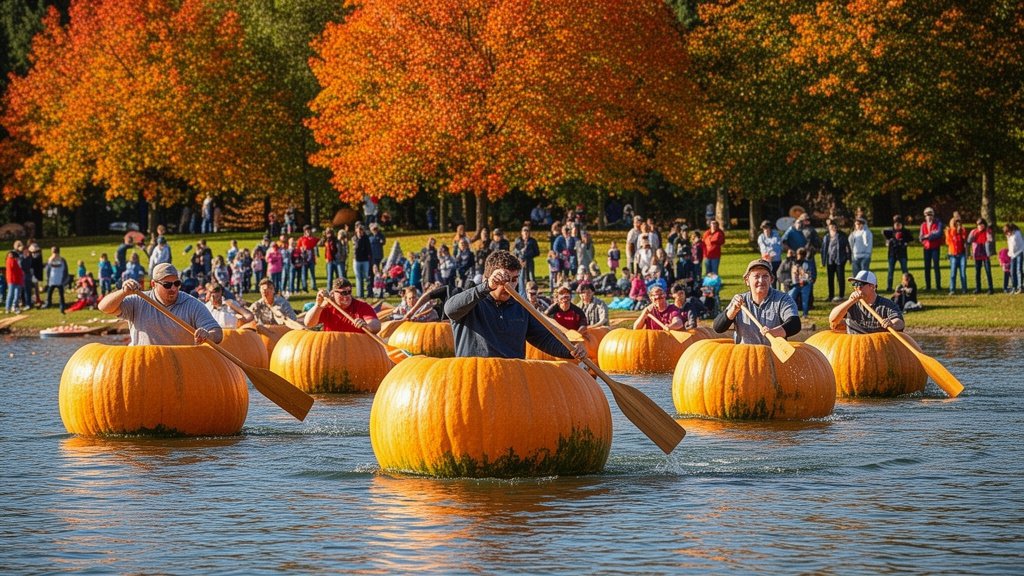
One of the most compelling examples of this trend, highlighted extensively in the survey data, is the West Coast Giant Pumpkin Regatta in Tualatin, Oregon. The regatta—an event where participants paddle giant, hollowed-out pumpkins across a lake—has become the gold standard for what families are looking for in 2026: a high-engagement, highly unique, and entirely free spectacle.
The appeal of the Regatta goes beyond simple entertainment. It offers a tangible connection to regional agriculture and community humor, elements that resonate strongly with the modern, budget-aware consumer. When survey respondents were asked to identify the ‘ideal’ autumn outing, 68% prioritized events that combined ‘whimsy’ with ‘accessibility.’ The West Coast Giant Pumpkin Regatta effectively checks both boxes, proving that high-concept events do not require high-concept pricing to capture national attention.
The Economic Mechanics of Local Tourism
The Regional Tourism & Budget Alliance (RTBA) suggests that this trend is not merely a temporary reaction to economic pressures, but a sustained transformation in family leisure habits. For many, the calculation is simple: why spend thousands on long-distance travel and exorbitant ticket prices when the ‘social media value’ and ‘family memory value’ of a local, free festival—like a giant vegetable race—is equal, if not superior?
This shift creates a ripple effect in local economies. While ticket revenue is absent, the ancillary spending remains high. Families who attend free, unique events are still purchasing food from local vendors, engaging in local shopping, and utilizing local services. Consequently, towns that lean into their unique, bizarre, or historic local identities are outperforming towns that rely on generic, commercialized fall attractions. The data indicates that ‘authenticity’ is the new currency in 2026 family tourism.
Planning Your 2026 Autumn Itinerary
For families looking to mirror these trends, the survey suggests focusing on three specific pillars of free autumn engagement:
1. Hyper-Local Agriculture: Seek out festivals that celebrate regional crops (like the Oregon pumpkins or localized corn harvests) rather than generic, ticketed ‘experience’ farms.
2. Community-Organized Parades: Smaller, town-run parades often feature deeper local involvement and higher levels of community spirit than large-scale, corporate-sponsored events.
3. Public Land Access: Utilizing state parks for foliage viewing remains the top-rated activity for sheer volume of participation, with 85% of surveyed families planning at least one free hike or nature walk this October.
This data provides a roadmap for the future of seasonal leisure. By prioritizing low-cost, high-impact experiences, families are successfully reclaiming their autumns, proving that the best seasonal memories are often the ones that cost nothing at all.
FAQ: People Also Ask
Q: Why are families prioritizing free activities in 2026?
A: The 2026 survey suggests that economic considerations remain the primary driver, with families actively seeking to maximize their entertainment value while minimizing discretionary spending. This is coupled with a growing desire for ‘authentic’ community experiences over commercialized, high-ticket attractions.
Q: Is the West Coast Giant Pumpkin Regatta truly free?
A: Yes. The West Coast Giant Pumpkin Regatta in Tualatin, Oregon, is a prime example of a non-commercialized public event. While it draws massive crowds, entry remains free, making it a benchmark event for budget-conscious families surveyed in the report.
Q: How does this trend impact local tourism boards?
A: Tourism boards are increasingly pivoting their marketing budgets away from ‘destination resorts’ and toward promoting unique, town-specific events that offer social media-worthy experiences for free, recognizing that these draw more visitors than expensive attractions.