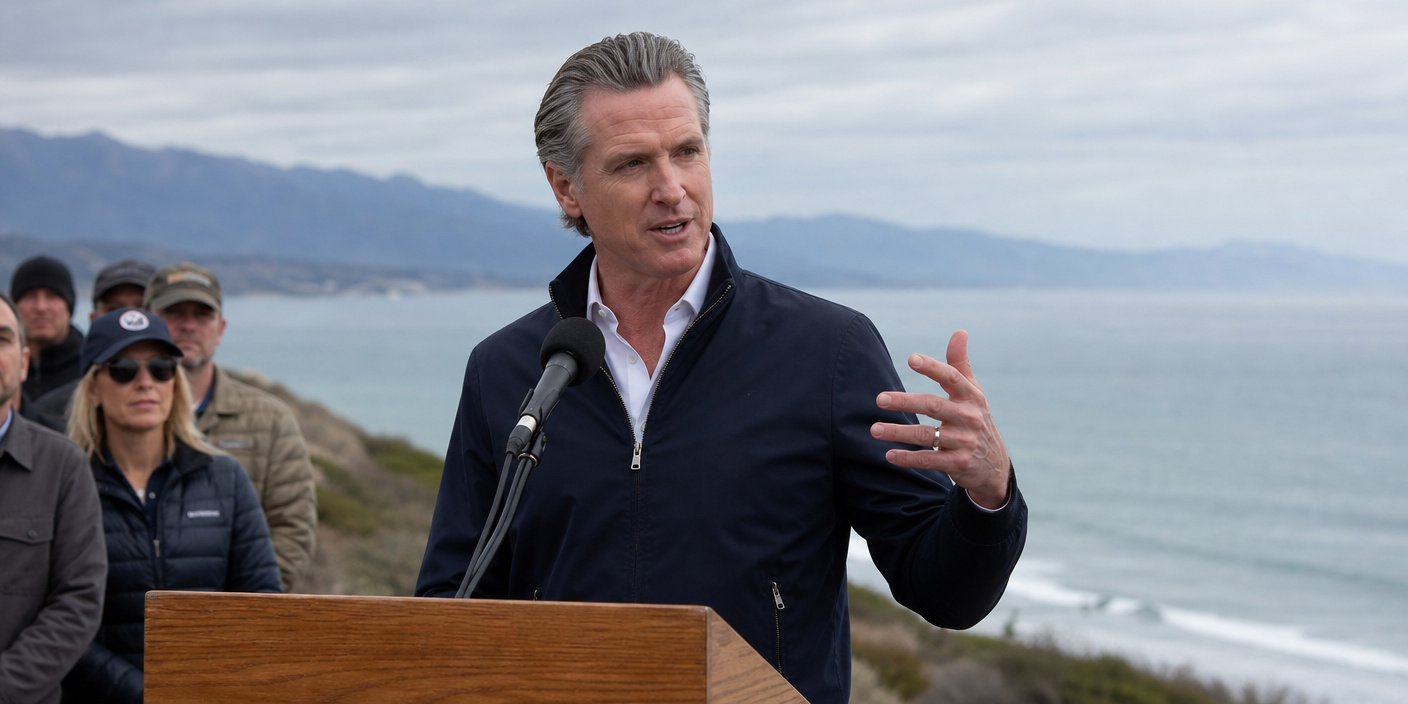
California Governor Gavin Newsom, acting in unison with the governors of Oregon and Washington, has formally declared a unified front against the Trump administration’s aggressive push to restart legacy offshore drilling operations, specifically targeting the Sable Offshore pipeline project. This tri-state coalition represents the most significant regional pushback against federal fossil fuel expansion efforts in over a decade, framing the issue not merely as a local environmental concern, but as a critical defense of the West Coast’s climate commitments and coastal heritage.
The Sable Offshore Controversy
At the heart of the dispute is the Sable Offshore Corp’s bid to restart operations at the Santa Ynez Unit, a complex of platforms and pipelines that has been largely dormant since the devastating Refugio oil spill in 2015. The pipeline, which carries crude oil from offshore platforms to the mainland, serves as the critical infrastructure link for the project. Environmental advocates and the Newsom administration argue that restarting this infrastructure, much of which has aged significantly, poses an unacceptable risk of catastrophic failure. The pipeline stretches across sensitive marine habitats, and a rupture would not only contaminate the coastline but could devastate the delicate marine biodiversity that characterizes the Santa Barbara Channel.
Protecting the Blue Economy
The opposition led by Governor Newsom is grounded heavily in economic reality. The Pacific coast’s economy is inextricably linked to the health of its ocean. The multi-billion dollar tourism, commercial fishing, and recreation industries rely on pristine water quality and untouched coastlines. A singular spill event, according to state impact reports, would cause immediate, measurable damage to property values, local business revenues, and the long-term viability of marine ecosystems that take decades to recover. By standing with Oregon and Washington, California is signaling that the “Blue Economy” is not an abstract concept but a massive regional GDP driver that cannot be sacrificed for the marginal gains of a single fossil fuel infrastructure project.
A Constitutional and Regulatory Standoff
This conflict is fast becoming a legal battleground. While the federal government exerts significant authority over offshore leases under the Outer Continental Shelf Lands Act, the states argue that the permitting for the associated pipeline infrastructure—particularly those sections crossing state waters—remains within their jurisdiction. Newsom’s legal team is preparing to leverage state environmental quality acts and coastal protection regulations to create a regulatory blockade. This strategy attempts to trap federal projects in a loop of administrative delays, environmental impact reviews, and litigation, effectively making the financial cost of restarting the Sable project prohibitive.
Secondary Angles of the Resistance
1. The Historical Echo of 1969: To understand the ferocity of this opposition, one must look at the 1969 Santa Barbara oil spill. That disaster was the catalyst for the modern environmental movement in the United States, leading to the creation of the EPA and the passage of the National Environmental Policy Act. Governor Newsom’s rhetoric intentionally invokes this history, reminding voters that the risks associated with offshore drilling are not hypothetical; they are a historical reality that redefined California’s relationship with the oil industry.
2. The Renewable Energy Paradox: The conflict highlights a broader philosophical divide. The West Coast states have committed to ambitious decarbonization targets, aiming for net-zero economies within the next two decades. Permitting new oil infrastructure, or in this case, restarting old infrastructure, is viewed as a direct sabotage of these long-term climate goals. The states argue that federal fossil fuel mandates are effectively locking them into carbon-intensive pathways that undermine the massive public and private investments they are making in offshore wind and renewable grid infrastructure.
3. Federal vs. State Authority Dynamics: This battle serves as a test case for the limits of federal preemption. If the Trump administration successfully forces the pipeline’s reopening, it could establish a precedent that weakens the state’s ability to manage its own coastline. Conversely, if the tri-state coalition succeeds, it will embolden other states—and potentially international partners—to use similar administrative and legal hurdles to resist federal energy mandates, fundamentally shifting the balance of power in energy infrastructure development.
The Road Ahead
The coalition has made it clear that they are prepared to pursue every available avenue, including litigation, to prevent the Sable pipeline from flowing again. As the Trump administration prioritizes energy dominance through deregulation, the West Coast states have solidified their role as the primary check on federal power. The battle over the Sable pipeline is just the beginning of what promises to be a prolonged, high-stakes confrontation over the future of the Pacific energy landscape.
FAQ: People Also Ask
Q: What is the Sable Offshore pipeline project?
A: It is a project aimed at restarting oil production at the Santa Ynez Unit off the coast of Santa Barbara, which requires the reactivation of legacy pipelines that were shut down following a major 2015 oil spill.
Q: Why are Oregon and Washington involved?
A: While the physical pipeline is in California, the governors of Oregon and Washington have joined the coalition because they view this as a systemic threat to the entire West Coast environmental policy, fearing that success in restarting this project could embolden further offshore drilling projects along the entire Pacific seaboard.
Q: What is the primary argument against the pipeline?
A: The primary argument is that the infrastructure is outdated and prone to failure, and that the potential for a catastrophic oil spill threatens the environmental health, tourism, and fishing industries that support the coastal economy.
Q: Does the federal government have the right to override state objections?
A: This is the core of the upcoming legal battle. While federal law often preempts state law on offshore matters, the states argue that the pipeline’s path through state waters and environmental impact mandates provide them with the legal standing to deny or delay necessary permits.