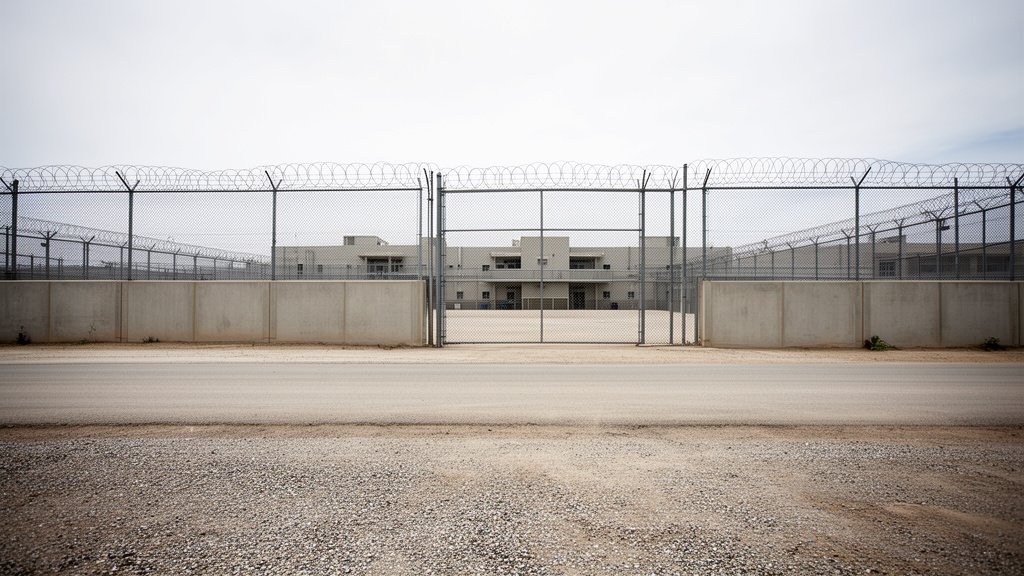
The U.S. government has finalized a monumental acquisition of two major Immigration and Customs Enforcement (ICE) detention centers in California, purchasing the facilities from private prison operator CoreCivic for a total of $1.5 billion. This strategic maneuver marks a definitive shift in federal strategy, effectively bypassing state-level legislative resistance—specifically California’s Assembly Bill 32 (AB 32)—which had previously sought to phase out private, for-profit detention centers within the state. By transitioning from a lease-based model to outright federal ownership, the Department of Homeland Security (DHS) has insulated these critical detention nodes from local political interference, securing long-term detention capacity in a region that has been a focal point of intense immigration policy debate for years.
Key Highlights
- Strategic Purchase: The federal government has acquired two California detention centers from CoreCivic for $1.5 billion, shifting control from private hands to federal ownership.
- Bypassing State Law: The move nullifies the impact of California’s AB 32, which aimed to ban private detention facilities, by reclassifying the centers as federal property.
- Long-term Infrastructure: This purchase guarantees the U.S. government indefinite operational control, insulating detention capacity from future state legislative or political shifts.
- Economic Impact: The $1.5 billion price tag represents a massive capital allocation, signaling the federal government’s commitment to maintaining existing detention levels regardless of state-level policy preferences.
The Sovereignty Battle: Federal Authority vs. State Legislation
The acquisition of these California facilities is not merely a real estate transaction; it is a calculated assertion of federal supremacy. For years, California legislators have engaged in a high-stakes tug-of-war with federal immigration authorities. With the passage of AB 32, the state attempted to leverage its regulatory power to force the closure of private, for-profit detention centers, arguing that the privatization of human incarceration is ethically flawed and inherently resistant to oversight.
However, the federal government has historically argued that its constitutional mandate to enforce federal immigration law overrides state-level attempts to restrict the tools used to carry out that enforcement. By purchasing these facilities outright, the U.S. government has effectively removed the ‘private operator’ variable from the equation. These centers are no longer subject to state-level contracts that could be canceled or regulated out of existence; they are now federal enclaves. This transition fundamentally changes the legal landscape, placing the burden of any future challenges onto the federal government’s own procurement and detention standards, rather than the contractual agreements between a private company and the government.
The Architecture of the Deal
At $1.5 billion, the price reflects not just the physical real estate—the concrete walls, the fencing, the administrative offices—but the strategic value of operational continuity. The facilities in question are vital nodes in the broader ICE network. Losing them would have necessitated the creation of new infrastructure or the transport of detainees to facilities across state lines, a costly and logistically complex undertaking that could have crippled ICE’s detention capacity in the Western region.
From a purely fiscal perspective, the purchase can be viewed as an attempt to stabilize long-term operational costs. Leases are subject to market fluctuations, contract renegotiations, and the looming threat of political termination. Ownership offers the government the ability to amortize the cost of these facilities over decades, providing a predictable—if expensive—asset that is immune to the vagaries of local municipal politics.
Institutionalizing Detention
For the private prison sector, represented by giants like CoreCivic and The GEO Group, this deal signals a precarious future. While the $1.5 billion influx provides immediate capital, it also highlights an industry-wide trend: the federal government is increasingly willing to internalize its infrastructure to maintain control. This creates a divergence in the private prison business model. Companies may find that while the government is still willing to pay for detention services, it is becoming increasingly interested in owning the ‘shell’ that houses those services.
This shift raises significant questions about the future of detention standards. Private facilities are often subject to contract compliance reviews, but when the federal government owns the site, the standards of operation are determined internally by the executive branch. Advocates for immigrant rights have expressed deep concern, arguing that this move allows the government to consolidate its power and insulate itself from the transparency that contract renegotiations previously provided.
The Future of Regional Immigration Policy
Looking ahead, this purchase serves as a bellwether for how the federal government will navigate ‘blue state’ resistance in the future. We can expect to see more federal attempts to codify its own jurisdiction through asset acquisition in states where local and state governments attempt to exert control over federal immigration operations. The $1.5 billion investment is a clear signal that the federal government is prepared to pay a premium to ensure that regional political movements do not dictate the operational realities of national immigration enforcement.
Furthermore, the long-term impact on the local communities surrounding these detention centers remains to be seen. While these facilities provide jobs and secondary economic activity, they remain a source of profound local controversy. The federal government’s permanent establishment in these locations will likely lead to a new phase of litigation and activism, as local governments and advocacy groups look for new legal avenues to contest the presence of detention centers that now effectively sit on federally immune, sovereign land.
FAQ: People Also Ask
Q: Why did the government pay $1.5 billion for these facilities?
A: The $1.5 billion figure covers the acquisition of the real estate and the associated operational assets. The primary driver was the need to secure long-term, uninterrupted capacity for federal immigration detention that cannot be shut down by local or state-level policies like California’s AB 32.
Q: Does this acquisition stop lawsuits against these centers?
A: No. While it changes the ownership structure and makes the facilities federal property, it does not provide immunity from constitutional or federal law challenges. However, it does move the battlefield entirely into the federal court system, effectively ending the relevance of California’s state-level private prison regulations in these specific locations.
Q: What happens to CoreCivic now?
A: CoreCivic offloads the real estate assets, receiving a significant capital infusion. While they may still be contracted to provide management or staffing services in some capacities, the fundamental shift is their transition from a landlord-operator model to potentially a strictly service-provider model in this specific region.
Q: Does this affect all detention centers in California?
A: No, this deal specifically pertains to the identified CoreCivic facilities purchased in this transaction. Other facilities in California may still operate under different contractual frameworks or may be subject to different legal challenges depending on their specific ownership and operation status.