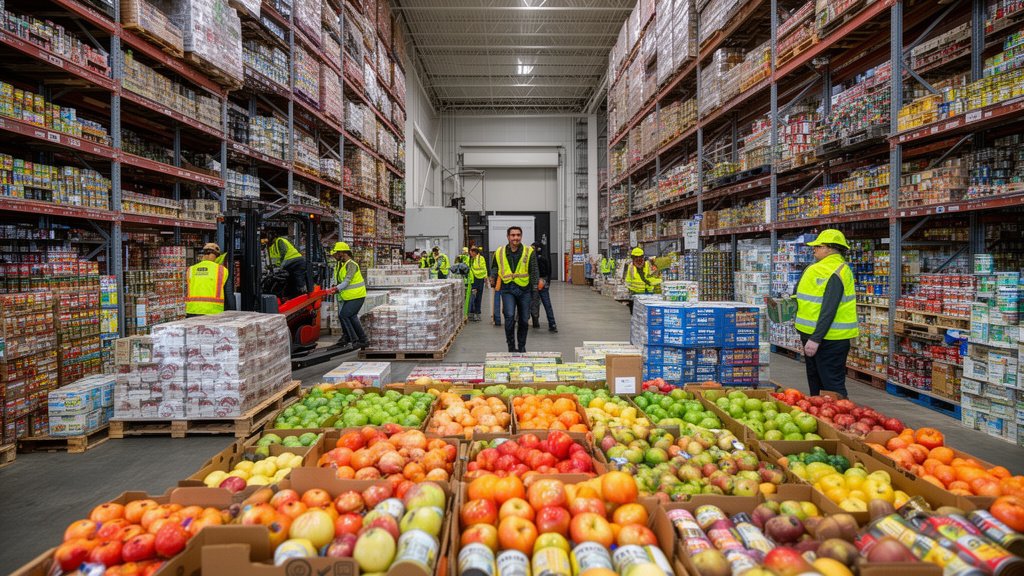
As the holiday season approaches, Southern California households are navigating a turbulent economic landscape defined by persistent grocery price inflation and an unprecedented reliance on charitable food assistance. For many families across the region, the traditional Thanksgiving table has become a point of financial anxiety rather than celebration. Data from the latest consumer price reports and regional logistics indicate that the cost of key holiday staples—ranging from turkey and poultry to potatoes and canned goods—has reached levels that continue to outpace moderate wage growth.
Key Highlights
- Rising Costs: Recent market analysis indicates that Thanksgiving meal essentials in Southern California are pricing significantly higher year-over-year, driven by supply chain volatility and elevated transportation costs.
- Unprecedented Need: The Los Angeles Regional Food Bank and Second Harvest of Orange County report record-breaking demand, with distributions increasing by an estimated 20-30% compared to previous holiday cycles.
- Economic Drivers: Inflation remains a primary factor, though local utility costs and housing affordability in the SoCal region are exacerbating the “household squeeze,” leaving less disposable income for holiday discretionary spending.
- Community Response: Local food banks are appealing for urgent donations and volunteer support to meet the shortfall, as the influx of “newly food insecure” families continues to climb.
The Financial Anatomy of a Southern California Thanksgiving
For the average Southern Californian, the grocery bill is no longer just a transaction; it is a calculation of sacrifice. According to data tracked by the U.S. Department of Agriculture (USDA) regarding the Food Price Outlook, while general inflation has shown signs of stabilization in some sectors, the grocery category remains “sticky.”
The Price of Holiday Staples
In Southern California, specific local market conditions—including higher regional fuel surcharges and labor costs—are pushing the price of Thanksgiving mainstays higher than the national average. Turkey prices, while volatile, remain elevated due to avian influenza impacts on supply chains in previous years, which still influence long-term production costs. Furthermore, the cost of potatoes, flour, and baking ingredients—essential components of a traditional holiday meal—have seen price variances that directly impact lower-to-middle-income families. For a family of four in Los Angeles or Orange County, the cumulative cost of a traditional holiday dinner has increased substantially, forcing many to pivot to smaller portions or cheaper, lower-nutrient alternatives.
The Strain on Charitable Infrastructure
The economic reality is nowhere more visible than at the loading docks of the Los Angeles Regional Food Bank. Directors have noted a paradigm shift in the demographics of those seeking assistance. It is no longer just the historically vulnerable; the current surge includes working families who are employed full-time but simply cannot cover the gap between rent, utility costs, and the rising price of food.
“We are seeing a consistent increase in new faces,” a representative from a regional distribution center noted. “The current demand isn’t a seasonal spike; it’s a structural challenge.” The volume of distributions has hit records, putting a strain on cold storage capacity and volunteer hours. Organizations like Second Harvest of Orange County are currently reallocating resources to ensure that the holiday surge does not lead to a total depletion of inventories before the winter season fully sets in.
Secondary Angles: Exploring the Economic Ripple Effect
To understand the full scope of this crisis, we must look beyond the immediate grocery receipt. Three secondary angles define the current environment:
1. The Housing-Food Trade-off: In high-cost-of-living areas like Southern California, “residual income” is almost non-existent. When rent increases consume 50-60% of a household budget, even a 5% increase in grocery prices forces a binary choice: pay for food or pay for utilities. This economic “trap” is the leading indicator of food bank reliance in the region.
2. Historical Context vs. Pandemic Relief: During the COVID-19 pandemic, massive federal and state subsidies created a temporary buffer for many families. Those programs have since expired, yet the cost-of-living increases they were meant to offset have become permanent fixtures of the economy. The current crisis is essentially a “reversion to the mean” of poverty, without the temporary safety nets that masked the issue in 2020 and 2021.
3. Long-term Predictions: Economists are predicting that the “tightening” experienced by California shoppers will likely persist through the first quarter of next year. Unless there is a significant cooling in logistics costs or a major intervention in agricultural yield pricing, food insecurity in Southern California will likely remain at elevated “record” levels well into the new year, potentially changing the way regional charities operate permanently.
The Path Forward
As we head toward the holidays, the reliance on regional food banks is a lagging indicator of a larger economic struggle. While the macroeconomic data might suggest a recovery, the microeconomic reality for SoCal shoppers remains one of severe constraint. The challenge for the coming months will be whether regional infrastructure can withstand the pressure of this persistent demand, or if the current “record” levels become the new baseline for Southern California’s social services.
FAQ: People Also Ask
Q: Why are grocery prices in Southern California higher than the national average?
A: Southern California faces unique pressures, including higher labor costs for grocery staff, significant “last-mile” logistics and transportation surcharges due to regional traffic and fuel costs, and a high real estate market that drives up operating expenses for distribution centers.
Q: Are food banks turning people away due to demand?
A: While most major food banks like the Los Angeles Regional Food Bank strive to never turn anyone away, they are increasingly forced to implement stricter distribution limits and prioritize families with children or seniors to manage inventory shortages.
Q: How can local residents best support the community during this holiday season?
A: Monetary donations are often more effective than food drives because they allow organizations to purchase food at bulk wholesale prices, maximizing the impact of every dollar. However, donating non-perishable staples or volunteering time for sorting and distribution is also critical.
Q: Is there any relief expected for grocery prices in 2025?
A: Most economists anticipate grocery price inflation to continue at a slower, more moderate pace, but they do not expect a significant decline in absolute price levels. Prices are expected to stabilize at this new, higher “plateau” rather than drop back to pre-2020 levels.