Southern California is effectively decoupling from broader national economic anxieties this holiday season, as travel projections indicate a significant surge in movement across the region. While national data suggests a slight cooling in holiday travel volume, the Automobile Club of Southern California estimates that 6.8 million residents will journey 50 miles or more during the Thanksgiving period. This anticipated volume marks a distinct upward trajectory compared to 2025 metrics, highlighting the unique resilience of the Southern California travel market in the face of broader domestic volatility.
Key Highlights
- Record-Breaking Volume: 6.8 million Southern California residents are projected to travel, defying the slight dip seen in national averages.
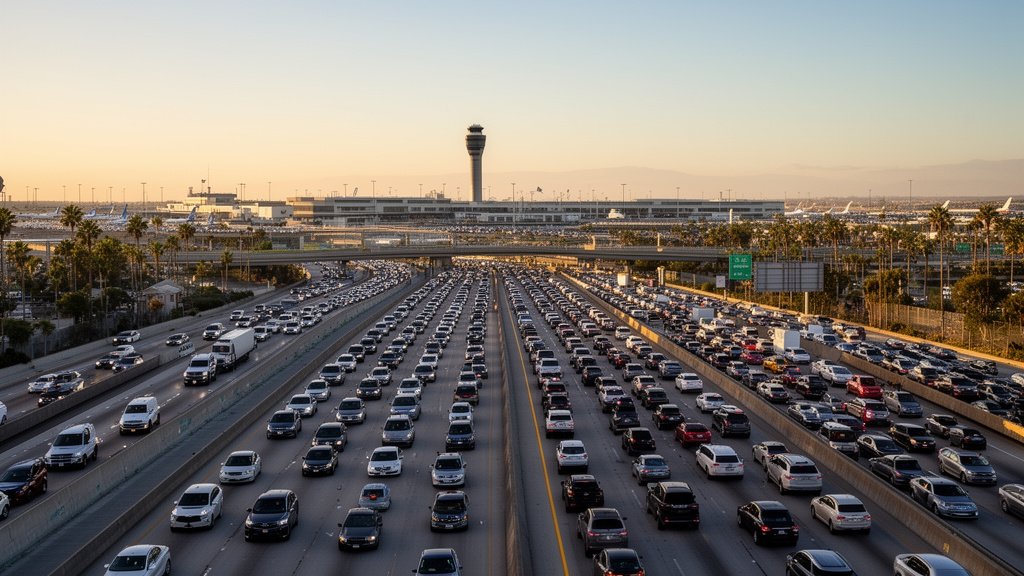
- Infrastructure Strain: Primary transit arteries, particularly the I-5 and major airport hubs like LAX, are expected to reach near-peak saturation levels by the Wednesday preceding the holiday.
- Economic Resilience: The surge suggests that regional consumer confidence in Southern California remains decoupled from the national inflationary caution typically seen in holiday travel forecasting.
- Strategic Timing: Transit authorities are urging travelers to adjust departure times to avoid the compounding effect of local traffic on holiday volume.
The Southern California Divergence: Analyzing the Holiday Surge
For most of the United States, the 2025-2026 holiday travel season is characterized by a cautious retrenchment. Economists and travel analysts have pointed to sustained high costs of living and inflationary pressures as the primary drivers for a nationwide dip in anticipated holiday transit. However, Southern California serves as a notable exception to this trend. With 6.8 million travelers expected to mobilize between the Tuesday before Thanksgiving and the following Sunday, the region is positioning itself for a period of extreme logistical demand.
This discrepancy is not merely a statistical anomaly but a reflection of the specific socio-economic profile of the region. Southern California maintains a high concentration of industries that have shown relative stability, and the region’s status as a major tourism hub creates a two-way flow of traffic—residents leaving to visit family, and visitors arriving to enjoy the milder winter climate. This dual-demand structure keeps regional transit metrics high even when the national sentiment shifts toward frugality.
Infrastructure Capacity and the I-5 Pressure Point
The logistical burden of moving 6.8 million people through the Southern California basin cannot be overstated. The region’s infrastructure, characterized by its reliance on arterial highways like the I-5 and the 405, is notoriously sensitive to volume fluctuations. During Thanksgiving, the combination of local commuters and long-distance travelers creates a compounding effect.
Caltrans and local highway patrols are preparing for what they define as ‘peak friction’ hours. Historically, the Wednesday before Thanksgiving sees the highest convergence of traffic, as the last of the local workforce commuters mix with early holiday travelers. For those planning to navigate the I-5 or the I-10 corridors, data suggests that the window of peak congestion is widening. While in previous years, the afternoon was the primary concern, current models suggest that the morning hours are increasingly becoming saturated as travelers attempt to ‘beat the rush,’ ultimately flattening the peak into a sustained plateau of heavy traffic that lasts from sunrise to late evening.
Airport Logistics: The LAX Factor
Air travel presents a parallel challenge. Los Angeles International Airport (LAX) remains the primary bottleneck for the region. Unlike highway travel, which offers some limited flexibility in route planning, air travel is constrained by slot availability and fixed airline schedules. The 6.8 million projection includes a substantial percentage of flyers who are expected to contend with tight security wait times and potential delays associated with increased tarmac congestion.
Airport authorities have issued warnings regarding terminal access, advising travelers to arrive at least three hours early for domestic flights. The surge is exacerbated by a lack of alternative regional capacity, meaning that even minor delays at LAX often ripple across the entire Southern California transportation network, complicating ground transfers and parking facility management.
The Economic Implications of Regional Resilience
Why does Southern California consistently outperform national travel trends? The answer lies in the intersection of disposable income and local lifestyle factors. Despite the broader national dip, the local economy remains robust enough to support holiday travel as a non-negotiable expense for a large segment of the population. Furthermore, the region benefits from the ‘visiting friend and relative’ (VFR) market. People who have migrated to Southern California for work or lifestyle reasons are more likely to prioritize travel back to their home states or host family locally, creating a floor for travel demand that is less susceptible to mild fluctuations in consumer confidence.
This behavior suggests that while the national economy might be tightening its belt, the Southern Californian demographic is viewing holiday travel as a high-priority expenditure. For local businesses, this is a signal to prepare for sustained consumer engagement, but for city planners and transit agencies, it is a call to manage a logistics environment that is operating at—and often beyond—its intended capacity.
FAQ: People Also Ask
Q: Why is Southern California seeing more travel than the rest of the country?
A: Southern California’s travel surge is driven by a strong regional economy and a high percentage of residents who view holiday travel as an essential, high-priority expenditure, effectively decoupling regional trends from broader national inflationary concerns.
Q: What is the most congested time to drive during the Thanksgiving period?
A: Traffic patterns indicate that the Wednesday before Thanksgiving is the peak day for congestion, with heavy volume expected to start early in the morning and persist throughout the day as commuters and long-distance travelers crowd major freeways like the I-5.
Q: Are there specific transit tips for navigating LAX during this period?
A: Authorities recommend arriving at least three hours before domestic departures. Travelers should also monitor real-time traffic updates for airport access roads, as gridlock surrounding LAX can often cause significant delays for ride-share and personal vehicles.
Q: How does the 6.8 million projection compare to previous years?
A: This figure represents a slight increase over 2025 numbers, demonstrating that even with national travel trends showing a dip, the local appetite for holiday transit in Southern California remains steady and growing.