Despite a projected national dip in Thanksgiving travel, Southern California is bracing for record holiday travel numbers this year. With an estimated 6.8 million residents expected to travel at least 50 miles, the region is seeing a slight but significant increase from 2025 levels, highlighting a local resilience in holiday mobility that stands in stark contrast to broader national trends. This surge comes as families and travelers navigate an evolving landscape of high costs, infrastructure constraints, and shifting logistical patterns across the Golden State.
Key Highlights
- Record-Breaking Volume: An estimated 6.8 million Southern California residents are projected to travel at least 50 miles this Thanksgiving, defying national projections of a cooling travel market.
- Local Resilience: While national trends indicate a dip in holiday travel interest, Southern California’s unique density and car-centric culture continue to drive higher-than-average trip frequency.
- Infrastructure Strain: Major transit corridors, including those managed by Caltrans and the Southern California Association of Governments (SCAG), are bracing for heavy congestion during peak travel windows.
- Economic Factors: Despite inflationary pressures on gas prices and accommodation, consumer appetite for regional holiday tourism remains robust, contributing to significant local economic activity.
The SoCal Paradox: Why Thanksgiving Travel Surges Amid National Cooling
The narrative surrounding the upcoming holiday season across the United States is one of consolidation and measured decline. National data from the American Automobile Association (AAA) suggests that while holiday travel remains significant, many Americans are pulling back due to economic uncertainty and travel fatigue. Yet, Southern California—a region defined by its sprawling geography and car-dependent infrastructure—is writing a different story. The projection that 6.8 million residents will take to the roads, skies, or rails for a trip of at least 50 miles marks a defiance of the national curve. This discrepancy warrants a deeper look into the behavioral and economic drivers that make the Southern California market an outlier.
Defying the National Narrative
Why does Southern California consistently outperform national travel averages during major holidays? The answer lies in the region’s specific demographic density. Unlike regions with limited connectivity, Southern California’s network of interconnected metropolitan areas—stretching from San Diego to Los Angeles and into the Inland Empire—creates a unique ‘commuter-traveler’ hybrid environment. Residents are accustomed to long-distance driving as part of daily life, making a 50-mile trip for a holiday gathering a routine expectation rather than a logistical hurdle.
Furthermore, the Holiday Travel Index indicates that Southern California families are prioritizing multi-generational gatherings, which often require regional travel rather than long-haul flights. This domestic focus maintains trip volume even when the cost of long-distance air travel or hotels reaches seasonal peaks. While the rest of the nation might see a ‘dip’ in vacation spending, the Southern California market sees a pivot toward local, accessible, and essential family-oriented travel.
Infrastructure Under Pressure: The Caltrans Challenge
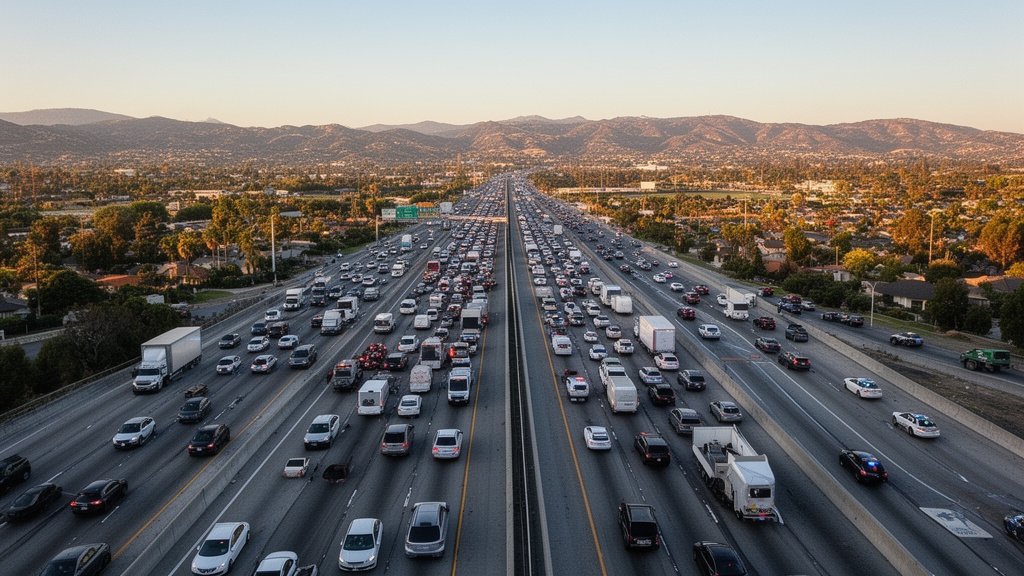
With 6.8 million people on the move, the burden on infrastructure is immense. Agencies like Caltrans are preparing for what they describe as ‘the great synchronization,’ where millions of individual travel plans collide with a finite system of highways and arterial roads. The challenge is not just the sheer volume of vehicles, but the timing. Holiday travel, unlike daily commuting, is highly compressed. Traffic patterns typically show sharp spikes on the Wednesday before Thanksgiving and the Sunday after, creating extreme pressure points on corridors like the I-5, the 405, and the I-15 leading toward the desert and mountain regions.
For the Southern California Association of Governments (SCAG), the data underscores a critical need for smarter transit management. Modern predictive modeling now allows agencies to better anticipate these surges, but there is no substitute for road capacity. As residents prepare to travel, officials are urging drivers to utilize ‘off-peak’ windows, though the sheer scale of the 6.8 million travelers often nullifies traditional ‘low-traffic’ hours. The infrastructure is being pushed to its limit, serving as a reminder that the region’s growth in population continues to outpace investments in transit capacity.
The Economic Ripple: Gas, Spending, and Holiday Commerce
There is a direct correlation between the record travel volume and the local economy. While high gas prices are often cited as a deterrent, they rarely act as a ‘stop’ for holiday travelers in Southern California; instead, they function as a tax on the holiday. The 6.8 million residents planning their trips are likely to absorb the costs of fuel, which impacts their discretionary spending in other areas.
However, this outflow of cash is recirculated back into the local economy. Gas stations, service plazas, regional hospitality providers, and grocery retailers see a massive uptick in business during the week of Thanksgiving. The movement of 6.8 million people generates millions of dollars in taxable revenue, acting as a massive, short-term stimulus for the regional economy. This trend confirms that the desire for holiday connectivity outweighs the granular concerns of fluctuating energy costs, cementing Thanksgiving as a cornerstone of the regional retail calendar.
Strategic Travel: Navigating the SoCal Gridlock
For the average resident, the prospect of navigating this record-breaking volume is daunting. Experts recommend a three-pronged approach to mitigating the stress of holiday transit. First, leverage real-time traffic intelligence. Applications integrated with Caltrans data can provide up-to-the-minute adjustments, but relying on them requires flexibility in departure times. Second, consider non-peak travel days. The ‘pre-game’ of the holiday—leaving two days early—has become the new norm for savvy travelers looking to bypass the Wednesday afternoon crunch. Finally, ensure vehicle maintenance is performed well in advance. Roadside assistance services often see their highest call volumes of the year during this period, and a single breakdown can cascade into a massive traffic jam, affecting thousands of other travelers.
As we look ahead, the 6.8 million figure is more than a statistic; it is a testament to the enduring priority of family and connection in Southern California culture. Despite the potential for fatigue and the reality of traffic, the region remains committed to the road, setting a trend that challenges the national narrative and underscores the unique spirit of the West Coast holiday season.
FAQ: People Also Ask
Q: Why is Southern California travel projected to be higher than the national average?
A: Southern California’s unique geography and car-centric infrastructure encourage more regional, family-oriented travel. Unlike regions where holiday travel may require expensive airfare, SoCal residents frequently engage in driving-based travel that is considered a necessity for family gatherings, which maintains volume even when national travel dips.
Q: What are the peak travel times to avoid in Southern California?
A: Based on historical data from Caltrans and AAA, the Wednesday before Thanksgiving and the Sunday following the holiday are the busiest times. Specifically, expect intense congestion on major corridors like the I-5 and 405 from 2:00 PM to 8:00 PM on those days.
Q: How does the 6.8 million traveler figure compare to previous years?
A: The 6.8 million figure represents a slight increase compared to 2025. It indicates a steady, year-over-year climb in the number of residents making trips of 50 miles or more, showing that holiday travel demand in the region remains robust despite external economic pressures.
Q: Should I use public transit instead of driving?
A: While public transit options like Metrolink or Amtrak Pacific Surfliner can be effective for specific routes, they also experience significant demand during the holidays. If choosing public transit, booking tickets well in advance is essential as they often reach capacity due to the surge in travelers.