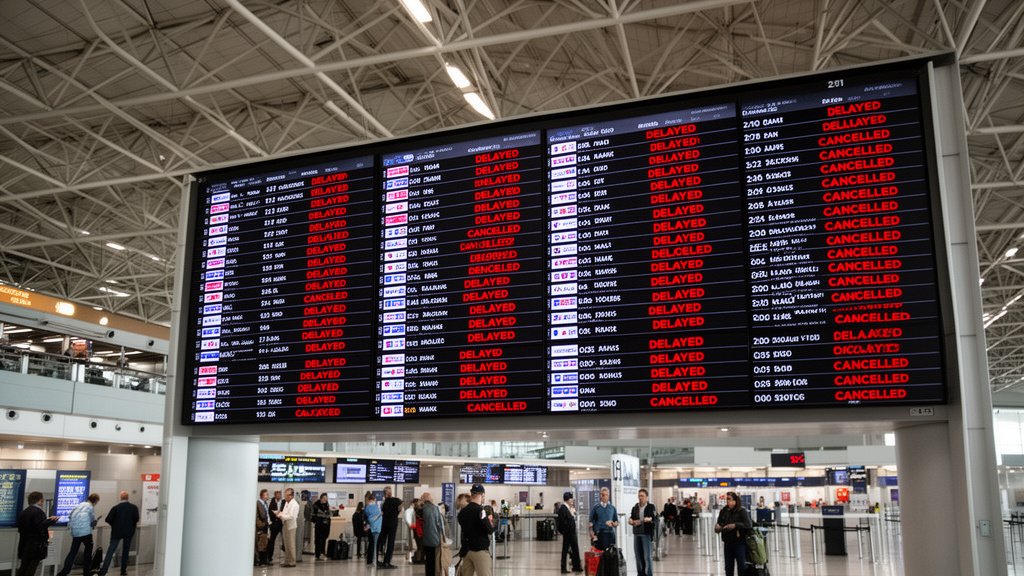
The Federal Aviation Administration (FAA) has officially issued a nationwide ground stop for all domestic departures across the United States. This unprecedented order, citing a catastrophic communication failure within the air traffic control infrastructure, has effectively paralyzed the American aviation network. As of the latest update, the agency is working urgently to address the technical malfunction that has rendered the essential safety data transmission system non-operational, with no immediate timeline for resumption of full service.
Key Highlights
- Nationwide Impact: The FAA has ordered all airlines to pause all domestic departures until further notice due to a corrupted data file in the Notice to Air Missions (NOTAM) system.
- Systemic Failure: The disruption stems from the NOTAM system, which provides real-time, essential flight safety information to pilots regarding hazards, runway closures, and flight paths.
- Cascading Delays: Thousands of flights have been delayed or canceled across major hubs, with the bottleneck expected to create congestion lasting well beyond the restoration of the system.
- Federal Response: The Department of Transportation is monitoring the situation, and the FAA is currently performing final validation checks to safely restore the system to full capacity.
The Anatomy of the Airspace Shutdown
The current crisis centers on the Notice to Air Missions (NOTAM) system, a vital component of the National Airspace System (NAS). Under normal operations, the NOTAM system broadcasts critical, time-sensitive information that pilots must review prior to every takeoff. This data includes updates on runway closures, equipment outages, personnel hazards, or any local conditions that could impact the safety of a flight.
When the system failed, the FAA lost the ability to push these updates to pilots and aircraft, creating a safety gap that necessitated a complete ground stop. In aviation, the golden rule is safety; without current, reliable mission data, flight crews cannot receive the vital information required to legally or safely operate. The decision to halt all departures represents a precautionary “fail-safe” state, prioritized to prevent any catastrophic operational error. While planes currently in the air are allowed to continue to their destinations, no new traffic is authorized to enter the departure phase, creating a massive logistical bottleneck.
Infrastructure Debt and Modernization Challenges
The failure highlights a long-standing debate regarding the aging infrastructure of the American aviation network. While the FAA has been engaged in a multi-year effort to upgrade the NAS, including the transition to more robust digital architectures, events of this magnitude expose the fragility of legacy systems. Experts suggest that the reliance on outdated backend architecture increases the probability of “cascading failures”—where a single point of data corruption disrupts the entire pipeline. This event serves as a stark reminder that modernizing flight safety communication is not merely a bureaucratic preference, but an urgent matter of national security and economic stability.
The Economic Ripple Effect
Beyond the immediate frustration of stranded passengers, the ground stop carries significant economic weight. Every hour of delay ripples outward, impacting airline crew scheduling, fuel consumption, and cargo operations. Because aviation operates on a “just-in-time” model, thousands of travelers are finding themselves in a domino effect of delays; crews “timing out” (reaching federal maximum work hours) must be replaced, and aircraft must be repositioned to handle the incoming backlog. For airlines, the cost is not just in potential ticket refunds, but in the operational chaos of rescheduling thousands of interconnected flight legs across the continent.
Passenger Rights and Navigating the Backlog
For those currently at airports or anticipating travel, the situation remains fluid. Travelers are advised to monitor the Department of Transportation’s airline customer service dashboard, which outlines individual airline commitments regarding cancellations and delays. Generally, when an airline initiates a cancellation due to safety or technical issues, they are often required to provide rebooking services. However, because this is an FAA-mandated ground stop, many airlines may cite “force majeure” clauses, complicating claims for financial compensation beyond the original ticket price. It is strongly recommended that passengers refrain from heading to the airport until their specific flight status is updated on the airline’s official mobile application.
FAQ: People Also Ask
Q: What is a NOTAM, and why does its failure ground planes?
A: NOTAM stands for “Notice to Air Missions.” It is a digital system that provides pilots with essential, real-time safety information about airport conditions, such as runway closures or navigational aid outages. Without these updates, pilots cannot safely plan or execute a flight, necessitating a ground stop.
Q: Is this a cybersecurity attack?
A: There is currently no evidence to suggest that the NOTAM system failure was the result of a cyberattack. Preliminary reports from the FAA indicate a technical malfunction involving the database that distributes this safety information.
Q: Will I be compensated for my canceled flight?
A: Compensation policies vary by airline. While the Department of Transportation mandates that airlines rebook passengers on the next available flight during uncontrollable events, cash compensation for hotel or meal vouchers is not federally mandated for ground stops. Check your airline’s specific “Contract of Carriage” for details.
Q: How long will the ground stop last?
A: The FAA has not provided a specific “all-clear” time. Restoration efforts are ongoing, and even after the system is back online, it will take significant time for the air traffic system to clear the backlog of delayed and canceled flights.