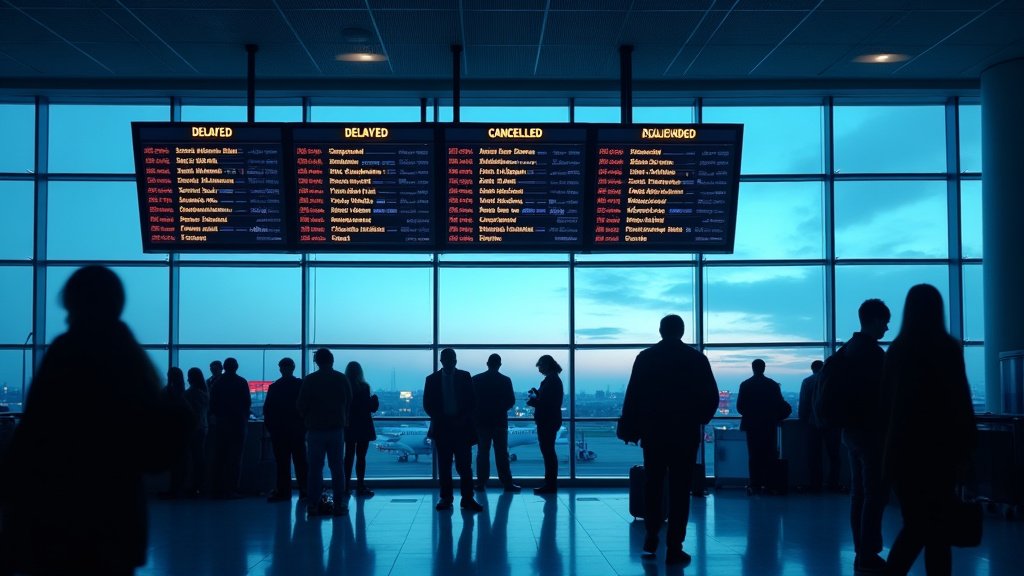
A nationwide ground stop was issued by the Federal Aviation Administration (FAA) on November 13, 2026, following a critical telecommunications failure at key Air Route Traffic Control Centers. The unprecedented directive, which halted all departing flights across the United States, sent shockwaves through the aviation industry and left travelers stranded in terminals nationwide. As ground crews and IT specialists work to restore connectivity, the incident has highlighted the severe vulnerability of the nation’s core aviation infrastructure, sparking immediate concerns regarding systemic reliability and the speed of critical system modernization.
- Unprecedented Action: The FAA mandated a nationwide ground stop on November 13, 2026, affecting all commercial and private flight departures within U.S. airspace.
- Root Cause: A widespread telecommunications outage originating at critical Air Route Traffic Control Centers severed communication links necessary for safe flight sequencing.
- Cascading Disruptions: The stoppage resulted in the mass cancellation and delay of thousands of flights, creating a massive logistical backlog that is expected to persist for days.
- Safety Priority: Officials emphasized that the ground stop was a preventative safety measure implemented to ensure that air traffic controllers retained full visibility and communication with active aircraft.
The Anatomy of the Aviation Infrastructure Collapse
The events of November 13, 2026, serve as a stark reminder of the complexity and fragility inherent in the National Airspace System (NAS). At the heart of the crisis lies the role of Air Route Traffic Control Centers (ARTCCs), which serve as the nerve centers for high-altitude en-route traffic. These centers are responsible for guiding aircraft safely across vast distances, ensuring proper separation between flights, and coordinating with terminal approach facilities near airports. When the telecommunications infrastructure supporting these hubs faltered, the ability to transfer flight data, flight plans, and critical safety updates was effectively compromised.
The Failure of Critical Redundancy
Initial reports from technical teams suggest that the failure was not limited to a single node but rather a broader systemic breakdown in the telecommunications pathway that connects these centers to the wider FAA network. While the FAA maintains robust backup systems designed to mitigate localized failures, this event bypassed those protocols, suggesting a deeper architectural issue within the data transmission layer. Cybersecurity and Infrastructure Security Agency (CISA) analysts have been deployed to assess the situation, primarily to rule out external interference or malicious cyber activity. While the current investigation points toward a technical malfunction—potentially linked to aged server hardware or a critical firmware error—the scope of the outage has reignited the debate over the pace of the FAA’s legacy system modernization efforts. The FAA has long been criticized for relying on aging telecommunications frameworks that, while once reliable, struggle to handle the high-volume data demands of modern aviation management.
Economic and Logistical Ripple Effects
The economic consequences of a nationwide ground stop are immediate and severe. Unlike a localized storm or runway closure, a system-wide halt creates a ‘bottleneck effect’ that compounds exponentially over time. Airlines, already operating on thin margins, face millions of dollars in losses from rerouted aircraft, crew displacement, and passenger rebooking logistics. For air cargo operators, the impact is even more acute; the sudden halt disrupts just-in-time supply chains, potentially delaying the delivery of time-sensitive medical supplies, perishable goods, and critical industrial components that rely on the speed of air transit. Business travelers, often the backbone of commercial aviation revenue, were left grounded in hubs from New York to Los Angeles, leading to a ripple effect of canceled meetings and lost productivity. Beyond the immediate financial tally, the reputational damage to the U.S. aviation network is significant, as thousands of international passengers were caught in the dragnet, raising questions about the reliability of the United States as a global travel and trade hub.
The Path to Recovery and Modernization
As the FAA works to restore nominal operations, the path forward is fraught with operational challenges. Bringing a complex, integrated system back online is not as simple as flipping a switch; it requires a systematic verification of every flight plan and communication channel to ensure that data integrity is maintained. The industry expects a period of ‘recovery traffic,’ where airlines will attempt to consolidate flights and prioritize long-haul departures. This recovery phase will likely test the limits of airport staffing and baggage handling capacity, which were already under pressure. Looking further ahead, industry experts are calling for a more rapid transition to cloud-based, decentralized communication systems that do not rely on a monolithic telecommunications backbone. The argument is that if the architecture were more modular, a failure in one region or one system could be isolated, preventing a nationwide catastrophe. This incident will undoubtedly serve as the primary catalyst for Congressional hearings regarding FAA funding and the acceleration of the NextGen program, the agency’s long-term plan to modernize the air traffic control system.
FAQ: People Also Ask
How does an FAA ground stop affect flights already in the air?
Usually, a ground stop applies only to aircraft that have not yet taken off. Flights currently in the air are typically permitted to continue to their destination, as they are already under the active control and monitoring of air traffic controllers. However, these flights may face significant holding patterns or rerouting if the outage impacts the destination’s ability to process arrivals.
Will I be entitled to a refund for my canceled flight?
Under U.S. Department of Transportation regulations, passengers are entitled to a full cash refund if an airline cancels a flight for any reason, including government-mandated ground stops, provided the passenger chooses not to rebook. Most airlines will offer rebooking options first, but passengers retain the right to request a refund to the original form of payment.
Is this incident related to a cyberattack?
While initial investigations are focusing on technical and hardware failures, the FAA and CISA have not ruled out any possibilities. Officials typically perform a thorough forensic sweep of the system logs before making any definitive statements regarding the cause. As of now, there is no verified evidence of malicious actor involvement, but the investigation remains ongoing.
How long does it take for air traffic to return to normal?
Recovery typically takes significantly longer than the stop itself. Once the system is restored, airports must deal with a backlog of aircraft that have been delayed or diverted. It can often take 24 to 48 hours for the flight schedule to fully normalize, as flight crews reach their federally mandated duty time limits and aircraft are moved back into their scheduled rotation.