The dawn of a new financial era for artificial intelligence turned into a scene of chaotic confrontation today as Anthropic completed its historic initial public offering. While the markets celebrated a massive influx of capital—raising over $81 billion and securing a staggering $2 trillion valuation—the firm’s celebratory moment was punctured by a wave of arrests. Demonstrators mobilized simultaneously at the company’s San Francisco headquarters and the Nasdaq exchange in New York City, creating a stark visual divide between the promise of technological supremacy and the mounting public fear of an unregulated AI future.
Key Highlights
- Historic Financial Milestone: Anthropic successfully raised $81 billion in one of the largest tech IPOs in history, cementing a $2 trillion valuation.
- Simultaneous Disruptions: Protests erupted at both the San Francisco corporate headquarters and the Nasdaq floor in New York City.
- Specific Demands: Activists, under the banner of a global AI-safety coalition, demanded an immediate “AI Freeze,” calling for a moratorium on further advanced development.
- Law Enforcement Response: Local authorities in both cities confirmed arrests related to site blockades and unauthorized demonstrations, marking a volatile debut for the tech giant.
- Market Sentiment: Despite the unrest, institutional investors showed heavy demand, indicating that financial markets remain bullish on the long-term potential of generative AI, regardless of social friction.
The Collision of Capital and Caution
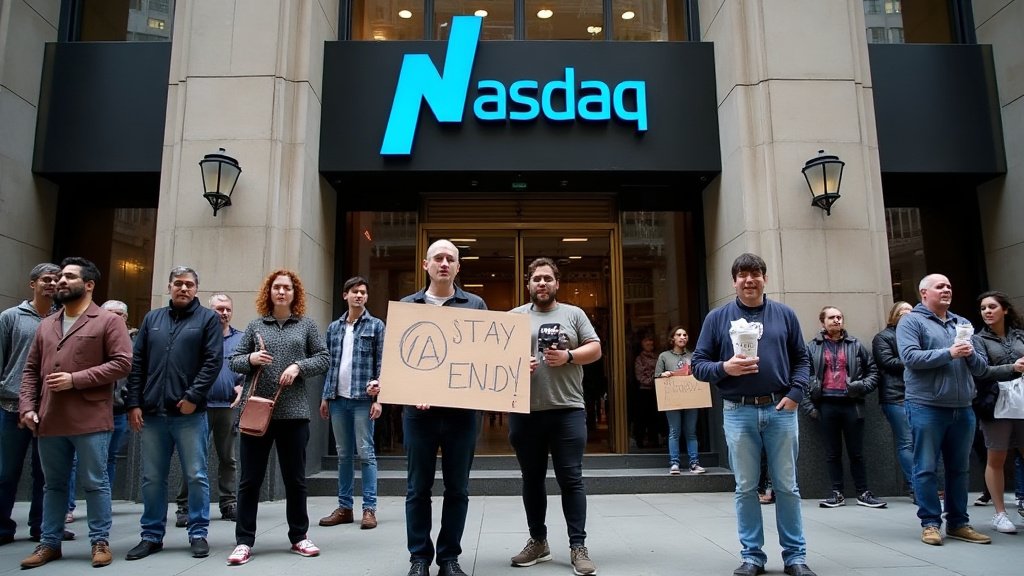
The dual-location protest serves as a potent microcosm of the current tensions surrounding Silicon Valley’s most powerful sector. As investors poured billions into Anthropic, the protestors outside—carrying signs demanding an “AI Freeze”—represented a growing movement that views the unchecked scaling of artificial intelligence as an existential threat. The contrast could not be sharper: inside the Nasdaq, the ringing of the bell symbolized the commodification of intelligence at a $2 trillion scale; outside, the clatter of police gear and the shouting of protesters signaled a deep, systemic distrust of that very process.
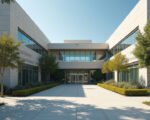
In San Francisco, the atmosphere turned heated shortly after the market opened. Activists formed a human chain across the entrance to the company’s headquarters, preventing non-essential personnel from entering. The San Francisco Police Department (SFPD) issued dispersal orders within the hour, eventually making several arrests for obstruction and trespassing. Simultaneously, in New York, a separate group infiltrated the public area near the Nasdaq stock exchange, chanting slogans about “algorithmic accountability” and “stopping the machine.”
This is not merely a local grievance; it is a signal of the “Great AI Divergence.” The financial sector sees a $2 trillion opportunity to revolutionize global productivity, while the protest movement sees a trajectory leading toward societal instability. The arrests today, while relatively small in number, indicate that Anthropic’s entry into the public markets will likely be accompanied by a persistent shadow of litigation and public disruption.
A Valuation War: Market Frenzy vs. Existential Risk
To understand the magnitude of this IPO, one must look at the numbers. Raising $81 billion is an outlier event, placing Anthropic in the rarified air of the world’s most valuable entities. Analysts suggest this valuation is driven by the perceived necessity of Anthropic’s R&D in the race against competitors like OpenAI and Google. The market is pricing in a future where Anthropic’s models are foundational to global infrastructure.
However, the activists’ core demand—an “AI Freeze”—challenges the very premise of this growth. They argue that the $81 billion should be redirected toward safety research and oversight, rather than the rapid, industrial-scale deployment of LLMs (Large Language Models). This is a battle over the “alignment problem”—the technical challenge of ensuring AI systems act according to human values—on a global, public stage. Investors, however, seem unfazed by these moral arguments, treating the protests as a manageable PR cost compared to the potential ROI.
The Activist Front: Why They Demand a Halt
The coalition behind the protests, which includes members of the AI ethics advocacy group ‘Humanity First’ and various transparency NGOs, argues that Anthropic has crossed a red line. Their primary concern is the “black box” nature of current AI deployment. By going public, the activists argue, Anthropic is prioritizing shareholder profit over public safety. They are calling for an immediate moratorium on training models more powerful than those currently in existence, arguing that the $81 billion raise will only accelerate a race to the bottom, where safety protocols are sacrificed for market speed.
Historical Parallels: From Dot-com to AI Fever
Critics of the IPO are already drawing parallels to the dot-com bubble of the late 1990s, where irrational exuberance led to unsustainable valuations. However, the current AI “supercycle” differs significantly because it is powered by tangible, immediate utility rather than just speculative website clicks. Unlike the dot-com era, the infrastructure for AI is already in production and generating revenue. The tension today, therefore, is not about the technology’s existence, but its velocity. The protests are a desperate attempt to tap the brakes on an industry that currently seems to have no off-switch.
Market Volatility and Future Implications
What happens next? Anthropic now faces a dual challenge. Internally, the company must manage the immense pressure to justify its $2 trillion valuation to public shareholders. Externally, it must contend with a growing, organized opposition that is willing to use physical disruption to make its point. If the protests continue, we may see increased security costs, potential legal injunctions, and a long-term erosion of the “goodwill” that tech companies typically rely on during their initial public growth phases.
For investors, the arrests are likely a short-term volatility event. For Anthropic’s leadership, however, they represent a significant cultural hurdle. The company has moved from being a private, research-oriented lab to a public, global utility, and with that transition comes the scrutiny of a public that is increasingly afraid of what it is buying into.
FAQ: People Also Ask
1. Why are protesters specifically targeting Anthropic?
Anthropic is viewed by many as the “last line of defense” in AI safety. Activists feel that by choosing to scale rapidly and go public, the company has abandoned its original safety-first charter, necessitating the protest to “sound the alarm” at the point of market entry.
2. What does an “AI Freeze” actually mean in this context?
It is a demand for a global pause on the development and training of new, more advanced frontier AI models. Activists argue that current models are powerful enough and that the industry should focus on research into safety and alignment rather than raw performance gains.
3. Will the protests affect Anthropic’s stock price?
Historically, public protests against major corporations have a negligible impact on stock prices. Institutional investors largely view these demonstrations as temporary disruptions rather than systemic risks to the company’s business model or product viability.
4. Is the $2 trillion valuation realistic?
That remains to be seen. The market is valuing Anthropic not just on current revenue, but on the expected dominance of its AI models in future technology stacks. Whether it can maintain that valuation depends on its ability to sustain growth without regulatory interference or safety failures.