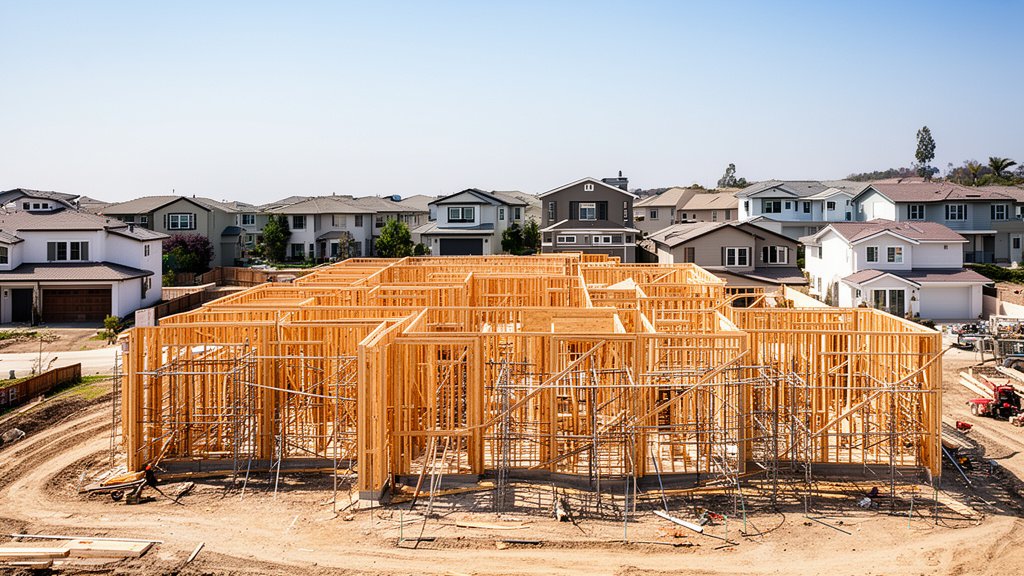
California’s persistent housing affordability crisis has reached a legislative inflection point with the introduction of Proposition 37, a massive, $25 billion bond-funded initiative designed to break the cycle of high costs and limited inventory. By specifically targeting middle-income buyers and mandating the purchase of newly constructed residences, the proposal aims to simultaneously unlock homeownership for the working class while aggressively stimulating the state’s construction sector.
Key Highlights
- Massive Funding Injection: Prop. 37 authorizes $25 billion in state bonds to fund a dedicated low-interest loan program for homebuyers.
- Strategic Targeting: The program is exclusively available to middle-income families, aiming to fill the gap where traditional market entry is most difficult.
- Construction Incentive: Loans are restricted to the purchase of newly built homes, a measure intended to drive housing supply and reduce the existing market bottleneck.
- Fiscal Scope: The initiative represents one of the largest state-backed housing interventions in recent California history, shifting the burden from immediate tax revenue to long-term bond debt.
The Anatomy of the $25 Billion Housing Initiative
The central mechanism of Proposition 37 is the issuance of $25 billion in state bonds. Unlike direct subsidies that deplete the general fund, this bond-driven approach allows the state to raise capital upfront, borrowing against future revenue to address an immediate, systemic failure in the housing market. By focusing this capital into a specialized loan program, the state is attempting to act as a market stabilizer.
The Middle-Income Gap
The core demographic for Prop. 37 is the ‘missing middle.’ Historically, housing assistance programs in California have focused heavily on low-income subsidies. While essential, this has left teachers, firefighters, and moderate-income professionals—often earning between 80% and 150% of the Area Median Income (AMI)—without a path to homeownership. Prop. 37 seeks to provide these families with favorable financing, likely in the form of down payment assistance or lower-than-market interest rates, specifically designed to bridge the affordability chasm created by high interest rates and inflated home prices.
New Construction as a Supply Lever
Perhaps the most controversial and innovative aspect of the proposal is the strict ‘new construction only’ mandate. Proponents argue that the primary driver of California’s housing crisis is a lack of supply. By limiting the loan program to newly built homes, the state aims to achieve a dual effect: increasing the total volume of available housing stock and creating a guaranteed buyer pool for developers. This effectively ‘de-risks’ construction for builders, theoretically encouraging them to break ground on projects that might otherwise be stalled by economic uncertainty.
Stakeholder Perspectives and Economic Reality
Organizations like the California Building Industry Association (CBIA) have cautiously eyed the potential for increased activity, though questions remain regarding the regulatory hurdles still facing new developments. Meanwhile, analysts from the Legislative Analyst’s Office (LAO) are expected to scrutinize the long-term debt servicing costs of a $25 billion issuance. The economic impact is two-fold: the immediate boost to construction labor and material markets, and the long-term impact on the state’s creditworthiness. Critics may argue that this could inflate home prices if the supply response is slower than the demand created by the loan program, potentially creating a localized inflationary bubble.
Secondary Angles: Beyond the Bond
1. The ‘New Build’ vs. ‘Existing Home’ Debate: By favoring new construction, Prop. 37 deliberately ignores the existing stock of homes, which many critics argue is the more immediate solution. This section explores whether the state should be prioritizing renovation or new density.
2. Historical Context of State Bonds: California has used bond measures for everything from water infrastructure to high-speed rail. We analyze how this housing bond compares to historical precedents in terms of success and voter appetite.
3. Long-Term State Debt Implications: A $25 billion bond is a significant increase in state debt. We examine the potential consequences for California’s bond ratings and the long-term burden on the state’s budget, factoring in interest payments over the next 30 years.
FAQ: People Also Ask
Q: Who qualifies for the Prop. 37 loan program?
A: The program targets middle-income households. While specific income caps will be defined by the California Department of Housing and Community Development (HCD) upon passage, it is designed to assist those who do not qualify for low-income assistance but are priced out of the open market.
Q: Can I use the loan to buy a house from a private seller?
A: No. The terms of Prop. 37 specifically restrict the use of these loan funds to the purchase of newly built homes, incentivizing the creation of new inventory rather than the turnover of existing properties.
Q: How will the $25 billion in bonds be repaid?
A: State bonds are typically repaid through the state’s general fund over several decades. This means the costs are amortized, though it does commit future tax revenue to debt service.
Q: What if I am a first-time homebuyer?
A: While first-time status is often a secondary criterion in such programs, the primary qualifier under this specific proposal is middle-income status and the purchase of new construction. First-time buyers will likely be prioritized within that cohort, but they must meet the primary criteria.