The Hawk Fire, an aggressive and rapidly expanding wildfire, has ignited near Reno, Nevada, plunging the region into a state of emergency. Fueled by dry vegetation and punishing wind gusts, the fire has forced the immediate evacuation of thousands of residents, transforming peaceful residential foothill communities into a high-stakes frontline. Emergency personnel, including the Truckee Meadows Fire & Rescue and the Washoe County Sheriff’s Office, are currently engaged in a critical struggle to establish containment lines as the blaze continues to threaten infrastructure and homes.
The Meteorological Perfect Storm
The explosive growth of the Hawk Fire is not a matter of chance; it is the direct result of a complex meteorological event that has plagued the Great Basin this season. Meteorologists from the National Weather Service (NWS) Reno office had issued warnings regarding the dry, unstable conditions in the days leading up to the blaze. The region is currently experiencing a combination of record-low humidity and seasonal drought, which has effectively turned the foothills into tinder. When strong, gusty winds hit these dried-out fuel loads, the result is near-instantaneous fire spread.
Fire behavior analysts note that the fire’s intensity is characteristic of ‘plume-dominated’ events. This occurs when the heat generated by the fire itself is sufficient to create localized weather patterns, including erratic updrafts that can carry burning embers hundreds of feet into the air. This phenomena, known as ‘spotting,’ is precisely what makes the Hawk Fire so difficult to suppress. Embers can jump over existing fire breaks, roads, and containment lines, effectively leapfrogging the efforts of ground crews and making a stationary front nearly impossible to hold. For the thousands of residents forced to flee, this volatility meant that evacuation orders—often issued in the dead of night or with very little lead time—were the only viable safety measure.
Tactical Firefighting in the Wildland-Urban Interface
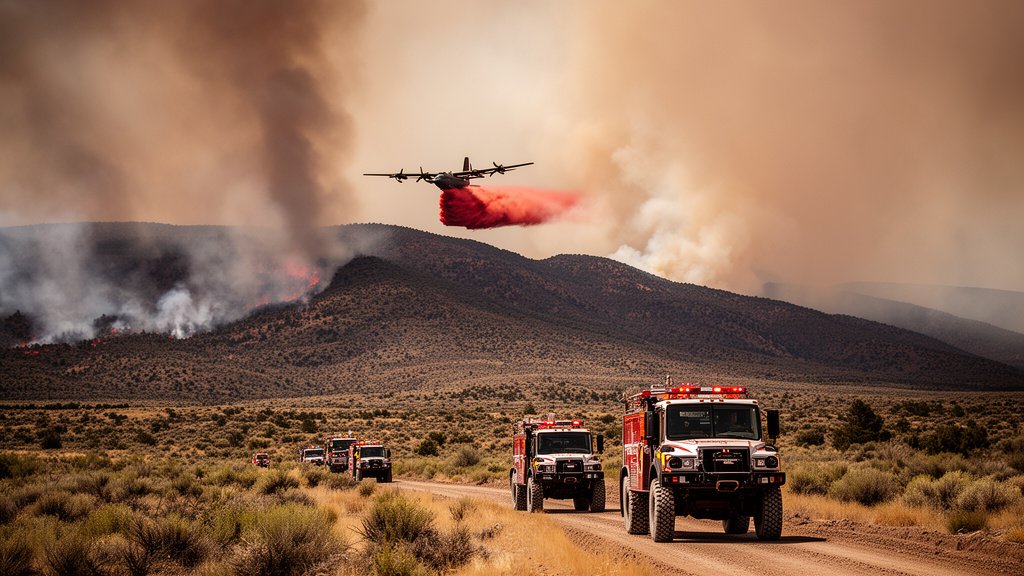
Fighting a fire in the wildland-urban interface (WUI) presents a unique set of challenges that differ drastically from traditional forestry firefighting. In this scenario, firefighters are not just battling the blaze; they are actively protecting critical infrastructure, including power lines, residential homes, and commercial zones. The Truckee Meadows Fire & Rescue teams, in coordination with mutual aid from nearby districts and the Bureau of Land Management (BLM) Nevada, have deployed a ‘defensive-offensive’ strategy.
Defensive tactics involve the triage of structures—quickly determining which homes can be saved and where resources are best allocated to stop the fire’s advance toward high-density population centers. Offensive tactics involve the aggressive use of aircraft, including heavy air tankers and helicopter bucket drops, to douse the most active flanks of the fire. However, the same winds that drive the fire often ground these aerial assets for safety reasons, forcing crews to rely almost exclusively on heavy equipment on the ground. Bulldozer crews are currently working around the clock to cut wide fuel breaks, carving trenches through the landscape to starve the fire of fuel. The coordination between local law enforcement, who are managing the chaotic evacuations, and fire crews, who are battling the wall of flames, remains the primary focus of the incident command post.
Secondary Angles: Examining the Broader Impact
To understand the full scope of the Hawk Fire, we must look beyond the immediate flames and analyze the systemic issues that make such disasters increasingly frequent in the American West.
1. The Escalating Reality of WUI Fires: The Reno foothills represent the frontline of a national crisis: the rapid expansion of residential development into fire-prone wildlands. As cities sprawl, the ‘defensible space’ required to protect homes is often compromised. Experts warn that unless zoning laws evolve to mandate fire-resistant materials and stricter vegetation clearing requirements, these high-stakes evacuations will become a seasonal norm rather than a rare catastrophe.
2. The Insurance and Real Estate Paradox: Beyond the immediate threat to life and limb, the Hawk Fire highlights the growing ‘insurance desert’ phenomenon. As wildfires become more frequent, major insurance carriers are re-evaluating risk in high-fire zones across Nevada and California. This fire is expected to trigger a wave of actuarial reviews that could spike premiums or lead to the cancellation of fire coverage for homeowners in the Reno area, regardless of whether their specific home was damaged in this current event.
3. The Long-term Ecological Shift: The repeated burning of these specific foothills is fundamentally altering the local ecosystem. The native sagebrush and grasses are struggling to recover in the wake of shorter return intervals between fires. This often leads to the encroachment of invasive, highly flammable cheatgrass, which further fuels future fires, creating a dangerous feedback loop of degradation that city planners and environmentalists are struggling to reverse.