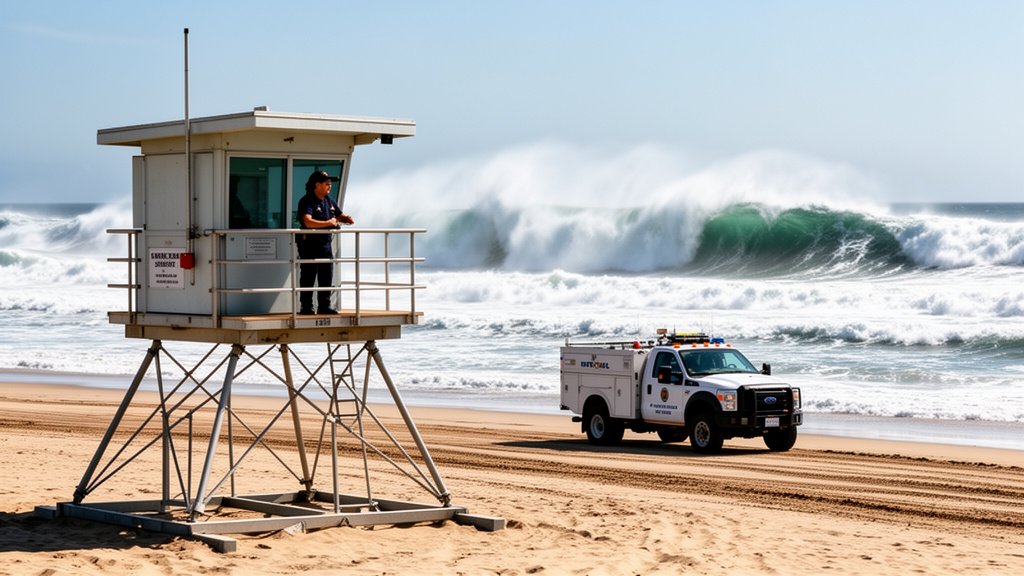
San Diego’s coastline faces a hazardous double-threat this weekend as the remnants of Hurricane Genevieve drive powerful, unpredictable swells toward local beaches, colliding with an intense, record-breaking heatwave. Local lifeguards and emergency personnel are bracing for a high-risk operational period, warning swimmers, surfers, and beachgoers of dangerous rip currents and the increased likelihood of heat-related illnesses as temperatures soar.
Key Highlights
- Hazardous Swells: Hurricane Genevieve is generating long-period south swells that increase the intensity and frequency of rip currents, posing severe risks even to experienced swimmers.
- Compound Crisis: The convergence of extreme heat and high surf creates a ‘perfect storm’ scenario, requiring lifeguard agencies to maintain maximum staffing levels throughout the weekend.
- Operational Readiness: Lifeguard services are implementing increased tower staffing and mobile patrols to manage the dual threats of water rescues and medical emergencies on the sand.
- Public Safety Mandate: Officials are strictly advising beachgoers to swim only near open lifeguard towers and to heed all posted warnings, as current conditions make self-rescue difficult.
Navigating the Confluence of Fire and Water
The arrival of Hurricane Genevieve, while hundreds of miles off the coast, acts as a force multiplier for the Pacific Ocean, translating atmospheric energy into kinetic power that reaches San Diego’s shoreline. When this energy hits the coast during an extreme heatwave—conditions where the National Weather Service (NWS) often issues Excessive Heat Warnings—the resulting scenario is one of the most difficult operational environments for water safety professionals. The combination of heat and high surf creates a unique set of challenges that requires strategic foresight, rapid physical endurance, and constant public communication.
The Mechanics of the Surge
Unlike local wind waves, the swells generated by a tropical system like Hurricane Genevieve are ‘long-period.’ This means the distance between wave crests is greater, allowing the waves to retain more energy as they travel across the ocean. Upon reaching the shallows of San Diego, these waves do not simply break; they ‘shoal’ violently. This creates an underwater topography of unpredictability. As the wave energy hits the beach, it forces massive volumes of water to return to the ocean through narrow, high-velocity channels—the classic definition of a rip current. These currents can form rapidly and often occur in areas where the water looks deceptively calm, entrapping swimmers who may be attempting to cool off from the inland heat.
Lifeguard Tactical Deployment
For San Diego Lifeguard Services, this weather pattern necessitates a shift from standard surveillance to active, preemptive intervention. During high-surf events, lifeguard agencies typically transition to ‘Red Flag’ conditions, which signify hazardous water quality or extreme rip current activity.
Operational adjustments include:
- Tower Consolidation: If beach attendance becomes unmanageable, lifeguards may consolidate tower placements to ensure maximum coverage in high-risk zones.
- Mobile Patrols: Increased use of rescue vehicles (sand trucks) to traverse the shoreline, enabling rapid response to medical emergencies caused by heat exhaustion or dehydration on the sand.
- Preventative Intervention: Lifeguards are tasked with proactively warning swimmers about current direction and intensity before they even enter the water, reducing the need for late-stage water rescues.
The Heat Factor: A Silent Emergency
While the surf captures public attention, the heat represents an equally significant threat to operations. High temperatures on the sand increase the rate of heat-related illnesses, including heat stroke, heat exhaustion, and severe dehydration. Lifeguards, while monitoring the water, must also serve as front-line medical responders for beachgoers who have spent hours under the sun without adequate shade or hydration. The physiological strain on the lifeguards themselves is also a factor; performing high-intensity water rescues in high heat requires extraordinary physical endurance. Agency leadership often mandates shortened rotations in the water and increased hydration breaks to ensure that personnel remain fully capable of executing rescues at a moment’s notice.
The Economic and Environmental Future
This compound event highlights an increasing trend in coastal management: the rise of multi-hazard weather phenomena. As the climate shifts, the frequency of tropical storms or their remnants interacting with local heat waves may increase, necessitating a permanent evolution in emergency management. For San Diego, which relies heavily on beach-driven tourism, the economic impact is a secondary but critical consideration. While public safety is the absolute priority, the need to restrict water access or limit beach capacity during peak summer days creates ripples throughout the regional hospitality and service economy. Moving forward, the integration of real-time swell modeling and heat-index data into emergency planning will be essential for balancing public enjoyment with the stark realities of climate-induced coastal hazards.
FAQ: People Also Ask
Q: Why are rip currents more dangerous during these specific weather conditions?
A: Hurricane-generated swells increase the volume of water moving toward the shore. When this large volume of water retreats, it creates narrower, faster, and more powerful rip currents that can overcome even strong swimmers, appearing suddenly in areas that seemed safe moments prior.
Q: What is the most critical rule for beachgoers during a high-surf advisory?
A: The non-negotiable rule is to swim only directly in front of an open lifeguard tower. Lifeguards are trained to identify rip currents and can provide real-time guidance on where it is safe to enter the water; their presence is the most effective safety tool available.
Q: How do heat waves impact lifeguard staffing levels?
A: Heat waves significantly increase the number of beach visitors seeking relief, leading to overcrowding. This forces agencies to maximize tower staffing, increase frequency of beach patrols, and maintain higher levels of emergency medical equipment readiness to address both water rescues and heat-related medical issues on the sand.