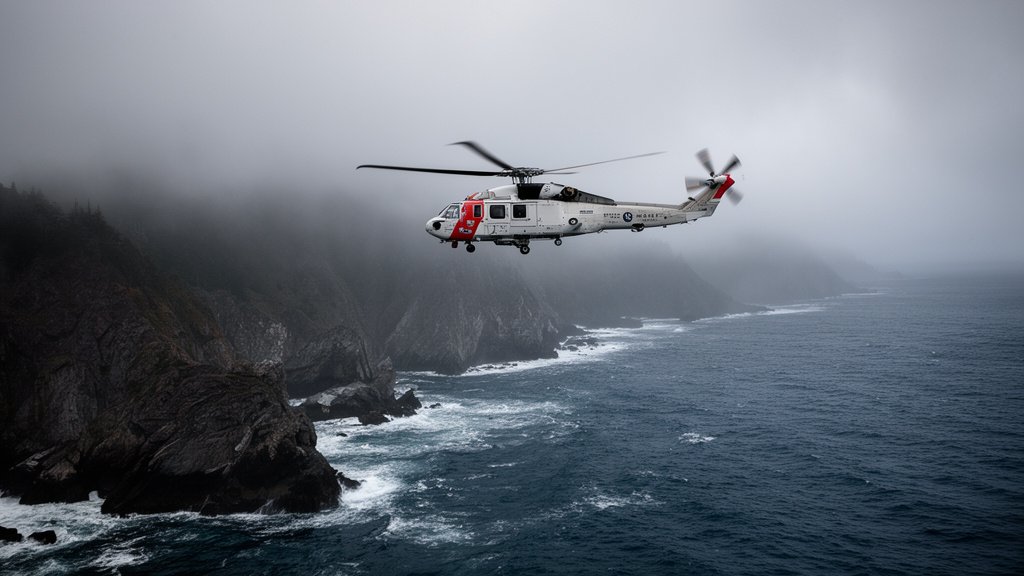
The U.S. Coast Guard has officially released the Major Incident Investigation (MII) report regarding the tragic February 27, 2026, aviation mishap involving an MH-60T Jayhawk helicopter off the coast of Cape Flattery, Washington. The findings detailed in the report mark the conclusion of a rigorous, multi-month examination into the events that led to the crash, which resulted in the death of Aviation Survival Technician Second Class Tyler Jaggers. This comprehensive investigation provides critical insight into the factors that contributed to the loss of both the aircraft and a valued service member, and outlines necessary updates to operational procedures within the fleet.
Key Highlights
- Final Report Released: The Coast Guard has publicly disclosed the Major Incident Investigation (MII) regarding the February 27, 2026, loss of an MH-60T Jayhawk.
- Loss of Life: The mishap claimed the life of Aviation Survival Technician Second Class Tyler Jaggers, whose service and sacrifice were central to the investigation’s focus.
- Operational Context: The aircraft was conducting routine flight operations off the rugged coast of Cape Flattery, Washington, at the time of the incident.
- Safety Adjustments: The report mandates specific changes to training maneuvers and mechanical maintenance schedules to prevent future occurrences of this type of mishap.
- Investigation Scope: The MII process was a comprehensive review involving District 13 leadership, aviation safety engineers, and independent military investigators.
Unveiling the Findings: The Cape Flattery MH-60T Investigation
The release of the Major Incident Investigation report serves as a somber milestone for the U.S. Coast Guard and the aviation community at large. Following the crash of the MH-60T Jayhawk on February 27, 2026, the service launched an exhaustive review to determine the root causes of the disaster. As the primary platform for Coast Guard search and rescue operations, the Jayhawk is typically regarded as a highly reliable workhorse. The findings of this MII are therefore significant, as they move beyond simple pilot error or mechanical failure to analyze a complex intersection of environmental stressors and technical performance parameters.
Chronology of the February 27 Mishap
On the morning of February 27, 2026, the flight crew was executing a scheduled training sortie in the vicinity of Cape Flattery, Washington. This region is notoriously challenging for aviation due to rapid weather shifts, heavy marine layer fog, and intense localized winds. According to the investigation, the flight began nominally. However, the data recorders recovered from the wreckage indicated a rapid sequence of events that occurred within seconds. The MII report reconstructs the final minutes, detailing how the interaction between local wind shear and the airframe’s response created a flight attitude from which the aircraft could not recover. The timeline emphasizes that the crew maintained professional focus throughout the event, with Aviation Survival Technician Second Class Tyler Jaggers and the rest of the crew performing their duties in accordance with established standard operating procedures. The investigation notes that there were no indicators of pre-flight mechanical negligence, highlighting that the incident was likely the result of an unforeseen confluence of environmental variables.
Mechanical Integrity and Environmental Factors
Central to the USCG MH-60T investigation was the technical evaluation of the Jayhawk’s systems. The MH-60T, an upgraded variant of the H-60 helicopter, has served the Coast Guard faithfully for decades, but it operates in some of the most punishing environments on Earth. The MII report dedicated significant analysis to the avionics and flight control systems during the moments leading up to the mishap. Investigators successfully extracted and analyzed the cockpit voice recorder (CVR) and flight data recorder (FDR) to paint a clear picture of the mechanical status of the helicopter.
Crucially, the report concluded that the aircraft was airworthy at the time of takeoff. The analysis of the wreckage confirmed that the primary mechanical systems were operating within expected parameters until the moment of impact with the water. The investigation shifted focus to ‘human-environment interface,’ exploring how the visual degradation near Cape Flattery may have impacted the crew’s spatial awareness. By isolating the mechanical components, the Coast Guard has been able to rule out structural deficiencies, effectively narrowing the cause to a high-difficulty maneuvering scenario that pushed the aircraft beyond its envelope under specific atmospheric conditions.
Coast Guard Safety Mandates and Future Readiness
In the wake of this report, the U.S. Coast Guard is not merely archiving the document but is actively implementing systemic changes to its aviation training pipeline. The MII report includes several ‘lessons learned’ that are currently being integrated into the curriculum for all MH-60T aircrews. These include enhanced training on low-altitude maneuvering in high-wind environments, updated criteria for aborting training sorties in marginal weather, and refined flight control sensitivity settings for pilots operating in the Pacific Northwest.
Furthermore, the death of AST2 Tyler Jaggers has spurred a broader conversation within the service regarding the inherent risks of search and rescue training. While the Coast Guard remains committed to operational excellence, there is a renewed emphasis on risk mitigation during non-emergency training flights. Command leadership at District 13 has stated that the safety of the crews is paramount, and that the findings of this report will be used to ensure that no other family has to suffer a loss of this nature. The service is moving toward a more data-driven approach to safety, using the lessons from the Cape Flattery incident to inform the maintenance and operational flight manuals for the entire Jayhawk fleet, ensuring a legacy of safety that honors the memory of those lost.
FAQ: People Also Ask
Q: What is an MH-60T Jayhawk?
A: The MH-60T Jayhawk is the primary medium-range recovery helicopter used by the U.S. Coast Guard. It is a multi-mission platform capable of search and rescue, law enforcement, and national security operations.
Q: How long does a Major Incident Investigation take?
A: MIIs are complex and thorough processes. They typically take several months, as they require the analysis of mechanical wreckage, flight data, environmental conditions, and human factors. The release of this report occurred after a comprehensive multi-month review.
Q: Was mechanical failure the cause of the Cape Flattery crash?
A: According to the official report, mechanical failure was not the primary cause. The investigation found that the aircraft was airworthy at the time of the incident, and the crash was largely attributed to environmental and situational factors.
Q: How will this report impact future Coast Guard operations?
A: The Coast Guard is using the findings to update training procedures, safety protocols, and risk assessment mandates for all aviation units, specifically focusing on maneuvers in challenging weather environments.