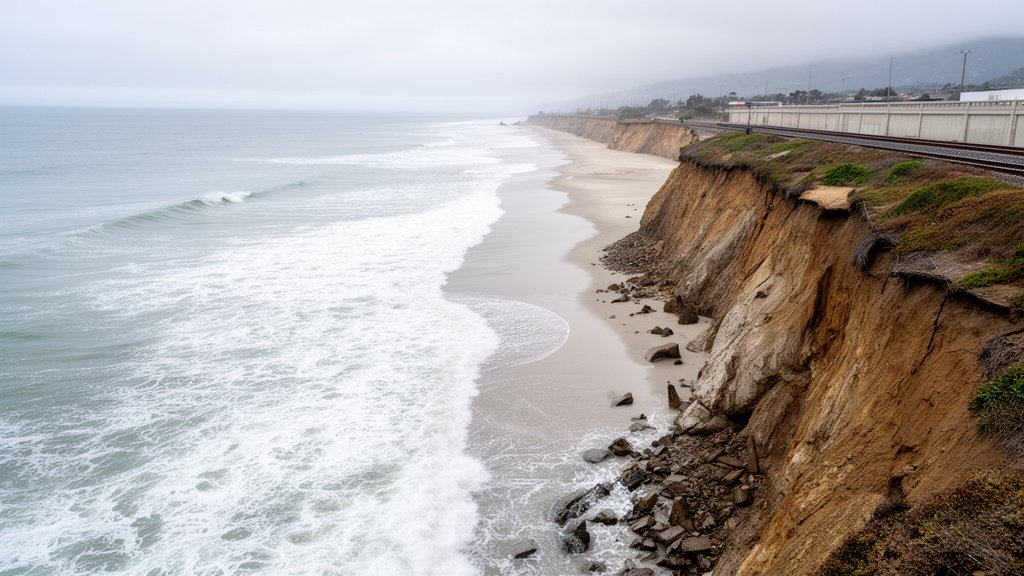
As the California coastline continues to recover from a relentless season of high-tide and hurricane-generated swell events, a new, hidden menace is emerging from the depths of the Pacific. Scientists are tracking a ‘coastally trapped Kelvin wave,’ a large-scale oceanographic phenomenon that acts as a conveyor belt for warm, elevated water. Moving up the West Coast, this wave threatens to raise sea levels by as much as six inches, creating a compounded crisis for coastal defenses, residential infrastructure, and vital transit corridors that have already been pushed to their breaking point.
The Mechanics of the Marine Menace
To understand why a Kelvin wave matters, one must first look at the Pacific Ocean’s broader behavior. The El Niño-Southern Oscillation (ENSO) cycle is characterized by the accumulation of warm water in the equatorial Pacific. When this cycle shifts, that warm water releases eastward. A coastally trapped Kelvin wave is essentially a massive pulse of this warm, buoyant water that hugs the continental shelf as it travels poleward along the coastline.
Unlike wind-driven waves that break violently on the shore, a Kelvin wave is a slow, gradual rise in water level that can persist for weeks or even months. According to research from the National Oceanic and Atmospheric Administration (NOAA) and oceanographers at the Scripps Institution of Oceanography, these waves can depress the thermocline and push sea levels significantly higher than the astronomical tides would dictate alone. When this surge aligns with king tides or heavy winter storms—both of which have battered California extensively over the last year—the results are often catastrophic for cliff-side homes, coastal railways, and public beaches.
Compounding Crisis: Why Erosion Matters
The California coastline is inherently dynamic, but it is currently in a state of hyper-vulnerability. The cumulative impact of the 2023-2024 El Niño cycle has already destabilized cliffs from San Diego to the Bay Area. When a Kelvin wave delivers an additional six inches of elevation, the wave energy that would normally dissipate on the beach is instead directed higher up the beach profile, directly attacking the base of coastal bluffs and sea walls.
This is not a theoretical threat. Engineering reports from municipalities along the Central Coast indicate that sea walls designed to withstand specific high-water marks are being overtopped or undermined. The structural integrity of the Pacific Coast Highway and various regional rail lines depends on maintaining a delicate balance of sand volume; the Kelvin wave disrupts this by aggressively pulling sand offshore and depositing it in deep water where it cannot easily return. This creates a feedback loop: less sand means less protection for the cliffs, which means more erosion, which eventually threatens critical infrastructure like the LOSSAN rail corridor.
Economic and Environmental Repercussions
The economic implications of this surge are profound. Coastal property owners are facing rapidly increasing insurance premiums and, in many cases, total loss of insurability. For state agencies, including the California Coastal Commission, the challenge is shifting from routine beach maintenance to emergency hazard mitigation.
Beyond human infrastructure, the environmental impact is equally concerning. The warm water associated with these Kelvin waves can stress marine ecosystems. While six inches might seem negligible to a casual observer, to the delicate balance of coastal wetlands and salt marshes—which act as essential buffers against storm surges—this sustained rise can lead to the ‘drowning’ of native vegetation. Once these marshes are submerged, their ability to sequester carbon and filter runoff is compromised, creating a long-term ecological deficit that is difficult to reverse.
The Long-Term Coastal Outlook
Looking ahead, the emergence of this Kelvin wave underscores the volatility of the modern Pacific climate. While this specific event will eventually dissipate, it serves as a preview of the ‘new normal’ under accelerated sea-level rise scenarios. Climate models suggest that as the ocean continues to absorb heat, the frequency and intensity of these dynamic sea-level anomalies may increase.
Local governments are now forced to accelerate adaptation strategies. Hardening the coast with more sea walls is becoming increasingly expensive and ecologically damaging, leading to a shift in policy toward ‘managed retreat’ or ‘living shorelines’ that mimic natural defenses. The current Kelvin wave, while perhaps not as visible as a hurricane, is a poignant reminder that the most significant threats to California’s coast are often the ones moving slowly beneath the surface, silently reshaping the map one tide at a time.