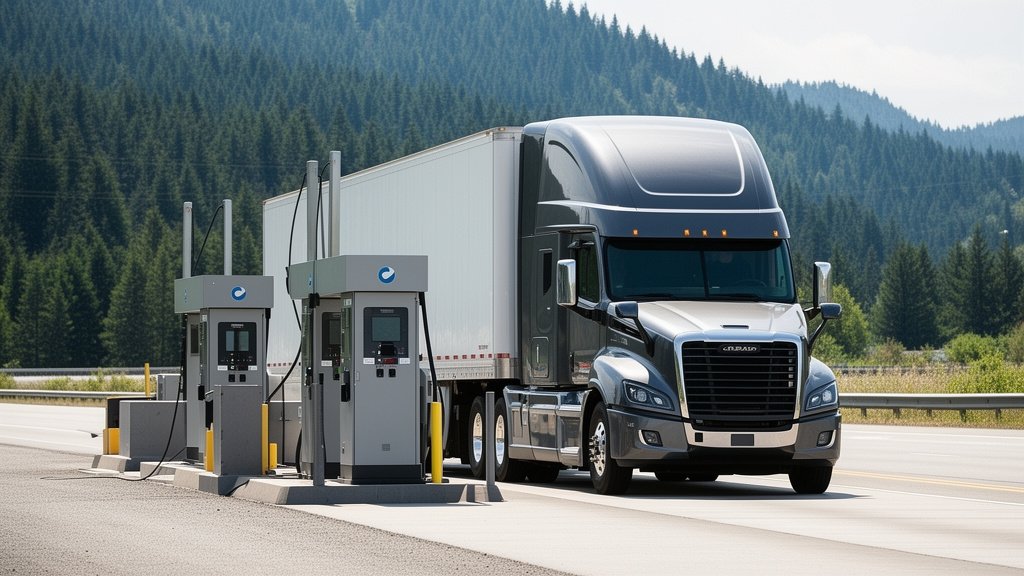
Washington state has officially solidified its commitment to the future of logistics, joining forces with Oregon and California in a massive, tri-state push to decarbonize the West Coast’s most critical commercial artery. With $21 million in newly secured federal funding, the Washington State Department of Transportation (WSDOT) is spearheading the installation of a comprehensive network designed to support zero-emission freight transport. This ambitious infrastructure project aims to turn the Interstate 5 (I-5) corridor into a seamless electric and hydrogen highway, bridging the gap from British Columbia, Canada, all the way to Baja California, Mexico.
The Infrastructure Backbone: Charging and Fueling
The project’s core objective is to eliminate the “range anxiety” that has historically throttled the adoption of electric heavy-duty vehicles. By placing 20 high-speed electric charging stations and three specialized hydrogen fueling stations strategically along Washington’s segment of I-5, the state is creating the necessary density for long-haul trucking companies to transition their fleets away from traditional diesel.
Electric vehicle (EV) charging technology is being tailored specifically for commercial use. Unlike consumer-level chargers, these stations will offer high-megawatt capacity, enabling heavy-duty trucks to recharge during mandatory rest periods. Meanwhile, the inclusion of three hydrogen fueling stations is a calculated strategic move. While battery-electric technology excels for shorter-haul and medium-duty freight, hydrogen fuel cells remain the frontrunner for ultra-long-haul applications, where weight constraints and rapid refueling times are non-negotiable for supply chain efficiency.
Why the I-5 Corridor Matters
The I-5 corridor is not just a road; it is the economic spine of the West Coast. Moving trillions of dollars in goods annually, it connects the major ports of the Pacific Northwest with the massive consumption centers of California and the manufacturing hubs to the north and south. Integrating this route into a unified zero-emission network is a logistical game-changer.
By aligning with Oregon and California, Washington is helping standardize infrastructure requirements. This tri-state synergy ensures that a trucking company operating in Seattle can rely on consistent, compatible technology all the way through Portland, Sacramento, Los Angeles, and beyond. This regulatory and technical harmony is essential to lowering the barrier of entry for logistics firms that otherwise fear fragmented, incompatible systems across state lines.
The Economic and Environmental Synergy
The transition to zero-emission freight is driven by a dual mandate: environmental stewardship and economic competitiveness. Heavy-duty trucking is a significant contributor to greenhouse gas emissions. Transitioning these fleets is one of the most effective ways to lower the carbon footprint of regional trade. However, the benefits extend beyond climate goals. Electric and hydrogen trucks offer lower maintenance costs and, as renewable energy scales, potentially more stable fueling costs compared to the volatile fluctuations of global diesel prices.
Moreover, this project positions the Pacific Northwest as a leader in the “Green Logistics” economy. By building out this infrastructure now, Washington is positioning its workforce to lead in the maintenance, engineering, and operation of advanced transport grids. It creates a local ecosystem of technical talent and industrial capabilities that will be highly sought after as other regions struggle to catch up.
Technical Challenges and Future-Proofing
Building this network is not without its hurdles. Integrating these high-load charging stations into the existing power grid requires significant upgrades to local substations and distribution networks. WSDOT, in partnership with private sector stakeholders and utility providers, is tasked with ensuring that this surge in electricity demand does not overwhelm the grid.
Furthermore, the selection of site locations is critical. Charging stations must be placed where drivers can access them easily without diverting from their optimized routes, yet they must also be near high-capacity electrical nodes. The planning phase involves complex geospatial modeling to balance truck stop proximity, power availability, and the specific daily operational habits of long-haul drivers. The integration of hydrogen stations presents its own set of logistical challenges, particularly in sourcing and transporting the fuel, which requires a specialized supply chain distinct from electric grids.
As the project progresses, the data gathered from these initial 23 stations will be invaluable. Washington’s model will likely serve as a blueprint for other states and international partners looking to build similar corridors, proving that with federal support and multi-jurisdictional cooperation, the decarbonization of heavy freight is not just a theoretical ambition, but an achievable reality.
FAQ: People Also Ask
Q: Why are both electric and hydrogen stations being built?
A: Battery-electric technology is highly efficient for medium-duty routes and shorter distances, while hydrogen fuel cell technology offers a higher energy density and faster refueling times, making it better suited for the heaviest, longest-haul trucking routes where weight and downtime are critical factors.
Q: How does this help truckers operating across state lines?
A: The tri-state initiative aims to create a consistent, reliable network of charging and fueling across Washington, Oregon, and California. This uniformity ensures that trucking companies do not encounter incompatible charging standards or “dead zones” while traversing the I-5 corridor, greatly reducing the risk of stranded vehicles.
Q: What is the timeline for the installation of these stations?
A: While specific construction start dates vary by site, the project is part of a broader federal push to accelerate infrastructure development. WSDOT is currently in the site-identification and grid-assessment phase, with federal funding allocations intended to fast-track the procurement and permitting process over the coming fiscal years.
Q: Will this project lower the cost of goods for consumers?
A: In the long term, yes. By reducing the reliance on volatile diesel prices and lowering fleet maintenance costs, zero-emission freight technology aims to make the logistics supply chain more stable and efficient, which can help mitigate the inflationary pressures often associated with fuel price spikes in transportation.