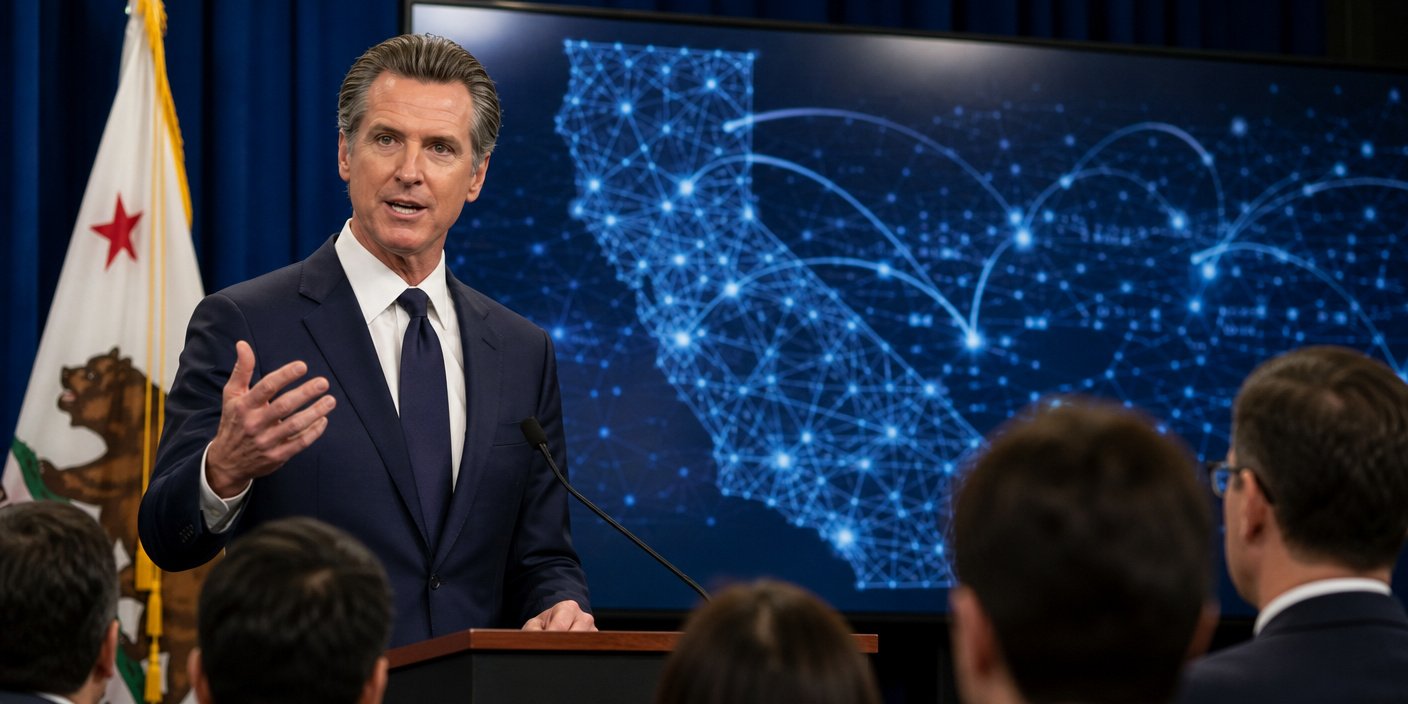
Governor Gavin Newsom has officially announced the launch of a groundbreaking AI Cyber Defense Program, a first-in-the-nation initiative designed to fortify California’s critical infrastructure against increasingly sophisticated digital threats. This strategic expansion of the Governor’s existing generative AI executive orders marks a shift toward proactive, machine-learning-driven defense mechanisms for the state’s most vital systems, including energy grids, water distribution, and transportation networks. By leveraging artificial intelligence, the administration aims to detect, analyze, and neutralize cyber-attacks with unprecedented speed and accuracy, establishing a blueprint for how state governments can manage the dual risks and opportunities of emerging technology.
Key Highlights
- Proactive Threat Detection: The AI Cyber Defense Program utilizes advanced machine learning models to monitor real-time traffic across state infrastructure networks, identifying anomalies that indicate potential cyber-attacks before they escalate.
- First-in-the-Nation Scale: California is the first state to integrate AI-driven defense at this scale, expanding upon the regulatory framework established by Governor Newsom’s 2023 Executive Order (N-12-23).
- Collaborative Resilience: The initiative mandates inter-agency cooperation, pulling resources from the California Office of Emergency Services (Cal OES) and the California Department of Technology to create a unified cybersecurity posture.
- Future-Proofing Infrastructure: The program is specifically targeted at protecting physical-digital hybrid systems, such as smart power grids and automated water treatment facilities, which remain primary targets for state-sponsored and criminal hacking collectives.
Fortifying the Digital Frontier: The AI Cyber Defense Strategy
In an era where infrastructure is increasingly digitized, the surface area for cyber-attacks has expanded exponentially. California’s critical infrastructure—which serves nearly 40 million residents and accounts for one of the world’s largest economies—has become a high-value target for adversaries seeking to disrupt essential services. The newly launched AI Cyber Defense Program represents a fundamental shift in how the state addresses this vulnerability: moving from a reactive model, which waits for breach detection, to an anticipatory model driven by predictive AI.
The Evolution of Threat Detection
Traditional cybersecurity protocols often rely on static rules or known signatures to identify threats. However, modern attacks utilize polymorphic code and social engineering tactics that bypass these outdated layers. The state’s new initiative leverages AI to perform behavioral analysis, establishing a “baseline” of normal operations across critical utilities. When deviations occur—such as unauthorized access patterns or unusual data flow spikes—the AI system can trigger automated containment procedures. This provides a critical buffer, allowing human security analysts to intervene before a full-scale systemic compromise occurs.
Strategic Infrastructure Partnerships
While the program is led by the California Department of Technology and the California Office of Emergency Services, its success relies on a unique public-private partnership. The state is collaborating with leading cybersecurity firms and academic institutions to refine the AI training datasets. By pooling data on known threats without compromising sensitive infrastructure information, the state can train its defense AI to recognize emerging patterns of attack that have not yet been seen in the wild. This “hive-mind” approach ensures that the defense system evolves as quickly as the threats it faces.
The Regulatory Framework for AI
This initiative is not an isolated effort but a logical evolution of Governor Newsom’s comprehensive AI framework. In September 2023, the Governor signed Executive Order N-12-23, which called for a deeper analysis of the risks and benefits associated with Generative AI (GenAI). The new Cyber Defense Program builds on this foundation by applying the rigorous ethical and safety standards developed during the EO’s implementation phase. By prioritizing transparency and accountability in how these AI tools monitor and manage public data, the administration aims to ensure that the security measures themselves do not introduce new privacy risks or algorithmic biases into the critical infrastructure they are designed to protect.
Secondary Angles: A National Model
1. Historical Context: This program marks the end of an era where state cyber-defense was largely outsourced to decentralized private contractors, centralizing authority and standardizing responses.
2. Economic Impact: The push for AI-based cybersecurity is expected to spur growth in the local tech sector, creating high-skill job opportunities for AI researchers and network security engineers within the state capital and surrounding tech corridors.
3. Scaling the Model: As other states grapple with similar infrastructure threats, California’s framework is likely to serve as the “Golden Standard,” influencing federal guidelines on how to safely integrate AI into public utility protection systems.
FAQ: People Also Ask
1. What is the goal of the new AI Cyber Defense Program?
The primary goal is to use predictive AI to secure California’s critical infrastructure—such as power, water, and emergency systems—from cyber threats by detecting and mitigating potential attacks in real-time.
2. Is this part of a larger plan?
Yes. This initiative is a strategic expansion of Governor Newsom’s Executive Order (N-12-23), which established the state’s overarching policy for the safe and responsible deployment of Generative AI technology.
3. Will this affect user privacy for California residents?
State officials have emphasized that the program adheres to the strict privacy and safety guidelines established in the Governor’s existing AI executive orders, focusing on network-level protection rather than the surveillance of individual user data.
4. Which state agencies are leading this effort?
The California Office of Emergency Services (Cal OES) and the California Department of Technology are the primary agencies spearheading the integration and deployment of the AI defense protocols.