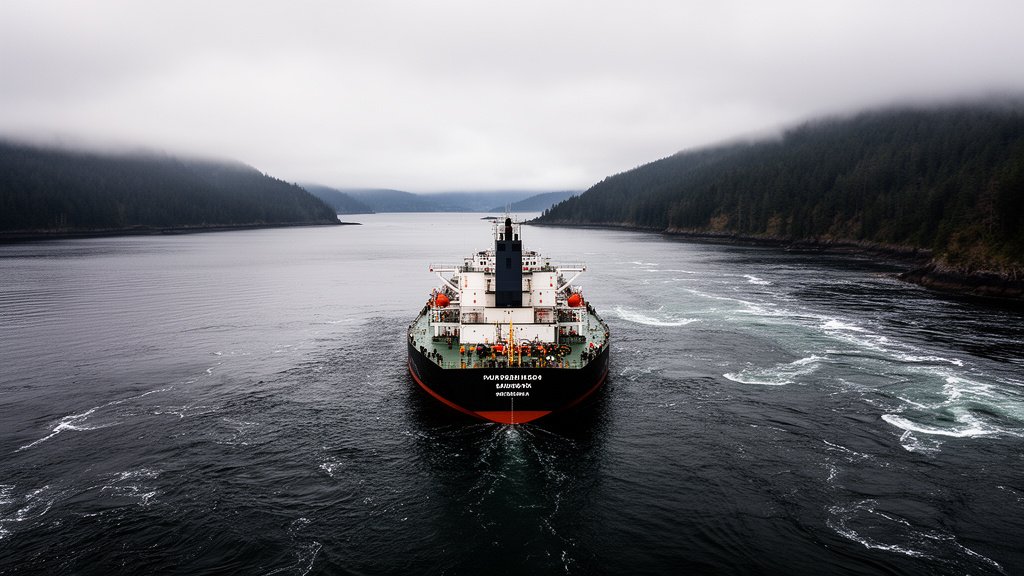
The Salish Sea, a delicate international waterway cradling the San Juan Islands and the Gulf Islands, faces an existential threat as local governance bodies escalate their resistance against the proposed expansion of Canadian oil sands transport infrastructure. San Juan County Council, representing Washington State’s interests, and the Islands Trust, the governing authority for British Columbia’s islands, have formalized a coalition to challenge the dramatic increase in supertanker traffic. The project in question—centered on the Trans Mountain Pipeline expansion—is slated to funnel up to 1 million barrels of crude oil daily into the Strait of Georgia, a move that critics argue exposes the ecologically sensitive marine environment to unacceptable risks of catastrophic spill events and acoustic pollution.
Key Highlights
- The Scale of Risk: The project aims to increase capacity to nearly 1 million barrels of crude oil daily, triggering a massive surge in supertanker traffic through the Salish Sea.
- Cross-Border Cooperation: San Juan County and the Islands Trust have formed an unprecedented inter-jurisdictional alliance to advocate for the protection of international waters shared by the U.S. and Canada.
- Ecological Vulnerability: The Southern Resident Killer Whale population and local fisheries serve as the primary focus, with experts citing the impossibility of effective clean-up in the event of a diluted bitumen spill.
The Pipeline Paradox: Energy Economics vs. Ecological Integrity
The central tension of the current battle lies in the disparity between the economic ambitions of energy exporters and the preservation of a bioregion that cannot withstand industrial error. The expansion of the Trans Mountain Pipeline is not merely a commercial infrastructure project; it represents a fundamental shift in the risk profile of the Salish Sea. Currently, the movement of oil through these waterways involves a calculated risk, but the proposed tripling of tanker traffic—from approximately 60 tankers per year to over 400 annually—changes the math entirely.
The Anatomy of the Threat
From the perspective of local councils, the threat is three-fold: immediate spill risk, acoustic disturbance, and the broader impact of vessel wake and emissions. Diluted bitumen, the primary product of the oil sands, behaves unpredictably when spilled in cold saltwater. Unlike lighter crudes that might evaporate or float, ‘dilbit’ can sink and emulsify, making recovery efforts in the complex, current-heavy archipelago of the San Juan Islands functionally impossible.
The Jurisdictional Quagmire
The alliance between San Juan County and the Islands Trust is unique because it forces a conversation across international borders. Environmental regulations often stop at the 49th parallel, yet the marine ecosystem knows no such boundary. By coordinating their legislative and public advocacy efforts, these two bodies are attempting to create a ‘unified governance block’ that can effectively lobby both the U.S. federal government and the Canadian authorities in Ottawa and Victoria. This collaboration highlights the critical need for a trans-border management framework that acknowledges the interconnectedness of the Salish Sea watershed.
Protecting the Southern Resident Killer Whales
Perhaps the most emotive and scientifically significant component of this opposition is the protection of the Southern Resident Killer Whale (SRKW) population. With fewer than 80 individuals remaining, the species is teetering on the brink of extinction. Increased tanker traffic introduces not only the risk of ship strikes but, more pervasively, high levels of underwater noise pollution. This acoustic ‘smog’ interferes with the whales’ echolocation, effectively ‘blinding’ them as they hunt for Chinook salmon—their primary food source. The coalition argues that the additional traffic volume is the final straw for a population already struggling with dwindling prey and chemical contaminants.
The Future of Emergency Response
One of the most persistent, unanswered questions in this debate is the readiness of current response infrastructure. Despite assurances from industry players that safety measures are robust, local officials from San Juan County maintain that the current response capacity—including tug escorts and boom deployment capabilities—is insufficient to handle a major spill in the high-energy, tidal-restricted environment of the Haro and Rosario Straits. The coalition is pressing for independent, third-party spill modeling that accounts for real-world conditions, rather than idealized ‘calm water’ scenarios that rarely exist in the Salish Sea.
FAQ: People Also Ask
What is the primary concern regarding the 1 million barrels of oil?
The primary concern is the catastrophic environmental impact of a potential spill, specifically of diluted bitumen (dilbit), and the logistical inability to contain it in the tidal-heavy waters of the Salish Sea.
How does the Islands Trust differ from San Juan County?
While both act as local government bodies, the Islands Trust is a unique federation of local governments in British Columbia with a specific mandate to ‘preserve and protect’ the environment, whereas San Juan County is a Washington State county government. Their union signifies a rare cross-border consensus on environmental risk.
What can residents do to support this coalition?
Residents can monitor the official progress of the San Juan County Council and Islands Trust public hearings, participate in local environmental advocacy groups, and engage in public comment periods when environmental impact assessments are released for review.
Does this pipeline only affect Canadian waters?
No. The tankers must transit through the Haro Strait and the Strait of Juan de Fuca, which are shared U.S.-Canada waters. A spill anywhere along this route would likely devastate the coastlines and marine habitats of both nations.