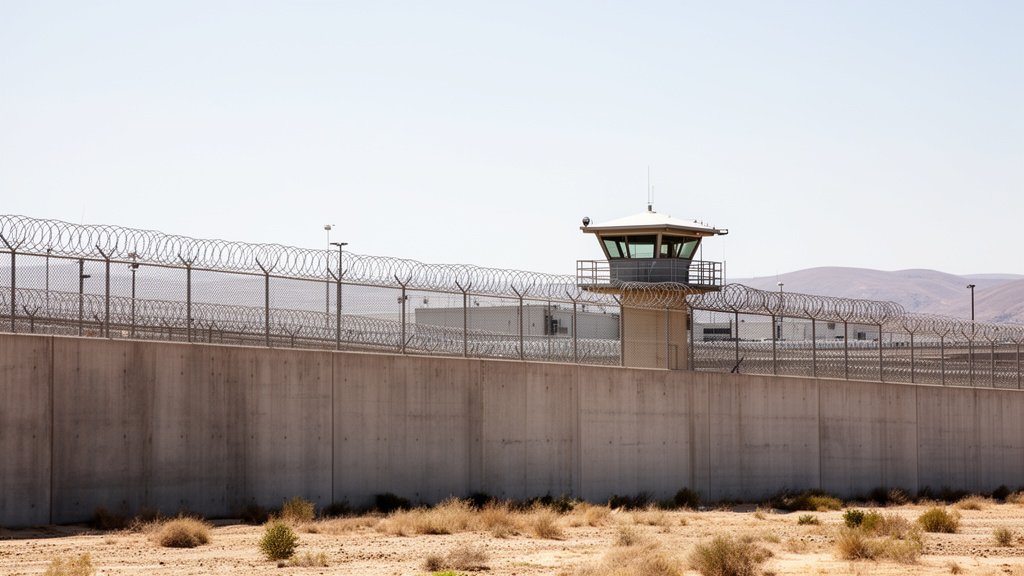
The landscape of rural California is undergoing a seismic shift as the state’s massive prison industrial complex continues its contraction. For decades, the California Department of Corrections and Rehabilitation (CDCR) served as the primary economic engine for isolated, geographically remote communities. Now, following years of declining inmate populations—driven by significant legislative reforms like Proposition 47 and Proposition 57—the state has begun a process of consolidation, leading to the closure of high-profile facilities. This retreat from the ‘prison-first’ economic model has left towns like Susanville and Blythe facing a bleak, immediate reality: the sudden evaporation of hundreds of middle-class state jobs, a gutted tax base, and the haunting question of how to redefine a community once synonymous with incarceration.
Key Highlights
- Massive Population Decline: California’s prison population has plummeted from historic highs of over 170,000 in the early 2010s to approximately 95,000, prompting the state to reassess its facility footprint.
- Closure Timeline: The state shuttered the California Correctional Center (CCC) in Susanville in June 2023, and the Chuckawalla Valley State Prison (CVSP) in Blythe was slated for closure by March 2025, eliminating nearly 1,000 state jobs in the latter alone.
- Economic Ripple Effect: The closures do not just impact correctional officers; they hit local school budgets, service-industry businesses, and housing markets, which rely heavily on the purchasing power of prison staff.
- Legislative Drivers: Voters and lawmakers have pivoted toward diversion and rehabilitation, creating a structural surplus of bed capacity that makes continued operation of older, maintenance-heavy facilities fiscally unsustainable.
The Anatomy of Economic Displacement
In California’s interior, the prison system was often viewed as a recession-proof employer. When the CDCR opened facilities in places like Susanville in Lassen County or Blythe in Riverside County, they weren’t just building jails; they were importing a stable, middle-class workforce. These jobs provided salaries that supported families, funded local school districts through tax revenue, and sustained a ecosystem of grocery stores, restaurants, and service providers.
However, the closure of the California Correctional Center (CCC) in 2023 marked a turning point. The fight to keep CCC open became a flashpoint for regional friction between local governments and the state administration in Sacramento. Municipal leaders argued that the closures were a ‘gut punch’ to rural stability, while state officials maintained that the aging infrastructure and declining inmate counts made the continued operation of such facilities an unnecessary burden on the state budget.
The Multiplier Effect of Job Loss
When a prison closes, it is not simply the loss of the correctional officer positions that cripples a town. It is the ‘multiplier effect.’ For every one job inside the prison walls, there is a secondary job in the community—a teacher, a contractor, a barista, or a mechanic—that is supported by that state salary.
In Blythe, the closure of Chuckawalla Valley State Prison represents the loss of a massive institutional pillar. For communities with few alternative industries, the loss of these state-funded roles often leads to a ‘brain drain,’ where the most skilled residents move to metropolitan hubs in search of employment, leaving behind a shrinking population and a declining tax base. This creates a feedback loop: lower tax revenue leads to poorer public services, which further discourages new private investment in the area.
Legislative Context: The Shift in Corrections
To understand the crisis, one must look at the structural changes in California’s judicial policy. Proposition 47, passed in 2014, reclassified certain low-level, non-violent crimes as misdemeanors, and Proposition 57 allowed for expanded parole consideration. These, combined with judicial interventions, have fundamentally altered the state’s inmate demographics.
With fewer people behind bars, the CDCR has faced a ‘capacity surplus.’ While the state has saved money on operational costs—estimated in the hundreds of millions—these savings have largely remained in state coffers, rarely trickling down to the local communities that suffer the direct impact of facility shutdowns. The SEIU Local 1000, representing many state employees, has frequently pushed back against the speed of these closures, arguing for more robust transition plans for the workers affected.
Can Alternative Industries Fill the Void?
Local leaders in affected regions are now in a frantic race to re-identify their economic identities. Some are lobbying for the conversion of prison sites into alternative industrial hubs, such as green energy production, logistics, or even specialized manufacturing. However, these transitions are easier said than done.
Many of these towns are geographically isolated, lacking the fiber-optic infrastructure or the skilled labor force required for the modern tech or green-energy economies. The ‘prison town’ identity, once an asset for stability, has now become a liability in attracting modern businesses that prioritize quality of life, cultural amenities, and connectivity. As the state moves forward with its reform agenda, the fate of these towns rests on whether the state government will treat these shutdowns as a localized fiscal exercise or a broader, regional economic responsibility.
FAQ: People Also Ask
1. Why is California closing prisons despite having a high crime rate?
It is a matter of capacity versus population. California’s prison population has declined by nearly 45% over the last decade. Many older facilities were also found to be earthquake-unsafe or required hundreds of millions of dollars in deferred maintenance, making them inefficient compared to newer or consolidated facilities.
2. What happens to the prisoners when a facility closes?
Prisoners are typically transferred to other, often newer or less-crowded, state facilities. The CDCR manages the logistics of these transfers, ensuring that the inmate population is distributed across the remaining, operational network of state prisons.
3. Are there any state programs to help towns transition after a prison closure?
Yes, there have been some state-level economic development grants and transition task forces established, but local officials often argue these funds are insufficient to replace the long-term, stable employment provided by the correctional facilities.
4. Is the closure of prisons the final goal of California’s penal reform?
Not necessarily. Reformers generally focus on reducing recidivism and changing sentencing laws. Prison closures are a secondary result of those policies—the infrastructure is being sized down to fit the current and projected incarcerated population, which is significantly smaller than it was twenty years ago.