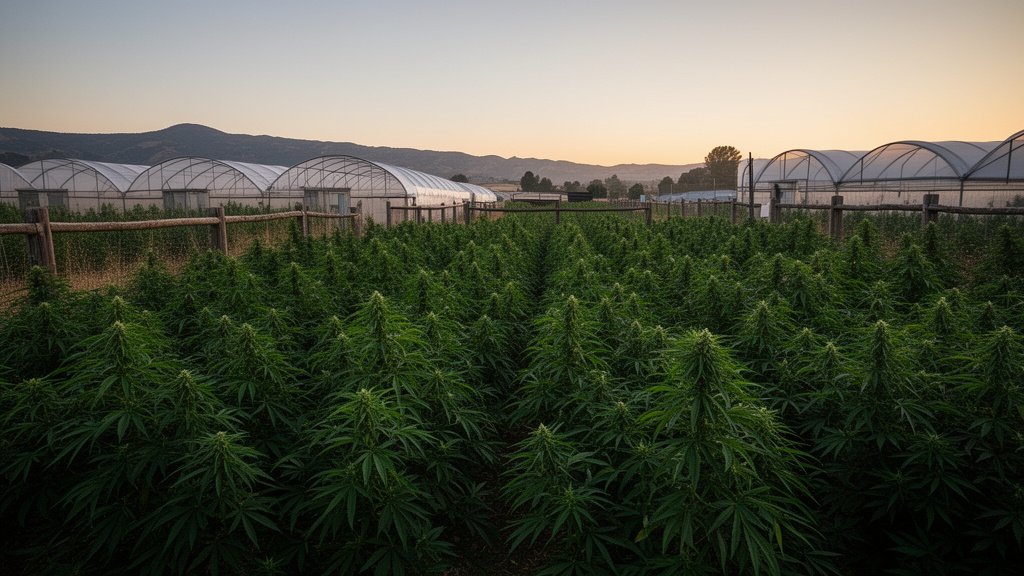
The intersection of state-regulated cannabis and federal prohibition has created a volatile legal landscape, nowhere more evident than in the recent high-profile ICE operation targeting a California cultivation site. While the raid was framed by authorities as an enforcement action against illicit activity, the human cost reveals a far more complex reality. The operation did not just disrupt an agricultural business; it fundamentally altered the trajectories of three distinct individuals—an army veteran, a farmworker, and a university professor—whose lives converged in a rural cultivation zone, only to be dismantled by a sudden surge of federal authority.
The Human Collateral: Three Lives Defined by Enforcement
The raid, conducted in the early hours of a Tuesday, underscored the profound disconnect between state-sanctioned cultivation and federal drug policy. For the army veteran employed at the site, the experience was a jarring reversal of service. Having served in combat zones overseas, he found himself facing federal agents on domestic soil, stripped of the security he had worked years to build. His transition to agriculture was a deliberate choice—a way to manage the invisible wounds of service in a setting that prioritized growth and recovery. When the raid occurred, his legal status as a licensed worker offered no immediate protection, and his post-service stability was shattered in a matter of minutes.
Simultaneously, the impact on the seasonal farmworker was immediate and devastating. Operating in a precarious legal limbo, this worker—who had been a vital part of the regional economy for nearly a decade—found their livelihood evaporated. The raid did not only lead to job loss; it triggered a cascade of legal complexities involving immigration status and regional labor compliance, forcing them into a state of forced displacement. Finally, the university professor, who was conducting long-term sociological research on the impact of cannabis legalization on rural economies, found their data, credentials, and reputation entangled in a federal investigation. The confiscation of research materials and the subsequent legal scrutiny effectively paralyzed an ongoing academic inquiry that had been funded by state grants.
Regulatory Limbo: Why Cannabis Operations Remain Targets
The central tension driving these raids is the ongoing conflict between the Controlled Substances Act (CSA) and California’s Proposition 64. While the state has established a rigorous framework for commercial cannabis, the federal government maintains that the substance is a Schedule I drug, granting agencies like ICE, the DEA, and the Department of Justice (DOJ) broad authority to intervene.
This legal friction creates a ‘regulatory gray zone.’ Even operations that are compliant with state licensing requirements can be deemed illicit at the federal level. For the individuals caught in this raid, the tragedy was not a matter of local law-breaking, but a clash of jurisdictions. The National Cannabis Industry Association has repeatedly argued that this lack of federal alignment incentivizes agencies to treat lawful, state-sanctioned businesses as targets, creating a climate of fear that destabilizes the market and criminalizes legitimate economic activity.
Legal Ramifications and Constitutional Challenges
The legal fallout from the raid highlights significant questions regarding the Fourth and Fifth Amendments. For the professor, the seizure of research notes and digital devices raises critical issues about academic freedom and the protection of intellectual property. For the workers, the lack of due process often associated with expedited federal enforcement actions is a recurring grievance. Legal counsel involved in the aftermath of the raid suggests that these operations often utilize civil forfeiture laws to seize assets, making it nearly impossible for affected parties—regardless of their level of involvement—to recoup losses or clear their names without years of litigation. The financial burden alone serves as a de facto penalty, often forcing those with the fewest resources to accept settlements or suffer ruinous consequences.
Future Outlook: Federal Enforcement Shifts
As public opinion shifts in favor of broader cannabis legalization, the political cost of these raids is rising. Critics argue that diverting federal resources to target state-compliant agricultural operations is an inefficient use of taxpayer dollars, especially when the focus is on workers and researchers rather than high-level criminal syndicates. Looking ahead, the case of this California farm will likely serve as a pivotal reference point for proposed federal legislative reforms. The legislative path toward descheduling cannabis remains slow, but the stories of the veteran, the worker, and the professor are increasingly being used as human-centric evidence for why a federal policy update is not just economic policy, but a civil rights necessity.
FAQ: People Also Ask
Q: Why does ICE raid cannabis farms if it is legal in California?
A: ICE and other federal agencies operate under federal law, specifically the Controlled Substances Act, which still classifies cannabis as a Schedule I substance. State laws do not preempt federal drug laws, allowing federal agencies to intervene in operations they deem illicit under federal standards.
Q: What happens to the seized property in these raids?
A: Property seized during these operations is often subjected to civil asset forfeiture. This is a complex legal process where the government can retain assets if they are alleged to be associated with federal crimes, often making it difficult and expensive for owners to reclaim them.
Q: How does this impact the legal cannabis industry?
A: These raids create immense market instability, deter investment, and discourage qualified professionals and labor from entering the industry, fearing the potential for sudden federal intervention regardless of state-level compliance.