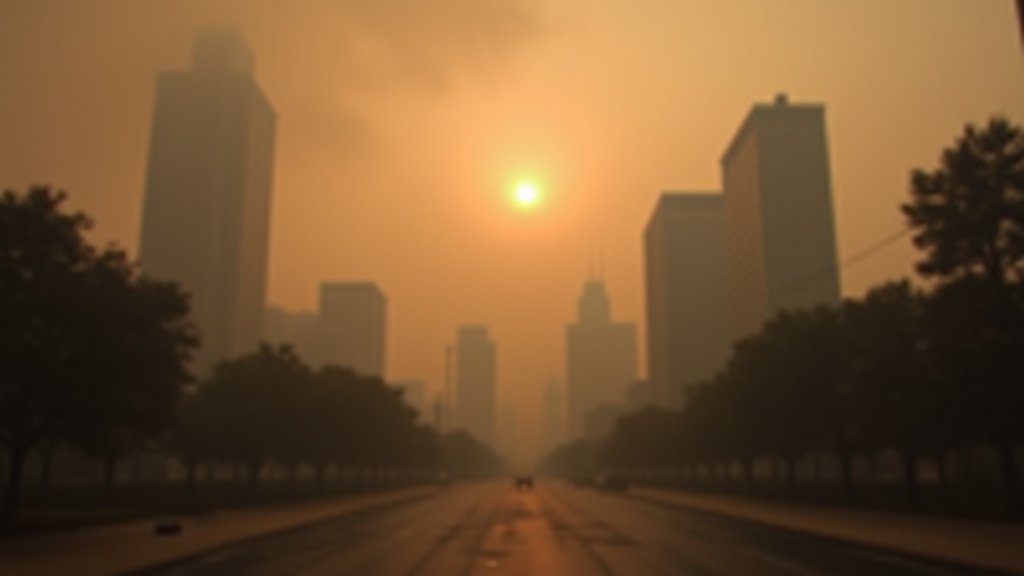
Millions of Americans are experiencing a stark reminder of the volatile nature of the current wildfire season, as thick smoke plumes generated by large-scale fires in the Pacific Northwest—specifically across Oregon, Washington, and British Columbia—have drifted thousands of miles east, reaching as far as Ohio. This phenomenon, which has turned brilliant blue skies into hazy, muted grays and ochre, serves as a significant atmospheric disruption, forcing local governments to issue urgent air quality alerts and public health advisories.
Key Highlights
- Massive Geographic Reach: Smoke originating from the Pacific Northwest and British Columbia has been transported by high-altitude winds across the Midwest, causing hazy conditions in states as far east as Ohio.
- Health Risks Elevated: Public health officials are emphasizing the dangers of PM2.5—particulate matter 2.5 micrometers or smaller—which can bypass the body’s natural defenses, leading to respiratory and cardiovascular issues.
- Air Quality Alerting: Local agencies across the affected path are implementing “Code Orange” and “Code Red” air quality designations, advising vulnerable populations to limit outdoor exposure.
- Atmospheric Transport: The phenomenon is driven by persistent jet stream patterns that act as a conveyor belt, effectively “exporting” smoke from the wildfire-ravaged West to the populated Midwest and Great Lakes regions.
The Atmospheric Conveyor Belt: How Smoke Travels Thousands of Miles
The current haze blanketing the Midwest is not merely a result of local fires, but a demonstration of sophisticated atmospheric transport. The Pacific Northwest, experiencing an exceptionally dry season, has seen a proliferation of active wildfires. These fires inject vast quantities of smoke, ash, and chemicals into the upper troposphere.
Typically, smoke from these massive blazes is caught in the prevailing westerly winds, specifically the jet stream. Meteorologists have noted that a persistent high-pressure ridge has locked into place, creating an “atmospheric highway.” This channel allows particulate matter to be transported rapidly across the Continental Divide. When this smoke reaches the Midwest and Ohio Valley, it often settles into the lower atmosphere due to temperature inversions, trapping the pollutants near the surface where humans breathe. The result is the hazy, muted sun and orange-tinted sunsets that residents have reported.
The Science of PM2.5 and Public Health
At the center of this environmental concern is PM2.5. Unlike larger dust particles that can be filtered out by the nose and throat, PM2.5 is minute—roughly 3% the diameter of a human hair. Because of its microscopic size, it penetrates deep into the lungs and can even enter the bloodstream.
Health organizations, including the EPA and local departments of health, utilize the Air Quality Index (AQI) to categorize the risk. During these smoke events, AQI levels frequently jump into the “Unhealthy for Sensitive Groups” range. For individuals with asthma, COPD, or cardiovascular disease, this level of particulate exposure is not merely an inconvenience but a significant medical trigger. Physicians are urging these populations to rely on HEPA-grade air purifiers, seal windows, and avoid strenuous outdoor activity until the plumes dissipate.
Economic and Societal Ripples
The impact of these widespread smoke events extends well beyond public health; it creates substantial economic friction. Aviation is among the first sectors to face disruption. Low visibility caused by dense smoke has forced regional airports to delay or ground flights, impacting supply chains and business travel across the northern U.S.
Furthermore, the agricultural sector faces a unique set of challenges. While smoke can theoretically lower temperatures by reflecting sunlight, the diffuse light can actually alter photosynthesis rates in crops. Additionally, outdoor-based industries, from construction to tourism, report productivity losses as employers prioritize the safety of their workforce, leading to stalled projects and canceled events.
The ‘New Normal’: Climate Change and the Extended Fire Season
Climate scientists and forestry experts are increasingly classifying these smoke-drenched summers as the “new normal.” Historically, the fire season in the Pacific Northwest was contained to a shorter window. Today, due to earlier snowmelt, prolonged drought conditions, and the “heat dome” phenomenon, the drying of biomass—forest fuel—begins months earlier and persists through autumn.
This structural change in the climate means that the U.S. is witnessing a paradigm shift where “fire season” is no longer regional but national. When the Pacific Northwest burns, the entire country breathes the consequences. Adaptation strategies are now becoming mandatory, with municipal planning committees in cities far removed from the forests now considering smoke-mitigation strategies as part of their urban infrastructure, such as “clean air centers” and more robust HVAC mandates for public buildings.
FAQ: People Also Ask
Why does the smoke travel so far without dissipating?
Smoke contains carbonaceous particles and aerosols that are incredibly light. When injected into the upper atmosphere by the heat energy of large wildfires, these particles can be carried by high-altitude winds (the jet stream) for thousands of miles before gravity pulls them down to the surface or precipitation washes them out.
How long will these hazy skies last?
The duration of the haze depends entirely on fire activity in the Pacific Northwest and the shifting of the jet stream. If wind patterns alter or if significant rainfall occurs over the burn zones, the smoke transport will cease. However, as long as the fires remain uncontained, the threat of subsequent smoke waves remains.
Is it safe to exercise outdoors when the sky is hazy?
Generally, no. Even if the air does not smell like smoke, if the sky is hazy, PM2.5 levels are likely elevated. Exercising increases the volume of air you inhale, which means you are bringing more particulate matter into your lungs. It is best to monitor your local Air Quality Index (AQI) via government resources like AirNow.gov before engaging in outdoor exertion.