How a New Generation of Dealmakers, Strategists, and Entrepreneurs Is Quietly Reshaping Hip-Hop
By Sierra Dalton
When most people think about power in the music industry, they think about artists.
They think about Drake, Kendrick Lamar, Future, Travis Scott, Nicki Minaj, and the superstars who dominate streaming platforms, arena tours, and social media conversations. They think about the faces of the culture because those are the people audiences interact with every day.
What most fans never see is the infrastructure operating behind the scenes.
For every artist signing a major deal, there is someone negotiating it. For every catalog acquisition making headlines, there is someone who spent months—or years—putting the pieces together. For every brand partnership, distribution agreement, licensing opportunity, or career revival, there is usually a small group of people working quietly in the background to make it happen.
The music industry has always had these people. What has changed is how important they have become.
Over the last two decades, the business of music has undergone a transformation unlike anything in its history. The rise of streaming, social media, independent distribution, catalog investing, creator economies, and now artificial intelligence has fundamentally altered how careers are built and how money moves throughout the industry.
Many of the traditional gatekeepers still exist, but they no longer control access in the way they once did. Artists can reach audiences directly. Independent companies can compete with major labels. Investors can buy music assets. Content creators can build audiences that rival traditional media companies.
In theory, all of this should have made the industry easier to navigate.
Instead, it has made it significantly more complicated.
Today an artist may need to understand publishing, distribution, touring, social media strategy, licensing, branding, merchandising, sponsorships, content monetization, intellectual property rights, and data analytics before they ever step into a boardroom. The opportunities available to creators have never been greater, but neither has the complexity.
That complexity has created demand for a new type of executive.
Within industry circles, they are often referred to as fixers.
The term can mean different things depending on who you ask. Some fixers are managers. Others are publicists, entrepreneurs, investors, distributors, or executives. What they all have in common is an ability to solve problems and create opportunities where others see obstacles.
A fixer is rarely the smartest attorney in the room, the best marketer in the room, or the most connected executive in the room. Their value comes from understanding how all of those people fit together.
The best fixers understand that the music industry is not a collection of separate businesses. It is an ecosystem. A distribution deal can impact publishing. A publishing decision can affect valuation. Valuation can influence investment. Investment can create leverage. Leverage can change the outcome of a negotiation.
The further one moves up the food chain of the music business, the more obvious those connections become.
Consider something as seemingly straightforward as a catalog acquisition.
From the outside, it often looks simple. An investor wants to purchase a music catalog and an artist wants liquidity. A transaction occurs and both parties move on.
In reality, some of the largest catalog transactions in the industry involve months of due diligence, rights verification, royalty audits, legal review, valuation modeling, tax planning, and negotiations among multiple stakeholders. The catalog itself is rarely the difficult part. The challenge is aligning all of the interests surrounding it.
The same can be said for artist management, distribution partnerships, licensing agreements, sponsorship deals, and virtually every major business decision in modern music.
That is where fixers create value.
Their role is not necessarily to control a transaction. Their role is to understand how to move it forward.
In many ways, the rise of the fixer mirrors the rise of hip-hop itself.
Hip-hop has always rewarded entrepreneurs. Long before ownership became a mainstream industry talking point, artists within the culture were building labels, launching clothing brands, investing in businesses, and creating independent revenue streams. As the genre evolved into the dominant force in global popular culture, the business surrounding it evolved as well.
Today some of the most influential people in hip-hop are not artists at all. They are the executives, founders, managers, strategists, and entrepreneurs helping build the infrastructure behind the culture.
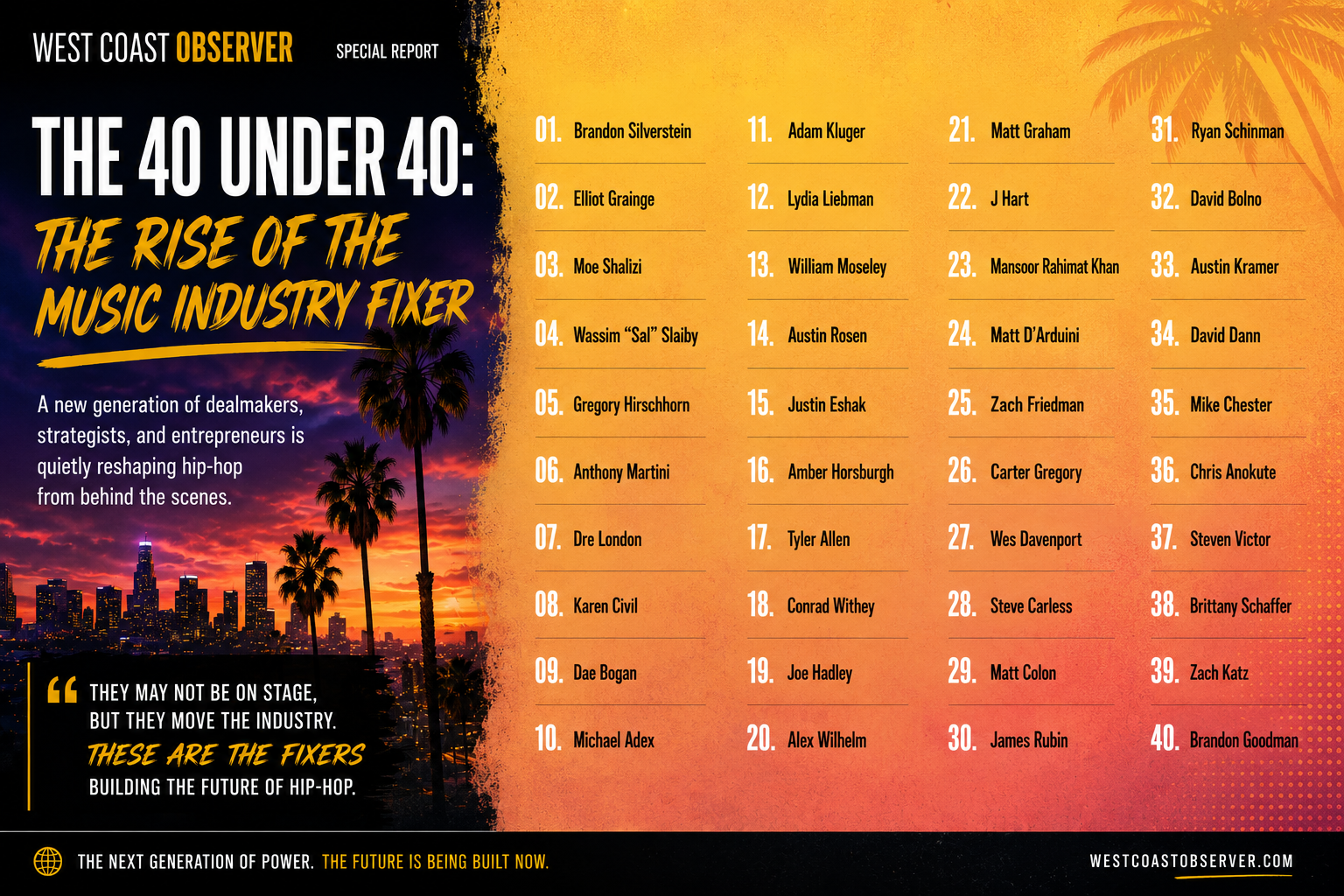
That reality inspired HipHop.News to create its inaugural ranking of the most powerful under-40 music industry fixers.
Rather than focusing solely on title or visibility, the ranking considered influence, execution, innovation, and what we call the Fixer Factor—the ability to solve problems, connect opportunities, and create outcomes that might not otherwise exist.
The result is a list that reflects not only where power exists today, but where the industry itself appears to be heading.
The 40 Under 40: Music Industry Fixers
Top 10
- Brandon Silverstein
- Elliot Grainge
- Moe Shalizi
- Wassim “Sal” Slaiby
- Gregory Hirschhorn
- Anthony Martini
- Dre London
- Karen Civil
- Dae Bogan
- Michael Adex
11–20
- Adam Kluger
- Lydia Liebman
- William Moseley
- Austin Rosen
- Justin Eshak
- Amber Horsburgh
- Tyler Allen
- Conrad Withey
- Joe Hadley
- Alex Wilhelm
21–30
- Matt Graham
- J Hart
- Mansoor Rahimat Khan
- Matt D’Arduini
- Zach Friedman
- Carter Gregory
- Wes Davenport
- Steve Carless
- Matt Colon
- James Rubin
31–40
- Ryan Schinman
- David Bolno
- Austin Kramer
- David Dann
- Mike Chester
- Chris Anokute
- Steven Victor
- Brittany Schaffer
- Zach Katz
- Brandon Goodman
What stands out about this year’s list is how difficult many of these individuals are to categorize. A generation ago, executives generally occupied clearly defined roles. They were managers, label executives, publishers, promoters, or investors.
Today’s industry leaders often operate across several disciplines simultaneously.
Many are entrepreneurs who happen to manage artists. Others are executives who invest in technology companies. Some operate media businesses while advising brands and artists. Several have built careers by moving fluidly between music, finance, technology, marketing, and entertainment.
That trend is unlikely to slow down.
If anything, the future will require even greater versatility. Artificial intelligence, catalog investing, creator economies, gaming, and emerging technologies are creating new opportunities at a pace few industries can match. As those opportunities grow, so too will the demand for people capable of navigating increasingly complex ecosystems.
For decades, power in the music industry belonged primarily to gatekeepers. The people who controlled access controlled opportunity.
Today, power increasingly belongs to navigators.
The executives on this list have built careers not by standing in front of the spotlight, but by understanding how the spotlight works, who controls it, and where it is moving next.
Artists will always remain the face of the culture.
But as hip-hop continues to evolve into a global business worth billions of dollars, the people quietly connecting opportunities behind the scenes may become just as important to its future.
The rise of the music industry fixer is ultimately a story about the evolution of power itself. In an industry defined by constant change, the people who can connect ideas, opportunities, capital, technology, and talent have become some of its most valuable assets.
And judging by the careers of the individuals on this year’s list, their influence is only beginning.