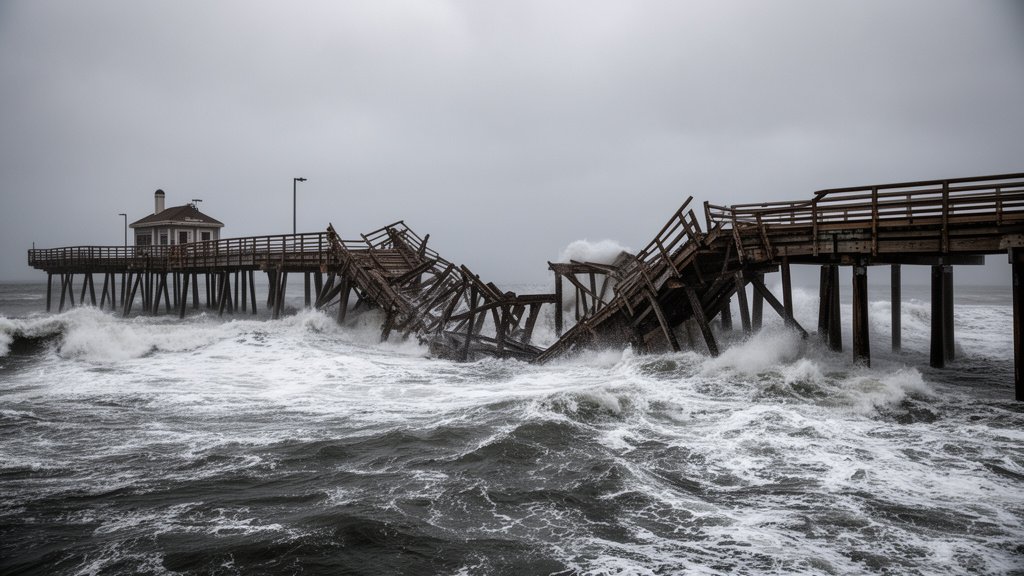
Thanksgiving festivities across the West Coast were abruptly halted as a severe, moisture-laden storm system barreled into the California coastline, triggering widespread flooding, power outages, and catastrophic infrastructure damage. At the heart of the crisis, the historic Pacifica Municipal Pier suffered a structural failure, a grim testament to the overwhelming power of the ongoing super El Niño event coupled with extreme tidal surges. As emergency crews struggled to navigate the treacherous conditions, the collapse serves as a stark warning regarding the vulnerability of coastal assets to intensifying climate patterns.
Key Highlights
- Infrastructure Failure: The Pacifica Municipal Pier, a vital community landmark, suffered a major structural collapse as relentless wave action overwhelmed its aging support pilings.
- Meteorological Confluence: The disaster was driven by a “perfect storm” scenario: a high-precipitation atmospheric river event, extreme “king tide” conditions, and a strong El Niño pattern elevating base sea levels.
- Regional Impact: Widespread flooding and wind damage affected large swaths of the West Coast, with transportation networks experiencing significant delays and closures throughout the holiday.
- Economic & Safety Concerns: Local authorities have declared safety zones around compromised coastal areas, as economic fallout from tourism disruptions and repair costs begins to mount.
The Anatomy of a Coastal Crisis
The collapse of the Pacifica Municipal Pier is not merely an isolated incident of structural failure; it is the manifestation of a compounding climate crisis. For days leading up to the Thanksgiving holiday, the National Weather Service (NWS) had issued urgent warnings regarding a massive atmospheric river—a long, narrow region in the atmosphere that transports most of the water vapor outside of the tropics. When this moisture met the West Coast, it stalled, dumping inches of rain onto already saturated soil and creating hazardous surf conditions that defied typical seasonal averages.
The Pacifica Pier: A Casualty of Environmental Stress
For years, the Pacifica Municipal Pier has been an emblem of the city’s coastal heritage. However, its structural integrity has been continuously challenged by the relentless energy of the Pacific Ocean. During this recent storm, the confluence of high-frequency swell and “king tides”—annual, naturally occurring high tides that are higher than average—created a lethal combination. These tides, pushed higher by the thermal expansion associated with the current super El Niño event, allowed waves to bypass natural buffers and strike the pier’s critical support pilings with unprecedented force. The resulting damage led to the buckling of the structure, forcing immediate closures to protect public safety.
Meteorological Drivers: The El Niño Factor
The current super El Niño—a climate pattern characterized by warmer ocean temperatures in the equatorial Pacific—has been the unseen architect of this Thanksgiving chaos. El Niño shifts the position of the jet stream, often directing storms into the southern and central United States with greater frequency and intensity. In this instance, the atmospheric river was fed by this moisture-rich, energized jet stream, turning a standard winter storm into a high-impact, headline-grabbing event. NOAA data confirms that these patterns create the “base-load” for sea level rise; when coupled with cyclical tidal events, the baseline for what constitutes a “major flood” is being recalibrated.
Secondary Angles: The Future of Coastal Resilience
While the immediate aftermath involves damage assessment and debris removal, experts are pivoting to three critical secondary angles that will define the coming months.
1. The Economic Ripple Effect: Beyond the structural repair costs, Pacifica and surrounding coastal towns rely heavily on holiday tourism. The loss of a primary attraction, coupled with travel chaos, creates a measurable economic deficit that hits local small businesses—restaurants, hotels, and retail shops—at their most critical revenue window of the year.
2. Infrastructure Adaptation vs. Managed Retreat: The Pacifica collapse has reignited the intense local debate between “hard” and “soft” infrastructure. Should cities spend millions to reinforce piers and build sea walls, or is the era of “managed retreat”—gradually pulling development away from the shoreline—a more viable, long-term fiscal policy?
3. Predictive Modeling Accuracy: The failure of this infrastructure highlights the need for more granular predictive modeling. While NWS warnings were accurate for the region, local micro-climates and specific structural weaknesses in municipal assets often remain “blind spots” in national forecasts, leading to calls for increased funding for regional geological and structural monitoring systems.
FAQ: People Also Ask
Q: Was the Pacifica Pier collapse predicted by meteorological services?
A: While forecasters accurately predicted the storm intensity and the flooding potential of the king tides, the exact structural failure point of the pier was a high-risk scenario that remained localized. Most public agencies warned of “coastal erosion” and “hazardous surf” broadly, but the failure of this specific asset was an operational outcome of those conditions.
Q: How does the super El Niño impact future storm risks?
A: Super El Niño events create a warmer, more energetic atmosphere. This increases the potential for heavier precipitation and higher sea levels, which makes every storm event—even average ones—more destructive than they would be in a neutral climate year.
Q: What is being done to restore the Pacifica Pier?
A: City officials and engineering teams are currently restricted from assessing the full damage while surf conditions remain dangerous. Once the ocean recedes and structural integrity can be safely evaluated, a formal assessment of repair versus replacement will be initiated by the Pacifica Department of Public Works.