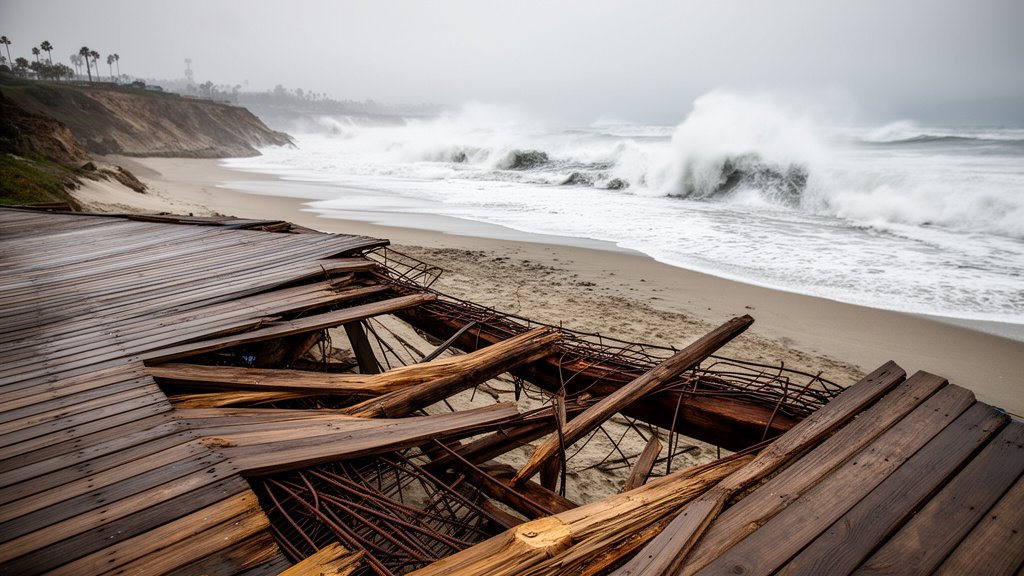
The remnants of Tropical Storm Rachel have unleashed a catastrophic surge of wave energy across the Southern California coastline, inflicting severe structural damage on residential properties and obliterating major stretches of boardwalk in Long Beach and Newport Beach. Local authorities are currently assessing the extent of the flooding, which has compromised the foundational integrity of several coastal homes and forced emergency closures of popular recreational waterfronts, signaling a grim start to the volatile weather season ahead.
Key Highlights
- Targeted Destruction: Tropical Storm Rachel’s remnants caused concentrated damage specifically to the waterfronts of Long Beach and Newport Beach, with reports of destroyed boardwalks and compromised residential foundations.
- Infrastructure Collapse: The event has rendered several coastal areas inaccessible, as severe wave action caused erosion and structural failure of critical public infrastructure.
- El Niño Warnings: Meteorologists and local officials are citing this event as a troubling harbinger for the upcoming El Niño cycle, suggesting current coastal defenses may be inadequate.
- Ongoing Emergency Operations: City planners and emergency response teams are actively conducting structural assessments to determine the safety of residential homes currently sitting on unstable, water-saturated ground.
The Anatomy of a Coastal Catastrophe
The arrival of the remnants of Tropical Storm Rachel was not merely a meteorological inconvenience but a violent re-evaluation of Southern California’s coastal resilience. Throughout the morning and afternoon of the event, the Pacific coastline—historically vulnerable but rarely hit with such direct, high-energy impact—experienced a surge of wave activity that overwhelmed traditional barriers. For residents of Long Beach and Newport Beach, the day began with rising water levels that quickly breached seawalls and flooded ground-level living spaces, causing rapid erosion of the very substrate upon which their homes are built.
Structural Vulnerabilities Exposed
The destruction of the boardwalks serves as the most visible marker of the storm’s intensity. In Newport Beach, specifically, sections of the iconic boardwalk were torn away by the sheer hydraulic force of the waves, leaving twisted timber and exposed rebar. This is not just a cosmetic issue; it represents a failure of current infrastructure to account for climate-driven, high-energy wave events. Engineering experts are particularly concerned about the ‘undercutting’ effect, where receding floodwaters pull sand and soil from beneath residential foundations, effectively destabilizing multi-million dollar properties. Many homes are now being red-tagged for inspection, as engineers must determine if the integrity of the soil has been compromised to a degree that makes habitation unsafe. This creates a secondary crisis: a housing instability issue that compounds the immediate physical damage of the storm.
The El Niño Connection and Long-Term Implications
Atmospheric scientists are looking at the remnants of Tropical Storm Rachel not as an isolated incident, but as a critical data point within the broader context of a developing El Niño season. El Niño generally alters the atmospheric jet stream, potentially steering more storms directly into the California coast. The worry among city planners is that if a relatively localized remnant of a tropical storm can cause this level of infrastructure devastation, the compounding impact of multiple, consecutive storm fronts during an active El Niño period could lead to widespread shoreline retreat.
This raises questions about the future of ‘hard’ versus ‘soft’ coastal protection. Hard infrastructure, such as concrete seawalls, is proving effective against low-tide surges but is failing to mitigate the energy of high-intensity wave action, which can simply overtop or bypass these structures. The discussion is now shifting toward managed retreat, beach nourishment, and the construction of more robust dune systems that can absorb wave energy before it impacts private or public assets.
The Economic Toll on the Waterfront
Beyond the physical damage, the economic impact on these municipalities is staggering. Tourism in Long Beach and Newport Beach relies heavily on the accessibility of their waterfronts. The destruction of boardwalks halts foot traffic, impacting local businesses, restaurants, and souvenir shops that operate in these zones. Furthermore, insurance providers are already signaling a reassessment of risk in these zip codes. Homeowners, who were already navigating a complex property insurance market in California, are now facing the prospect of significantly higher premiums—or, in the worst cases, non-renewal—due to the increased frequency of these ‘storm-driven’ events. As municipal budgets are stretched to fund the immediate reconstruction of boardwalks and the shoring up of public utilities, the fiscal burden of adapting to a more volatile climate is becoming a primary, if often overlooked, cost of living in Southern California.
FAQ: People Also Ask
Q: What is the primary cause of the damage seen in Long Beach and Newport Beach?
A: The damage was primarily caused by high-energy wave surges associated with the remnants of Tropical Storm Rachel, which led to flooding and structural erosion of boardwalks and coastal residential foundations.
Q: How does this storm relate to the upcoming El Niño season?
A: Meteorologists view this storm as a precursor to what could be a very active El Niño season. The storm demonstrated that existing coastal infrastructure may be insufficient to handle the frequency and intensity of storms expected in the coming months.
Q: Are residents being evacuated from their homes?
A: Local authorities are currently assessing the structural integrity of residential buildings. Many homes have been flagged for inspections to determine if the erosion under their foundations has rendered them unsafe, which could necessitate future evacuations.
Q: Is there a long-term plan for coastal protection in these areas?
A: Following these events, city officials are intensifying discussions regarding long-term resilience, including the potential for more robust sea walls, enhanced dune restoration, and the complex, controversial topic of ‘managed retreat’ from the shoreline.