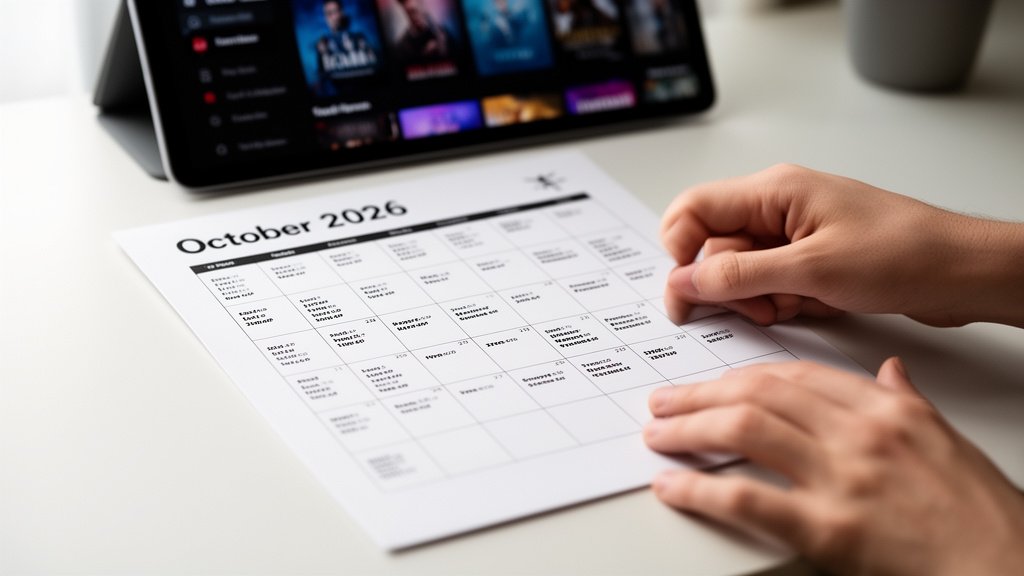
As the television industry enters the critical October window, viewers are faced with an unprecedented volume of content. The shift from summer reruns to fall prestige programming creates a ‘bottleneck effect’ where dozens of high-profile series, season finales, and limited-run event specials debut within the same 31-day period. Navigating this landscape requires more than just a vague notion of what is coming; it requires a systematic approach to appointment viewing. TVLine’s comprehensive October 2026 premiere calendar serves as a vital tool for subscribers overwhelmed by the sheer velocity of the streaming wars, providing a structured map to ensure no major title gets lost in the algorithm.
Key Highlights
- Peak Scheduling: October 2026 features a significant spike in content density, with over 40% of major streaming services scheduling flagship titles in the first two weeks of the month to capture early-quarter engagement.
- The Calendar Utility: Printable guides are re-emerging as essential tools for viewers to track fragmented release dates across disjointed platforms like Netflix, Max, Disney+, and traditional broadcast networks.
- Strategic Viewing: Studios are increasingly shifting away from ‘binge-drops’ toward weekly episodic releases to extend audience retention and social media conversation windows.
Navigating the October 2026 Streaming Landscape
The fundamental challenge facing the modern consumer is the ‘Paradox of Choice.’ With the consolidation of streaming platforms and the continued proliferation of niche services, the average household struggles to reconcile their subscription costs with their viewing capacity. The October 2026 calendar is not merely a list of show dates; it is a tactical manual for audience management. By mapping out exactly when shows drop, viewers can mitigate ‘choice paralysis’—that stressful period spent scrolling through menus rather than watching content.
The Fragmentation of Appointment Viewing
Historically, television relied on the concept of ‘appointment viewing,’ where audiences tuned in at specific times to watch broadcast network content. Today, while streaming has largely democratized access, it has also destroyed the synchronized cultural moment. However, the data for October 2026 suggests a fascinating pivot: major streamers are returning to the weekly cadence to recreate the water-cooler effect that broadcast television enjoyed for decades.
By releasing premiere episodes in early October and sustaining them through November, networks are creating ‘eventized’ television. This allows for a sustained narrative presence in the public discourse. For the consumer, this necessitates a more deliberate approach. You are no longer just ‘watching a show’; you are managing a weekly subscription cadence. The printable calendar allows you to visualize this flow, identifying where overlaps occur between major franchises and allowing for better allocation of your ‘screen time budget.’
Economic Implications of the Content Glut
Why is October such a crowded field? The answer is tied to the fiscal year and the lead-up to the holiday season. Advertising budgets typically shift in Q4, and studios want their strongest IP to be available to drive subscriber acquisition and retention before the year-end churn. This creates an economic incentive for networks to ‘dump’ content, regardless of whether the viewer has the time to consume it.
This trend has created a secondary market for ‘curated guides.’ When platforms like TVLine aggregate these releases, they are performing a necessary service for the consumer’s economic health. By knowing which shows are premiering when, subscribers can strategically time their ‘subscription hopping’—canceling services that don’t have immediate draws and reactivating those that do, based on the specific calendar weeks where their preferred content is airing.
The Shift Toward Multi-Platform Ecosystems
We are also witnessing the integration of streaming and linear broadcast in ways we haven’t seen since the early 2000s. Many of the ‘streaming’ hits of October 2026 are actually produced by legacy broadcast entities (ABC, CBS, NBC) that are now utilizing their streaming arms (Hulu, Peacock, Paramount+) to host delayed viewings. This hybrid model means the distinction between ‘cable’ and ‘streamer’ is becoming semantic.
The October 2026 landscape reflects this convergence. You will find that many of the ‘must-watch’ shows are serialized dramas that benefit from the production budgets of film studios. Because the production value is consistently high across these tiers, the viewer’s task is no longer distinguishing between ‘quality’ and ‘filler,’ but rather managing their limited time against an infinite content supply. The definitive calendar acts as the ultimate filter.
FAQ: People Also Ask
Q: How can I manage my subscriptions effectively with a busy calendar?
A: Use the calendar to identify your ‘Must-Watch’ shows for the month. Focus your budget on the streaming services that host these specific titles, and consider rotating your subscriptions monthly to match the premiere cycle shown on your calendar.
Q: Is binge-watching dead in October 2026?
A: Not entirely, but it is in retreat. Data shows that major platforms are increasingly utilizing a ‘hybrid release’ model—dropping the first 2-3 episodes to hook the audience, followed by a weekly rollout to sustain engagement.
Q: What is the benefit of a printable calendar over an app?
A: Cognitive load reduction. A printed calendar provides a tactile, persistent view of your entire month without the distractions of digital notifications, algorithm-based recommendations, or ‘autoplay’ features that often lead to aimless viewing.
Q: How do I handle shows that I ‘missed’ earlier in the year?
A: Treat your October calendar as a priority list for new content. Schedule your catch-up viewing during the ‘low-density’ weeks when the major premiere calendar has gaps, typically found in the final week of the month.