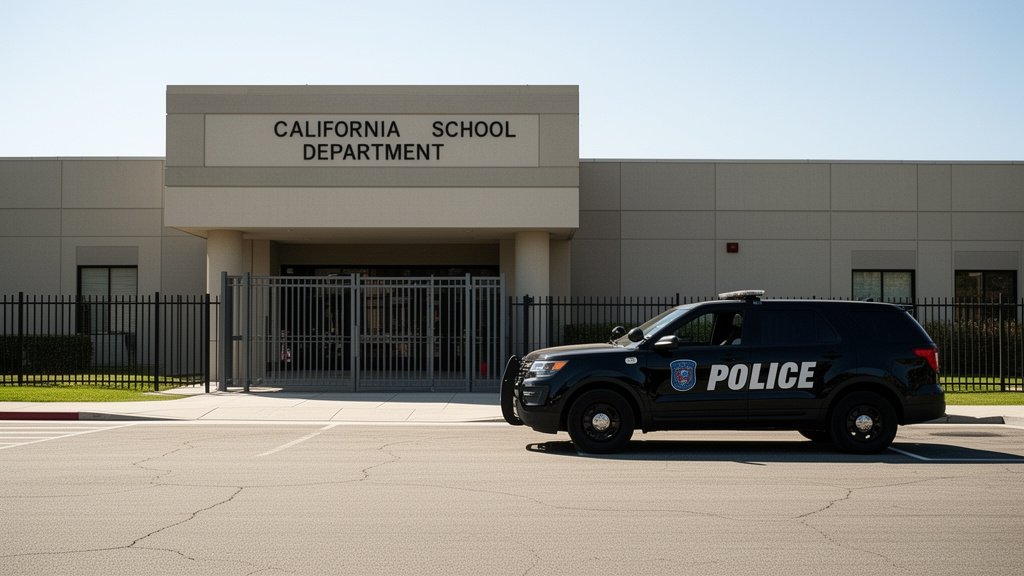
At least nine California K-12 school police departments have failed to comply with a critical 2021 transparency law designed to track the acquisition and use of military-grade equipment. This ongoing lack of transparency, highlighted by a recent CalMatters investigation, raises significant questions about the extent of militarization within educational institutions and the effectiveness of oversight mechanisms intended to hold school law enforcement accountable.
Key Highlights
- Legislative Non-Compliance: Nine California school districts have not consistently reported their military-grade equipment inventories as mandated by Assembly Bill 481 (AB 481).
- The Transparency Gap: Despite the law’s intent to force public disclosure and board approval for military gear, many departments have failed to post required policy documents on their websites.
- Equipment Scope: Covered items include a broad spectrum of gear, ranging from armored vehicles and high-caliber rifles to flashbangs and specialized surveillance technology.
- Post-Inquiry Reaction: Following direct inquiries from journalists, several districts scrambled to update their reports, revealing a reactive rather than proactive approach to public accountability.
The Anatomy of the Accountability Gap
When California passed Assembly Bill 481 in 2021, the legislative intent was crystal clear: to curb the “militarization” of local law enforcement agencies, including those operating within school districts. The law requires agencies to obtain approval from their governing bodies—in this case, local school boards—to fund, acquire, or use “military equipment.” It also mandates that these agencies publish annual reports detailing their inventories, their specific uses, and the costs associated with maintenance and deployment.
However, the CalMatters investigation exposes a stark disconnect between the law on the books and the reality on the ground. For many of these districts, the compliance process appears to have been treated as a bureaucratic formality rather than a substantive transparency measure. In the worst instances, the required documents were entirely absent from official websites, effectively rendering the school community and the public blind to the tactical arsenal present on campus.
The Ambiguity of ‘Military-Grade’
One of the primary challenges in enforcing AB 481 within a school context is defining exactly what constitutes “military-grade.” While the public often envisions tanks or heavy artillery, the reality of school police arsenals is often more nuanced and, in many ways, more invasive in a classroom setting. The law covers items such as long-range acoustic devices, tactical drones, specialized chemical agents, and rifles that are functionally identical to those used by military units.
The failure to disclose this inventory isn’t just a technical oversight; it is a fundamental breakdown of the trust required between students, parents, and school administrators. When a school district obscures the presence of tactical equipment, it prevents the public from engaging in necessary discourse about whether such gear is appropriate for an educational environment—a space supposedly dedicated to safety, learning, and growth.
The Mechanics of Non-Compliance
Why have nine districts failed to meet these requirements? The reasons appear to vary, ranging from administrative negligence to an intentional desire to avoid public scrutiny. Interviews and documentation suggest that many school police departments lack the dedicated administrative infrastructure required to manage the complex reporting standards of AB 481.
However, there is a secondary, more concerning angle: the potential for backlash. School boards and district officials are often acutely aware that the presence of “military-grade” equipment is a lightning rod for community protest. By delaying or obfuscating the disclosure of this gear, districts may be attempting to avoid the political friction that inevitably follows the revelation of a militarized police presence in schools. The fact that several districts immediately updated their disclosures only after being confronted by journalists serves as an indictment of their internal oversight mechanisms.
The Psychological Impact on Campus Culture
Beyond the logistical failure of record-keeping, there is a broader sociological concern regarding the normalization of military-grade presence in schools. Educators and civil rights advocates argue that the presence of such gear contributes to a “police-state” atmosphere, which can profoundly impact student perception of safety.
Research has consistently shown that when students perceive their schools as being policed by entities that prioritize tactical readiness over community-based conflict resolution, the learning environment suffers. The “school-to-prison pipeline” discourse is intrinsically linked to these issues; when administrators adopt the tools and tactics of traditional law enforcement, they shift the paradigm from discipline and counseling to surveillance and control. The failure to comply with AB 481, therefore, isn’t just about missing paperwork—it’s about the erosion of the sanctuary status that schools should hold in society.
Future Predictions and Legislative Fallout
Looking ahead, it is highly probable that the California legislature will address these loopholes. If school districts continue to treat transparency laws as optional, lawmakers may move to implement stricter penalties for non-compliance, such as withholding funding or removing the authority of districts to possess certain categories of equipment altogether. Furthermore, the CalMatters investigation serves as a clarion call for school boards to take a more active, oversight-heavy role in the operations of their police departments. The passive approval of police budgets without interrogating their equipment inventories is no longer a sustainable policy in the post-AB 481 era.
FAQ: People Also Ask
What is Assembly Bill 481?
Assembly Bill 481 is a California state law enacted in 2021 that requires law enforcement agencies—including school police—to gain approval from their governing body (such as a school board) before acquiring or using military-grade equipment. It mandates transparency, requiring agencies to publish policies and annual reports on their equipment.
Why does a school district need military-grade equipment?
Proponents of school police militarization often argue that this equipment is necessary for responding to high-stakes emergencies, such as active shooter scenarios. Critics, however, argue that such gear is disproportionate to the needs of a school setting and that it creates an intimidating atmosphere that negatively impacts students.
What happens if a school district refuses to comply?
Currently, the enforcement mechanisms for AB 481 are relatively weak, often relying on public pressure and media scrutiny. However, repeated failure to comply could lead to state-level audits, legal challenges from civil rights organizations, and potential legislative action to implement stricter oversight and penalties for departments that ignore the law.
Does this impact all California school districts?
No, it impacts specific school districts that operate their own dedicated police departments. Many smaller districts contract with local municipal police or sheriffs, who are covered under different regulatory frameworks for their own equipment, but the specific investigation into the nine non-compliant districts refers to independent school police departments.