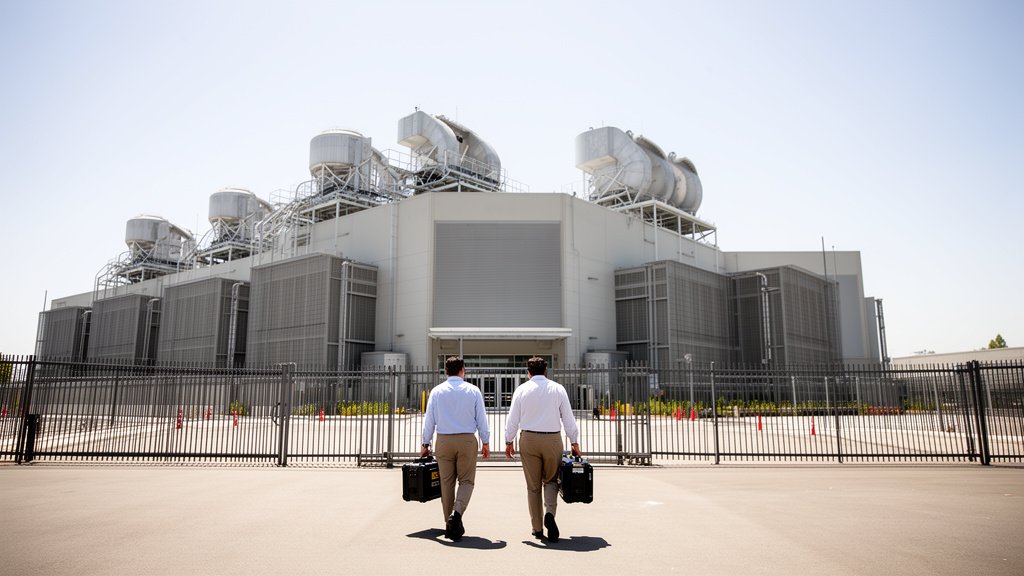
California state regulators have initiated an unannounced audit of several major AI data centers across the Silicon Valley corridor, citing urgent concerns over unpermitted water consumption and excessive energy grid strain during the recent summer heat waves. The move, spearheaded by the California Public Utilities Commission (CPUC) in coordination with the California Energy Commission (CEC), marks a significant escalation in the state’s oversight of the burgeoning artificial intelligence sector.
Key Highlights
- Surprise Regulatory Action: Regulators have launched an unannounced, targeted audit of AI data centers across the Silicon Valley corridor.
- Dual Focus: Inspections are focused on unpermitted water usage—primarily for liquid cooling systems—and the strain these facilities place on the electrical grid during extreme weather events.
- Infrastructure Stress: The investigation comes on the heels of record-breaking summer heat waves that tested California’s grid stability, drawing sharp criticism from local advocacy groups regarding the energy-intensive nature of AI training.
- High-Stakes Compliance: Findings from this audit could set a legal precedent for how the state enforces resource management mandates on hyper-scale computing providers.
The Regulatory Clash in Silicon Valley
For months, the intersection of rapid AI adoption and resource scarcity has been a simmering point of contention in California. The recent surge in generative AI development has required a massive influx of compute power, with major data centers often consuming electricity and water at rates that far outpace previous municipal projections. The surprise audit is the state’s direct response to growing public and legislative pressure to ensure that the expansion of the digital economy does not come at the expense of regional resource stability.
The Anatomy of the Audit
Unlike standard annual reviews, this unannounced audit is designed to observe real-time operational conditions. Teams from the CPUC and CEC have descended upon data center sites to evaluate the delta between permitted water rights and actual consumption metrics. AI data centers are notorious for their reliance on evaporative cooling, a water-intensive process that becomes increasingly inefficient during the extreme heat experienced in the California summer.
Regulators are specifically scrutinizing the “Power Usage Effectiveness” (PUE) and “Water Usage Effectiveness” (WUE) metrics of the audited facilities. The goal is to determine if these operators are adhering to local drought-response protocols or if they are bypassing regulations by utilizing “emergency” cooling protocols that were never authorized under their original land-use permits.
Energy Grid Stability and AI Demand
Beyond water, the issue of energy load is the audit’s secondary, yet perhaps more significant, focal point. AI workloads are “always on,” creating a baseload demand that is difficult for grid operators to modulate, especially when renewable energy generation—specifically solar—drops off in the evening. During the recent summer heat waves, the California Independent System Operator (ISO) came close to rolling blackouts. State officials are investigating whether data centers, which are often incentivized to run at 100% capacity, contributed to grid instability by failing to throttle down operations during “Flex Alert” periods.
Industry analysts suggest this audit could result in significant operational shifts. “The days of ‘move fast and break things’ are over for data center infrastructure,” says a regional utility strategist. “The state is signaling that if you are a significant load player, you are now a utility-level stakeholder, and you will be treated as such regarding reliability and resource ethics.”
Economic and Environmental Implications
This audit serves as a litmus test for the sustainability of AI growth in the Western United States. If the audit finds widespread non-compliance, it could trigger a wave of new state-level mandates, potentially forcing companies to invest in water-neutral cooling technologies or on-site, behind-the-meter energy storage solutions. For the data center operators, the risk is not just financial penalties, but the potential for permit revocation or enforced moratoriums on future capacity expansion in the region.
The Secondary Angles of Concern
1. The Water-Energy Nexus: A critical aspect of the investigation is the realization that AI data centers require both immense energy and immense water. As cooling systems evaporate water to shed heat from high-performance GPUs, the state is effectively losing millions of gallons that could otherwise be used for agriculture or residential consumption.
2. Technological Sovereignty vs. Local Oversight: There is a growing tension between the federal importance of maintaining the U.S. lead in AI and the local necessity of keeping the lights on in Silicon Valley. This audit puts local regulators in direct conflict with the rapid deployment timelines of global tech giants.
3. Future-Proofing Grid Infrastructure: The audit is expected to force a conversation about whether AI data centers should be required to act as “grid-aware” facilities, capable of shedding load instantaneously to prevent statewide outages during heat emergencies.
FAQ: People Also Ask
Q: What specific penalties could data centers face?
A: While currently in the investigation phase, penalties could include hefty fines for unauthorized water usage, mandated retrofitting of cooling systems, or temporary suspension of operational capacity permits during declared heat emergencies.
Q: Are these audits targeting specific companies?
A: The CPUC has not named the specific companies, citing ongoing investigations, but sources indicate the audit targets “major hyper-scale facilities” located in the Silicon Valley corridor that were operating at high capacity during the summer peak.
Q: How does AI training affect grid stability?
A: AI model training requires constant, high-density computing power. Unlike standard IT workloads, AI tasks often run continuously at peak capacity, which prevents the grid from modulating the load during times of high demand, such as extreme heat waves, thus increasing the risk of rolling blackouts.
Q: Will this affect my AI services?
A: It is unlikely to affect end-user services immediately. However, if data centers are forced to reduce power usage or retrofit cooling systems, it could lead to increased operational costs for tech companies, which might eventually influence service pricing or availability for high-compute AI models.