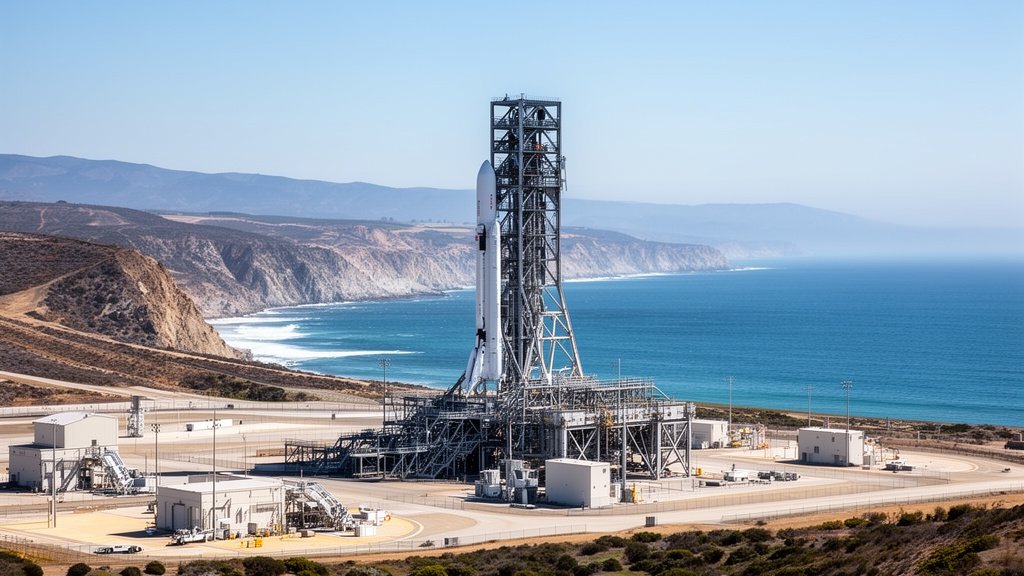
The landscape of space operations is undergoing a paradigm shift, and Vandenberg Space Force Base (VSFB) is at the epicenter of this evolution. During the recent ‘Spaceport of the Future’ Industry Day, military commanders, government stakeholders, and private sector leaders converged to outline the strategic transformation of the California-based installation. The objective is clear: to evolve VSFB from a traditional launch site into a hyper-efficient, high-capacity spaceport capable of supporting the exponential growth of the global commercial space economy.
The Strategic Imperative: Scaling for the New Space Age
The fundamental challenge discussed at the Industry Day is the increasing demand for launch capacity. As commercial space companies continue to deploy mega-constellations and advanced satellite systems, the traditional launch infrastructure—designed during the Cold War era—is increasingly becoming a bottleneck. Space Systems Command (SSC), which spearheaded the Industry Day, emphasized that maintaining national security and economic competitiveness requires a modernized approach to launch cadence. The ‘Spaceport of the Future’ initiative is not merely about renovation; it is about architectural and logistical transformation.
Modernization efforts are slated to address the critical friction points of current operations: utility throughput, road network efficiency, and launch pad versatility. By soliciting direct feedback from private partners, the Space Force aims to create a plug-and-play environment where commercial entities can integrate their hardware with minimal lead time. The shift toward a high-cadence operational tempo is necessitated by the need to orbit assets faster than adversaries, keeping the U.S. at the cutting edge of global space dominance.
Infrastructure Modernization: Building for High Cadence
A core pillar of the industry dialogue was the extensive infrastructure upgrade program currently in development. Participants analyzed the requirements for robust utility grids, including hardened power distribution and high-speed data connectivity capable of managing complex telemetry for simultaneous launches. The ‘Spaceport of the Future’ framework envisions a modular infrastructure that allows for rapid reconfiguration of launch facilities, supporting diverse vehicle sizes and propulsion technologies.
The logistical strategy also includes the modernization of internal road networks to accommodate the transport of larger, more complex launch vehicles and support equipment. These structural upgrades are designed to facilitate a ‘hot-swap’ capability, where multiple launch providers can operate in closer succession, significantly reducing the downtime between missions. This creates a scalable ecosystem that can grow alongside the technological advancements of the private launch sector.
Economic Impact and Workforce Development
The transformation of Vandenberg is projected to have significant ripple effects on the regional economy of California’s Central Coast. The ‘Spaceport of the Future’ is not just a technological undertaking; it is a catalyst for workforce development. The industry session highlighted the need for a highly skilled labor force capable of maintaining the sophisticated systems of the new spaceport.
This initiative effectively signals a long-term commitment to the region, promising sustained growth in engineering, aerospace manufacturing, and site operations roles. By partnering with local educational institutions and industry leaders, the Space Force aims to build a talent pipeline that can sustain the high-tech demands of the future space economy. This regional integration ensures that the base remains an indispensable asset, anchoring high-tech employment and fostering innovation that extends well beyond the base perimeter.
Secondary Angles: Analyzing the Future
1. Geopolitical Resilience: The ability to surge launch capacity on short notice is a critical component of national security. The ‘Spaceport of the Future’ enhances the resilience of U.S. space assets, ensuring that launch capability remains uninterrupted even in a contested environment or during peak commercial demand.
2. Environmental Stewardship in Modernization: A nuanced angle of the project involves balancing industrial growth with environmental considerations. The modernization plan incorporates advanced sustainability metrics, aiming to minimize the ecological footprint of high-cadence launches while complying with stringent environmental regulations inherent to the California coast.
3. The Shift to Commercial-First Models: This initiative represents a profound cultural shift within the Department of Defense. By treating commercial entities as primary tenants rather than secondary visitors, the Space Force is redefining the traditional military-industrial relationship, paving the way for more integrated public-private operations.
FAQ: People Also Ask
Q: What is the primary goal of the ‘Spaceport of the Future’ initiative?
A: The primary goal is to modernize the infrastructure at Vandenberg Space Force Base to support a significantly higher launch cadence, enabling the base to handle the increasing volume of commercial and national security space launches efficiently.
Q: How does this project impact commercial space companies?
A: It creates a more streamlined, predictable, and robust environment for commercial providers. By upgrading utilities, roads, and launch site logistics, the Space Force provides a ‘ready-to-use’ framework that lowers the barrier to entry and accelerates mission timelines.
Q: When will the infrastructure upgrades be completed?
A: While the Industry Day was a planning and feedback-gathering milestone, the rollout is part of a multi-year modernization strategy. Specific completion dates are tied to ongoing budgetary approvals and phased construction schedules outlined by Space Systems Command.
Q: Does this change the military nature of the base?
A: No, the base remains a vital military installation. The initiative is designed to integrate commercial success into the base’s broader national security mission, ensuring the infrastructure serves both military and commercial requirements simultaneously.