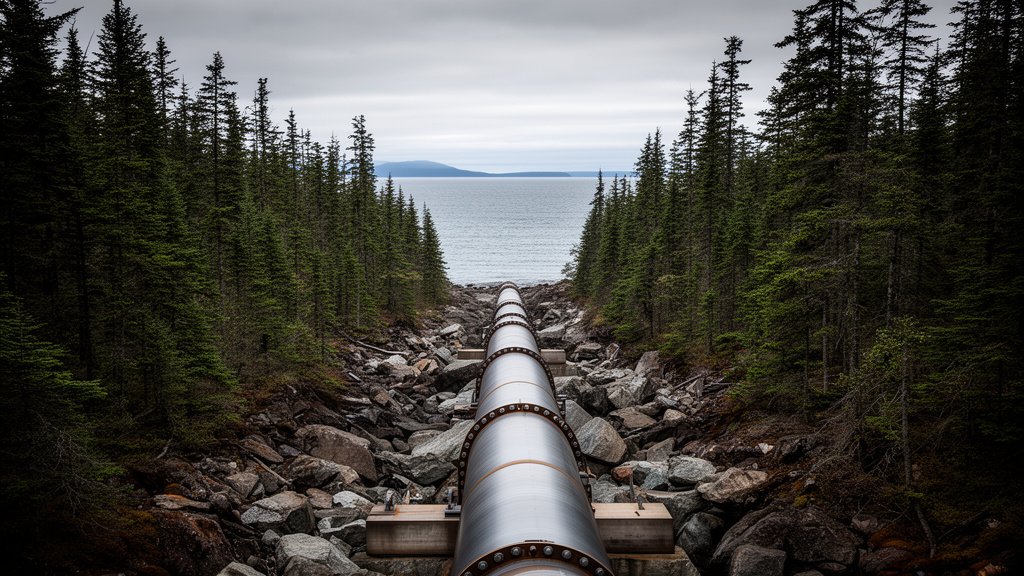
The ambition to transport one million barrels of crude oil daily from Alberta’s oil sands to the British Columbia coast represents one of the most contentious infrastructure projects in modern Canadian history. Despite federal advocacy—driven by the narrative of ‘national interest’ and the need for global market diversification—the proposed pipeline remains mired in a complex web of legal, environmental, and financial obstacles. This gridlock highlights a fundamental friction within the Canadian federation: the tension between resource-rich provinces seeking economic expansion and coastal jurisdictions prioritizing ecological preservation and Indigenous sovereignty.
The Clash of National Interest vs. Regional Sovereignty
At the heart of the pipeline debate is the legal and political mechanism of the federal ‘national interest’ designation. In theory, this designation allows the federal government to bypass certain provincial objections to ensure economic stability and interprovincial trade. However, in practice, this has proven to be a blunt instrument in a nuanced political environment. The clash between Alberta’s government, which views the pipeline as a vital artery for the national economy, and the British Columbia government, which has historically prioritized the protection of the Salish Sea and coastal communities, creates a jurisdictional tug-of-war.
Legal experts note that previous high-profile pipeline projects have often faltered due to insufficient consultation. The ‘national interest’ argument is increasingly being challenged in courts, where First Nations and environmental groups argue that the federal government fails to account for the cumulative impacts of downstream emissions and marine traffic risks. This leaves the project in a state of permanent litigation, creating a risk profile that scares off institutional investors.
Environmental Compliance in the Net-Zero Era
Beyond politics, the project faces the harsh realities of the global energy transition. Modern pipeline proposals are no longer scrutinized merely for the risk of spills—though that remains a primary concern for local coastal communities—but for their alignment with international climate goals. As Canada commits to net-zero emissions targets, a massive fossil fuel infrastructure project designed to operate for the next 40 to 50 years faces severe ‘stranded asset’ risk.
Environmental organizations are leveraging sophisticated legal strategies to demand a ‘climate test’ for all major infrastructure. This implies that the project must not only account for the safety of the pipe itself but also for the lifecycle emissions of the one million barrels of oil it intends to move every day. Regulators, such as the Canada Energy Regulator (CER), are under immense pressure to tighten these oversight mechanisms, making the path to final approval significantly longer and more expensive than it was even a decade ago.
The Economic Calculus: Cost Overruns and Market Volatility
Financially, the pipeline is a precarious proposition. The combination of rampant inflation in construction materials, labor shortages, and rising interest rates has ballooned the projected budgets of large-scale energy projects. When a project faces a decade of delay, its initial cost-benefit analysis becomes obsolete.
Global crude price volatility further complicates the math. The primary argument for the pipeline is the ‘Western Canadian Select’ discount—the price gap between Canadian crude and the global benchmark, Brent crude. However, as international markets pivot toward renewables and alternative energy, there is no guarantee that the heavy crude shipped by this pipeline will command the premium prices needed to recoup the massive capital expenditure required to build it. Investors are increasingly demanding guaranteed returns, which are impossible to promise when the construction timeline is indefinite.
Indigenous Stewardship and the Legal Landscape
Perhaps the most significant hurdle is the evolving legal status of Indigenous rights and title. Following precedent-setting Supreme Court rulings, proponents of large infrastructure must go beyond the traditional ‘consult and accommodate’ model. Modern standards require something closer to free, prior, and informed consent.
Many First Nations across the proposed route are not merely stakeholders to be managed; they are sovereign nations with legal standing to halt development. Their concerns regarding water protection, salmon habitat, and traditional land use are not easily assuaged by financial compensation. As these nations exert greater control over their territories, the pipeline operators face a challenging reality: without a strong partnership and true co-management agreement, the project lacks the social license required for stability, leaving it vulnerable to both civil disobedience and judicial injunctions.
FAQ: People Also Ask
Q: Why is a million-barrel-a-day pipeline considered a ‘national interest’ project?
A: The federal government designates it as such because the crude oil export sector is a major contributor to Canada’s GDP and tax revenue. Proponents argue that reaching Pacific markets is essential to reduce reliance on U.S. refineries and to secure better pricing for Canadian bitumen on global markets.
Q: What is the primary environmental fear regarding the BC coast?
A: The primary concern is the dramatic increase in oil tanker traffic in the Salish Sea. Local communities, First Nations, and environmental groups cite the heightened risk of a catastrophic oil spill, which would have devastating impacts on marine ecosystems, coastal tourism, and traditional fishing grounds.
Q: Why do financial hurdles matter more now than in the past?
A: High inflation, increased interest rates, and the global energy transition make long-term oil infrastructure a ‘risky bet.’ Investors are less likely to fund projects that may become ‘stranded assets’ if international demand for oil drops or if carbon taxes make the export of heavy crude economically unviable in the coming decades.