The U.S. Department of Energy (DOE) has officially tapped the combined intellectual power of Stanford University and the SLAC National Accelerator Laboratory to spearhead six critical initiatives under the newly unveiled ‘Genesis Mission.’ This strategic endeavor represents a definitive transition from traditional, hypothesis-driven experimental methods to a new paradigm of AI-accelerated scientific discovery. By deploying advanced artificial intelligence models across a spectrum of complex problems—ranging from the circular economy of lithium-ion battery waste to the volatile mechanics of atmospheric rivers—these institutions aim to compress decades of research cycles into years, if not months.
Key Highlights
- Strategic Leadership: Stanford University and SLAC have been awarded the lead on six distinct U.S. Department of Energy ‘Genesis Mission’ projects.
- Scientific Focus: The initiative targets critical infrastructure and climate challenges, including sustainable battery recycling and the prediction of high-impact atmospheric river weather patterns.
- AI Integration: The mission utilizes state-of-the-art foundation models to solve complex, multi-variable scientific problems that have historically eluded linear computational modeling.
- National Impact: This partnership reinforces the DOE’s commitment to securing the American energy supply chain and enhancing climate resiliency through cutting-edge machine learning.
Transforming Discovery Through the Genesis Mission
The Genesis Mission is more than a research grant; it is an organizational pivot by the Department of Energy to harness the power of artificial intelligence as a primary instrument of scientific inquiry. For years, the scientific community has grappled with the ‘curse of dimensionality’—the reality that as systems become more complex, the number of variables to analyze grows exponentially, making traditional supercomputing simulations prohibitively slow. The Genesis Mission seeks to solve this by training specialized AI foundation models on vast, multi-modal datasets generated by national laboratories like SLAC.
The Convergence of Artificial Intelligence and Hard Science
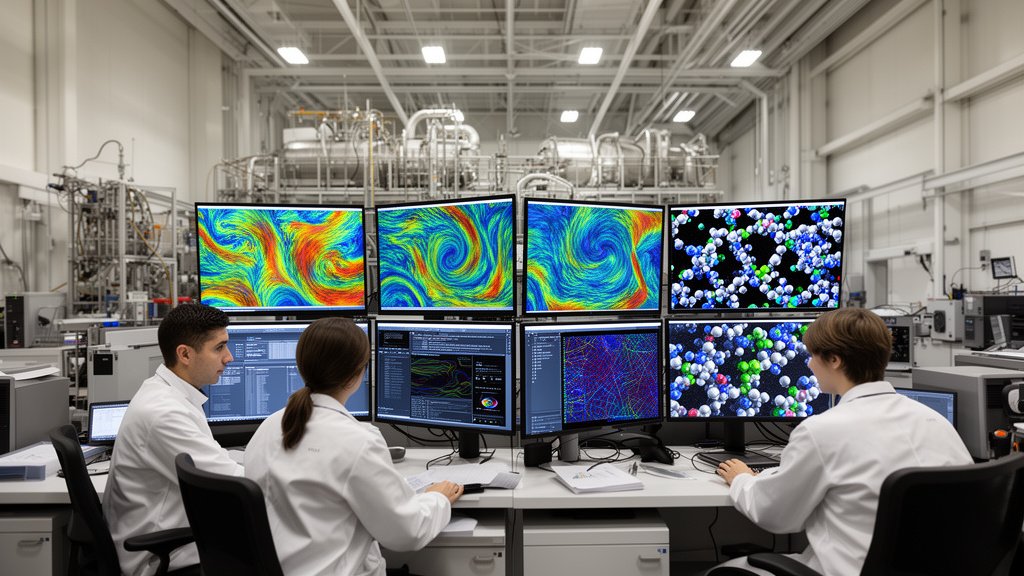
At the heart of the Genesis Mission lies the integration of ‘AI for Science.’ Unlike generative AI used in consumer technology, which focuses on language and imagery, the models deployed in these Stanford and SLAC projects are engineered to solve differential equations and physical simulations. By leveraging the high-throughput computing capabilities of the Stanford Research Computing Center and the LCLS (Linac Coherent Light Source) at SLAC, researchers can create ‘digital twins’ of physical processes. This allows for the rapid prototyping of materials and predictive modeling of environmental systems that would otherwise require physical testing that is both expensive and time-consuming.
Solving Climate Extremes: The Atmospheric River Project
One of the most consequential mandates within the Genesis Mission is the application of deep learning to atmospheric rivers. These narrow, long regions in the atmosphere—often referred to as ‘rivers in the sky’—are responsible for the majority of water transport from the tropics to the West Coast of the United States. While they are essential for water security, they also pose significant flood risks. Previous forecasting models have struggled with the extreme variance and nonlinear dynamics of these events. The Stanford-led teams are now feeding petabytes of satellite imagery and climate sensor data into neural networks to identify precursors to extreme precipitation events with greater lead time, theoretically enabling better flood management and water resource allocation.
Revolutionizing Energy: Next-Gen Battery Recycling
Parallel to climate initiatives, the Genesis Mission addresses the economic and environmental bottleneck of the energy transition: battery waste. As the U.S. pushes toward widespread electric vehicle (EV) adoption, the current method of recycling lithium-ion batteries remains inefficient and chemically intensive. The research teams at SLAC and Stanford are utilizing AI to ‘reverse engineer’ the battery degradation process. By using machine learning to analyze the micro-structural breakdown of battery cathodes during charge cycles, the team is developing AI-driven sorting and regeneration technologies. This approach aims to create a circular supply chain where materials can be extracted and purified with significantly lower carbon intensity, directly impacting the economic viability of the domestic EV market.
Historical Trajectory and Future Implications
This mission marks a historic moment in the collaboration between academic institutions and federal laboratories. Historically, these entities operated with distinct mandates—universities on fundamental discovery and labs on large-scale infrastructure. The Genesis Mission breaks down these silos, acknowledging that the speed of modern innovation requires a unified approach.
From an economic standpoint, the success of these projects could determine the U.S.’s standing in the global green technology race. If the models prove effective in battery recycling, the intellectual property generated could drastically reduce reliance on foreign supply chains for rare earth metals. Furthermore, the predictive capability for weather events has massive implications for insurance, civil engineering, and infrastructure planning, potentially saving billions in annual damages.
However, the mission also faces significant challenges. The integration of AI into critical infrastructure requires a level of ‘explainability’ that is often lacking in deep learning models. Ensuring these models provide accurate, actionable insights—and not ‘hallucinations’—will be the primary hurdle for the Stanford and SLAC researchers over the coming funding cycle. As they navigate these challenges, the Genesis Mission stands as a blueprint for the future of national-level scientific research.
FAQ: People Also Ask
Q: What is the primary goal of the Genesis Mission?
A: The Genesis Mission is a U.S. Department of Energy initiative designed to apply advanced artificial intelligence to solve complex scientific and engineering problems, accelerating the pace of discovery in fields like climate science and energy storage.
Q: Why were Stanford and SLAC selected?
A: They were selected due to their unique ecosystem that combines world-class academic research at Stanford with the large-scale experimental facilities and computational resources of the SLAC National Accelerator Laboratory, creating a comprehensive pipeline for AI-driven scientific development.
Q: How does AI assist with atmospheric river predictions?
A: The AI models analyze massive, multi-modal climate datasets—including satellite, radar, and sensor data—to identify complex, non-linear patterns that traditional simulation methods often miss, allowing for more accurate and timely warnings of extreme weather events.
Q: Will this mission impact consumer technology directly?
A: While these projects are high-level scientific initiatives, their success in optimizing battery recycling and climate resiliency will have downstream effects on the sustainability, cost, and reliability of consumer electric vehicles and energy grid infrastructure.