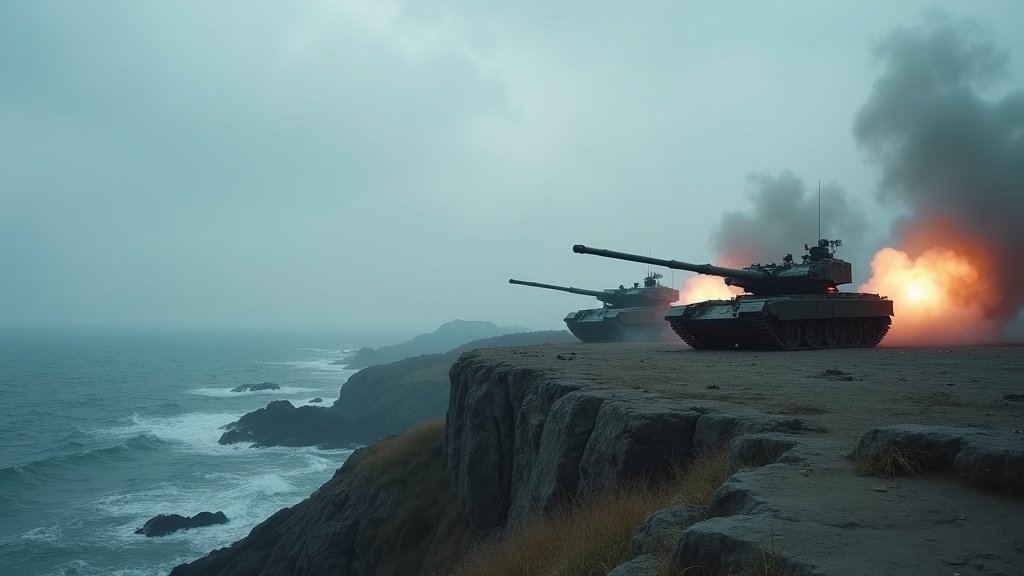
The latest South Korea drills, involving artillery exercises near its maritime border on Tuesday, December 16, 2025, highlight persistent Korean Peninsula tensions. North Korea has once again ignored Seoul’s proposals for **North Korea talks**. These South Korea drills occurred in the sensitive northwest islands area, situated along the Northern Limit Line (NLL). The Sixth Marine Brigade and the Yeonpyeong unit of the South Korea military drills were prominent participants, utilizing K9 self-propelled howitzers. Firing over 100 rounds at virtual targets in South Korean waters, south of the NLL, these **South Korea Drills** signify the third such exercise under the current administration, underscoring a consistent defensive stance. These South Korea drills are considered routine defensive training, with the United Nations Command (UNC) observing and the Neutral Nations Supervisory Commission (NNSC) providing oversight. Prior notification of the South Korea drills was given to North Korea, a move intended to promote transparency and mitigate risks. This event is a critical update regarding the ongoing **Korean Peninsula tensions**.
Background to the Standoff and South Korea Drills
Seoul formally proposed **inter-Korean military talks** on November 17, 2025, with the stated objectives of preventing accidental clashes and easing tensions, including discussions around the Military Demarcation Line (MDL). However, Pyongyang has maintained its silence and continues to ignore these overtures, a pattern that has contributed to escalating **Korean Peninsula tensions**. Following a breach of the MDL by North Korean soldiers on November 19, the lack of response from North Korea persists, leading South Korea to proceed with its scheduled exercises. These **South Korea Drills** resumed after the previous administration’s suspension of the 2018 inter-Korean military agreement. North Korea frequently characterizes joint drills as “war rehearsals,” while Seoul consistently maintains their defensive nature. The continuation of **South Korea drills** is a key aspect of regional security discussions.
New Missile Enhances Deterrence: South Korea Drills Context
In a significant development, South Korea announced the completion of the deployment of the Korean Tactical Surface-to-Surface Missile (KTSSM), nicknamed “Ure” (thunder). This advanced system, crucial for precision strikes against North Korea’s long-range artillery and command facilities, forms a vital component of South Korea’s “Kill Chain” pre-emptive strike system. The **KTSSM missile deployment** enhances South Korea’s operational capabilities and national deterrence, with a range of approximately 180 kilometers, developed after the 2010 Yeonpyeong Island shelling. This technological advancement provides a stronger foundation for future **South Korea Drills** and reinforces defensive strategies.
West Coast Defense News and South Korea Drills
The recent South Korea drills took place off the west coast, a strategically sensitive region encompassing the five northwest islands near North Korea and the de facto maritime border, the NLL. Live-fire drills in this area are a recurring event, with this being the third exercise since the current administration took office. Previous **South Korea military drills** in this sector have also featured K9 howitzer firings and Chunmoo rocket launchers, demonstrating a consistent approach to **West Coast defense**. The focus on **West Coast defense** during these South Korea drills is paramount.
Implications for Regional Security and South Korea Drills
North Korea’s continued silence regarding dialogue proposals is noteworthy, with analysts suggesting limited incentive for engagement from Pyongyang, which views Seoul as an adversary. This pattern of ignoring proposals is consistent with a trend of disengagement, creating an uncertain security environment characterized by **Korean Peninsula tensions**. South Korea’s military readiness and commitment to defense are demonstrated through its ongoing exercises and the **KTSSM missile deployment**. These developments signal a robust response capability and are a critical consideration for regional security, especially concerning the **NLL maritime border**. The strategic implications for the **West Coast defense** are clear, and the ongoing **South Korea Drills** are a significant part of maintaining stability.
Future Outlook for South Korea Drills
South Korea continues to maintain its defensive posture, conducting regular **South Korea Drills** and modernizing its arsenal. Meanwhile, North Korea’s response remains unpredictable, and the lack of **inter-Korean military talks** persists, posing a challenge to regional stability. Future investigations will closely monitor North Korea’s actions and South Korea’s responses, with the overarching goal of preventing conflict. Establishing clear communication channels, essential for de-escalation, remains elusive. This ongoing situation, particularly developments along the **NLL maritime border** and related to **West Coast defense**, requires close observation as part of the broader trending geopolitical climate, directly influenced by the frequency and nature of **South Korea drills**.