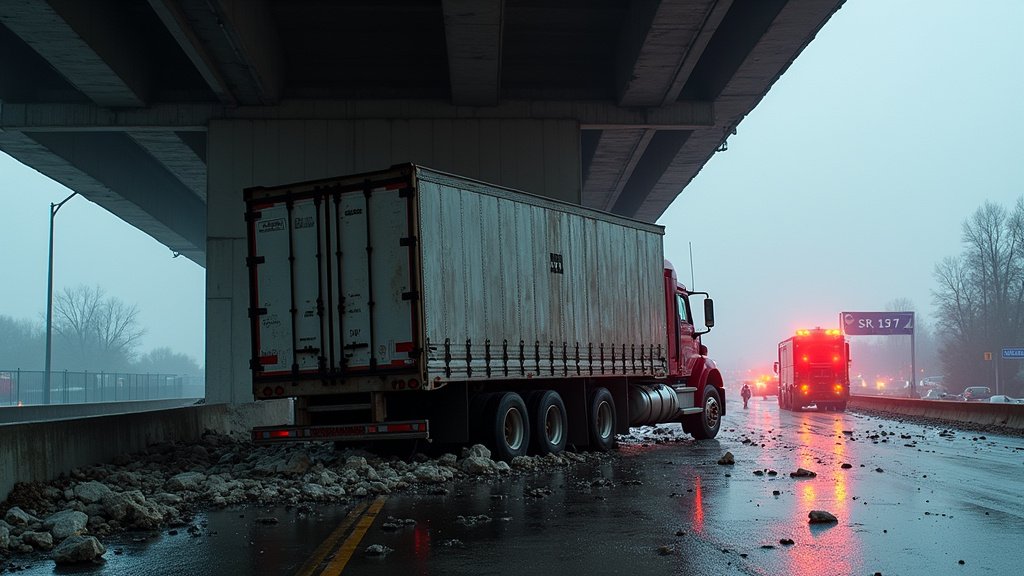
Two critical bridges in Washington’s South Sound region, the SR 410 White River Bridge and the SR 167 bridge over 3rd Avenue Southwest in Pacific, have sustained significant damage following separate incidents involving over-height commercial trucks. State Patrol reports released by the Washington State Department of Transportation (WSDOT) detail the circumstances, leading to prolonged closures, substantial repair costs, and ongoing investigations into accountability. These events highlight a concerning trend impacting key commuter routes on the west coast.
SR 410 White River Bridge Closure
On August 18, 2025, the SR 410 White River Bridge, a vital link between Buckley and Enumclaw, was struck by a semi-truck. According to Washington State Patrol collision reports, the truck’s water tank had not been lowered, leading to impact with the bridge’s support beams. The incident caused extensive structural damage, affecting all seven bridge panels and necessitating a full closure in both directions. Engineers confirmed significant horizontal and vertical damage, deeming it “not a simple fix.”
Crews are working on temporary repairs using steel braces, with an initial hope of opening one alternating lane by the end of September and a projected full reopening between October 31 and November 14. However, permanent repairs are expected to take longer. The closure has resulted in a substantial 38-mile detour, adding up to an hour of travel time and significantly impacting local businesses in Buckley and Enumclaw, who report devastating losses.
The estimated cost for the SR 410 bridge repairs is approximately $4.5 million.
SR 167 Bridge Damaged by Over-Height Load
Just over a month later, on September 23, 2025, a commercial truck with a raised hoist unit struck the SR 167 bridge over 3rd Avenue Southwest in Pacific. State Patrol reports indicate the driver of the recycling semi-truck was unaware that the boom trailer was stuck in the “up position.” This collision damaged a concrete support beam, dislodging concrete and exposing rebar.
As a result of the damage, two northbound lanes of SR 167 have been closed since September 30, causing significant traffic disruptions and delays for thousands of daily commuters. WSDOT plans to temporarily reopen two northbound lanes by October 17 with reduced speeds and truck restrictions, but extensive repairs, including girder replacement, are required. These repairs are expected to take months, not weeks, with an anticipated completion by early 2026.
The preliminary estimated cost for the SR 167 bridge repairs stands at $2.5 million.
State Patrol Reports Detail Cause and Accountability
In both incidents, State Patrol reports point to driver error involving commercial vehicles carrying components that were not properly secured or lowered. For the SR 410 incident, the driver was cited for operating a vehicle over the legal height. The SR 167 driver received a citation for second-degree negligent driving after suffering chest injuries in the impact.
WSDOT has confirmed its standard practice of pursuing third-party damages. The agency is seeking reimbursement from the companies responsible for the trucks – Puget Construction Services for the SR 410 incident and Valley Recycling for the SR 167 incident. The Governor’s office has issued an emergency proclamation for the SR 167 incident to facilitate federal reimbursement for repair costs.
Ongoing Investigations and Impacts
These events are part of a larger narrative of infrastructure challenges and ongoing investigations into traffic safety across the west coast. The prolonged disruptions on these major routes underscore the importance of adherence to height restrictions and proper load management. WSDOT is working diligently on repair strategies for both bridges, prioritizing safety and aiming to restore full capacity as efficiently as possible, though the timeline for complete restoration remains lengthy.
Travelers are advised to plan for continued congestion and delays, and to check WSDOT resources for real-time updates on traffic conditions and detour routes. The economic and logistical ripple effects of these closures are substantial, affecting regional commerce and daily commutes.