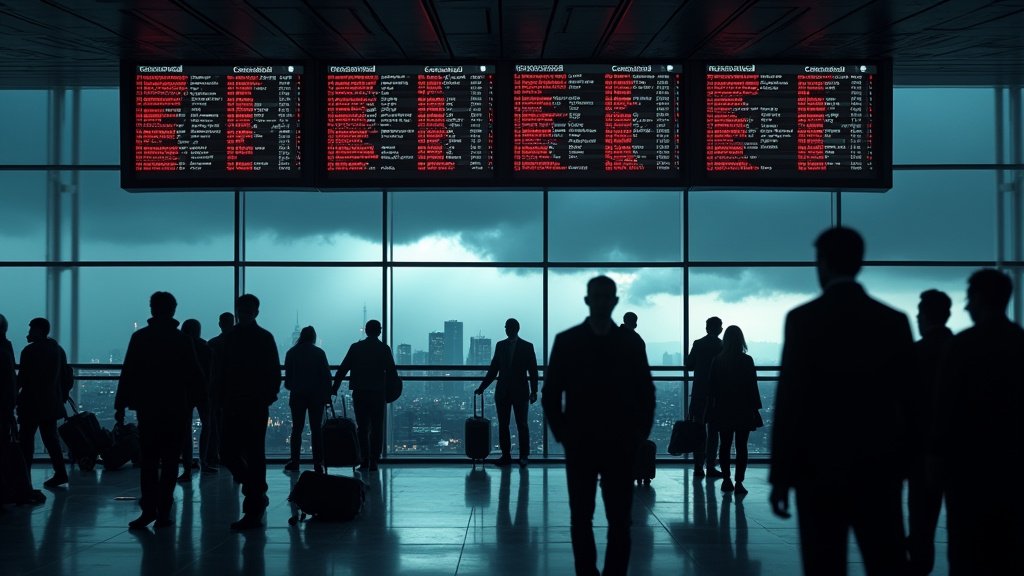
A catastrophic weather system has grounded flights at Chicago O’Hare (ORD) and Midway (MDW) today, April 28, 2026, triggering a cascading, nationwide aviation emergency that has paralyzed air travel across the United States. With over 5,500 flight delays and hundreds of cancellations reported in just a few hours, the disruption is rippling through every major hub, from Boston to San Diego. This event marks the 28th day of what is now considered the most sustained disruption sequence in American aviation since the post-pandemic recovery era of 2022, placing massive strain on both legacy and budget carriers.
Key Highlights
- Severe Weather Ground Stop: Intense thunderstorms forced the Federal Aviation Administration (FAA) to issue an immediate full ground stop at Chicago O’Hare and Midway, freezing all arrivals and departures.
- National Gridlock: The localized Chicago event has spiraled into a national emergency, with over 5,500 delays and 353 cancellations impacting Denver, Phoenix, Atlanta, Boston, and Washington D.C.
- Carrier Impact: Southwest Airlines and SkyWest Airlines are reporting the highest volumes of flight delays and cancellations, respectively, as crews and aircraft remain out of position.
- Long-Term Instability: Today represents Day 28 of the current “post-Easter” crisis, underscoring systemic vulnerabilities within the US airspace infrastructure.
Anatomy of a National Network Collapse
The aviation industry is built on a delicate balance of precision timing, crew scheduling, and gate availability. When a primary hub like Chicago O’Hare—one of the world’s busiest airports—is removed from the equation, the entire network suffers. A ground stop is the most restrictive tool available to the Federal Aviation Administration (FAA). Unlike a ground delay program, which merely slows the flow of traffic, a full ground stop acts as a hard reset, halting all activity on the runways.
The Ripple Effect Explained
When ORD ceases operations, the consequences are immediate and far-reaching. Aircraft that were scheduled to land in Chicago to pick up new passengers are diverted or forced to hold in airspace, burning through fuel and crew duty-time limits. Simultaneously, the outbound aircraft sitting on the tarmac at ORD miss their departure windows. Because modern aviation relies on a “rolling” schedule, where an aircraft might fly five different legs in a single day, one disruption at a central hub effectively wipes out the next 12 to 24 hours of that specific plane’s operation.
Today’s emergency is exacerbated by the geographic breadth of the storms. As the weather system moved across northern Illinois, it didn’t just impact Chicago; it created a secondary wave of disruptions in regional centers. Airlines like Southwest, which utilizes a point-to-point network model, have faced compounding delays because their aircraft are not tied to a single hub. When a key node in their network faces a ground stop, they cannot easily swap planes or crews, leading to the disproportionate number of delays we are witnessing today.
The 28-Day Marathon
Industry analysts have categorized the period since Easter as a sustained crisis. For 28 consecutive days, the US aviation system has teetered on the edge of capacity limits. Staffing shortages—a recurring theme since 2025—coupled with aggressive spring weather patterns, have prevented the major carriers from building any buffer into their schedules. Passengers have become accustomed to the “Day-of-Travel” anxiety, but today’s numbers represent a new threshold of instability. The sheer volume of disruptions, surpassing even the major incidents observed on April 17th and April 25th, suggests that the current operational model is not built to withstand even moderate weather volatility.
Regulatory Pressure and the Path to Recovery
The United States Department of Transportation (DOT) and the FAA are under increasing pressure to address the structural deficiencies that allow single-city weather events to paralyze the national grid. The upcoming summer travel season is already casting a long shadow over the industry, with the FAA preparing to implement a landmark reduction in flight caps at Chicago O’Hare starting May 17, 2026.
The May 17th Regulatory Shift
In roughly 19 days, O’Hare will be restricted to 2,708 daily operations, down from the currently scheduled 3,080. This decision, while controversial among legacy carriers like United Airlines and American Airlines, is widely viewed by aviation analysts as a necessary “pain point” to restore reliability. By limiting the number of flights during peak hours, the FAA intends to create a “buffer” in the schedule. Under current conditions, the airport is over-scheduled; there is zero margin for error. If a thunderstorm hits, the system has no capacity to absorb the delay. With the new caps, the hope is that even if a weather event occurs, the airport will have the “slack” in its schedule to recover without the disruption rippling into the following day.
Economic and Logistical Fallout
Beyond the frustration of stranded travelers, there is a significant economic cost to these constant interruptions. Airlines face millions of dollars in additional costs for crew hotels, rebooking operations, and fuel burn during holding patterns. For the traveler, this translates to higher ticket prices as carriers attempt to offset these operational inefficiencies. Furthermore, the volatility in flight schedules undermines the reliability of air cargo, impacting businesses that depend on just-in-time logistics. As we move closer to the summer peak, the industry is essentially running a trial-by-fire to see if these new regulations can prevent a total system failure during the busy July and August months.
Navigating the Current Disruption
For passengers caught in today’s gridlock, the advice from the Department of Transportation remains consistent: proactively monitor airline apps, not just airport screens. Airlines often issue travel waivers before a cancellation is officially confirmed. If you are flying into or out of a major hub in the Midwest or Northeast today, assume your itinerary is at risk. Travelers should look for “rebook” options as soon as a delay is announced, rather than waiting for a cancellation, to secure the limited remaining seats on alternative flights. The recovery timeline for an event of this magnitude is typically 24 to 48 hours, meaning the “ghost of today’s storm” will likely continue to impact flight schedules through Wednesday morning.
FAQ: People Also Ask
Q: What is the difference between a ground delay program and a ground stop?
A: A ground delay program (GDP) restricts the number of aircraft allowed to arrive at an airport per hour, effectively metering the flow. A ground stop is a total halt—no aircraft are permitted to arrive or depart—and is usually reserved for severe weather, security incidents, or critical infrastructure failure.
Q: Why does a storm in Chicago affect airports in places like Phoenix or Boston?
A: Modern aviation is an interconnected network. Aircraft are scheduled to fly multiple “legs” per day. If a plane is grounded in Chicago, it cannot complete its next scheduled flight in Boston or Phoenix. This “crew and aircraft out of position” effect propagates the delay across the entire national airspace system.
Q: Will the May 17 FAA caps actually reduce delays?
A: Experts are cautiously optimistic. By reducing the total number of scheduled flights, the FAA aims to eliminate the over-saturation that currently prevents airports from recovering after minor disruptions. While it may reduce the number of available seats, the goal is to significantly improve on-time performance and reliability.
Q: How do I know if I am eligible for compensation?
A: While the FAA does not mandate cash compensation for weather-related delays, major airlines have established customer service plans. Check the airline’s website for their specific “Customer Commitment” policy, which often details provisions for meals, hotels, and rebooking services during controllable and sometimes uncontrollable disruptions.