Coastal erosion in San Clemente, California, is intensifying at an alarming rate, threatening both iconic beaches and a critical regional rail corridor as the state braces for the lasting impacts of a significant Super El Niño climate event. The crisis has transformed a beloved stretch of Southern California coastline into a battleground between nature’s persistent encroachment and vital public infrastructure, forcing local authorities to navigate a complex web of engineering challenges, budgetary constraints, and environmental regulations.
Key Highlights
- Infrastructure at Risk: The LOSSAN (Los Angeles–San Diego–San Luis Obispo) rail corridor, the second busiest intercity passenger rail line in the United States, faces repeated shutdowns due to bluff instability in San Clemente.
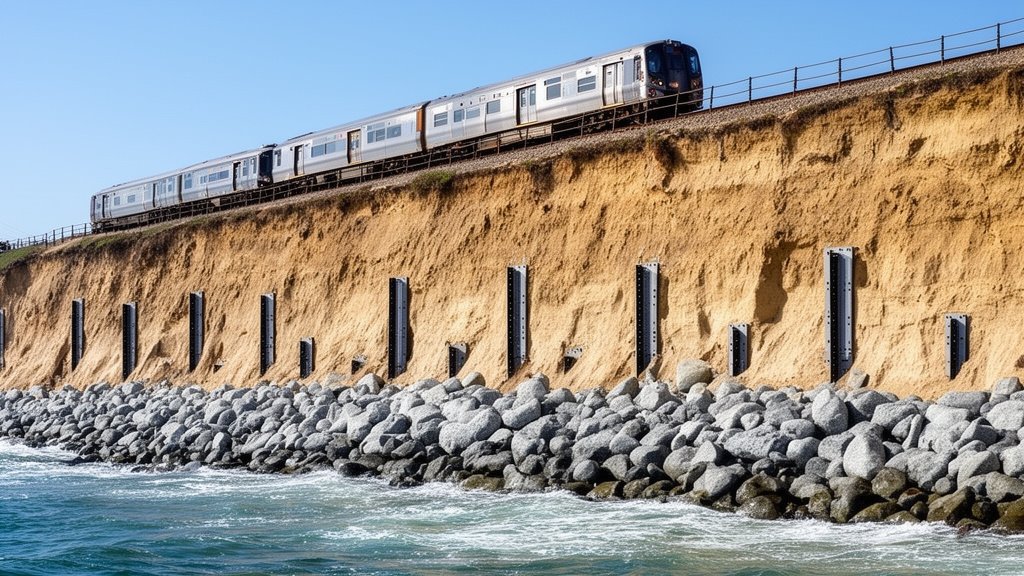
- Emergency Stabilization: The Orange County Transportation Authority (OCTA) has invested over $12 million in emergency slope stabilization efforts, involving the installation of large steel tie-backs and thousands of tons of riprap.
- Climate Drivers: The 2023-2024 Super El Niño event has significantly accelerated erosion rates, leading to higher-than-average tides and increased storm frequency that batter the fragile bluffs.
- The Conflict: Tension persists between the need for immediate, hard-engineered protection for the rail line and the California Coastal Commission’s mandate to protect the natural sand supply and public beach access.
The Battle to Save the LOSSAN Corridor
For decades, the railway line that runs through San Clemente has been a backbone of Southern California’s transit system. Serving as the primary artery for Metrolink commuter trains and Amtrak’s Pacific Surfliner, this corridor is more than just tracks on a map; it is a critical link for thousands of daily commuters and tourists traveling between San Diego and Los Angeles. However, the geology of San Clemente—composed largely of soft, erodible sandstone bluffs—has always been prone to the shifting tides of the Pacific Ocean. Recent years have revealed that this ancient geological dance has turned into a desperate sprint against accelerating collapse.
The Engineering vs. Environment Dilemma
The fundamental conflict centers on how to protect the tracks without destroying the very beaches that define San Clemente. When the bluffs began to give way in recent years, the OCTA moved quickly to implement “hard” solutions. This primarily involved driving massive steel beams deep into the bluff and covering the base with boulders, known as riprap. While effective at halting immediate landslides that could derail trains, these interventions have sparked intense scrutiny from environmentalists and state regulators. Critics argue that “armoring” the coast prevents the natural erosion of the cliffs, which is the primary source of sand for the beaches. Without this natural replenishment, the beaches narrow, eventually disappearing—a process known as “coastal squeeze.”
The Economic Toll of Disruption
The repeated, unplanned closures of the rail corridor have had a tangible economic impact. When trains stop running, freight delivery slows, commuter habits are disrupted, and tourism in San Clemente experiences a downturn. Local businesses rely heavily on the accessibility provided by the rail line. Each shutdown, often lasting weeks or months, incurs significant logistical costs and forces the OCTA to reallocate budgets from expansion projects to emergency repairs. It is a cycle of reaction that is becoming increasingly unsustainable, raising questions about whether the region must eventually consider relocating the tracks inland—a project that would cost billions of dollars and face immense political and geographic hurdles.
The Super El Niño Variable
The climate context adds a layer of unpredictability. The Super El Niño conditions experienced throughout 2023 and early 2024 have been a primary accelerant. Warmer ocean temperatures and shifted storm tracks have resulted in more frequent, high-energy wave events. These waves strike the base of the bluffs with more force, eroding the toe of the cliff and destabilizing the material above. As scientists warn that climate change may make such weather patterns more erratic, the “band-aid” approach of current stabilization efforts may soon prove insufficient. The question is no longer whether the ocean will reclaim more of the coastline, but how quickly the city, county, and state can adapt to a new reality of rising tides.
The Path Forward: Resilience and Relocation
Looking beyond immediate repairs, the long-term future of the San Clemente coastline remains uncertain. Transportation agencies are now engaged in feasibility studies exploring long-term resilience. These include everything from advanced drainage systems to slow the erosion of the bluffs from the top down, to the controversial but necessary discussion of rail realignment. Realignment is the “nuclear option” of transit planning: expensive, technically difficult given the hilly topography, and politically charged due to property rights. However, many experts argue that as long as the tracks remain at the water’s edge, the threat of disruption is a permanent feature, not a temporary glitch. Residents, meanwhile, continue to turn the tide in their own way, engaging in public forums, supporting beach preservation initiatives, and pressuring elected officials to prioritize both the transit corridor and the environmental health of the shoreline.
FAQ: People Also Ask
Q: Why is the rail line in San Clemente so important?
A: It is part of the LOSSAN corridor, the second-busiest intercity passenger rail route in the U.S. It connects major economic and population centers from San Diego to San Luis Obispo, making it vital for commuters and regional tourism.
Q: What is being done to stop the erosion?
A: The OCTA has implemented emergency measures, including drilling steel tie-backs into the bluffs to anchor them and placing heavy boulders (riprap) at the base to absorb wave energy and prevent further slumping.
Q: How does the California Coastal Commission get involved?
A: The Commission regulates development along the coast. They often oppose “armoring” the coast because it restricts natural erosion, which feeds sand to the beaches. They require transit agencies to find a balance between protecting the tracks and maintaining public beach access.
Q: Are there plans to move the train tracks?
A: Yes, there are long-term feasibility studies exploring the possibility of moving the tracks inland, away from the cliffs. However, this is a massive, multi-billion-dollar infrastructure project that would take years, if not decades, to plan and construct.